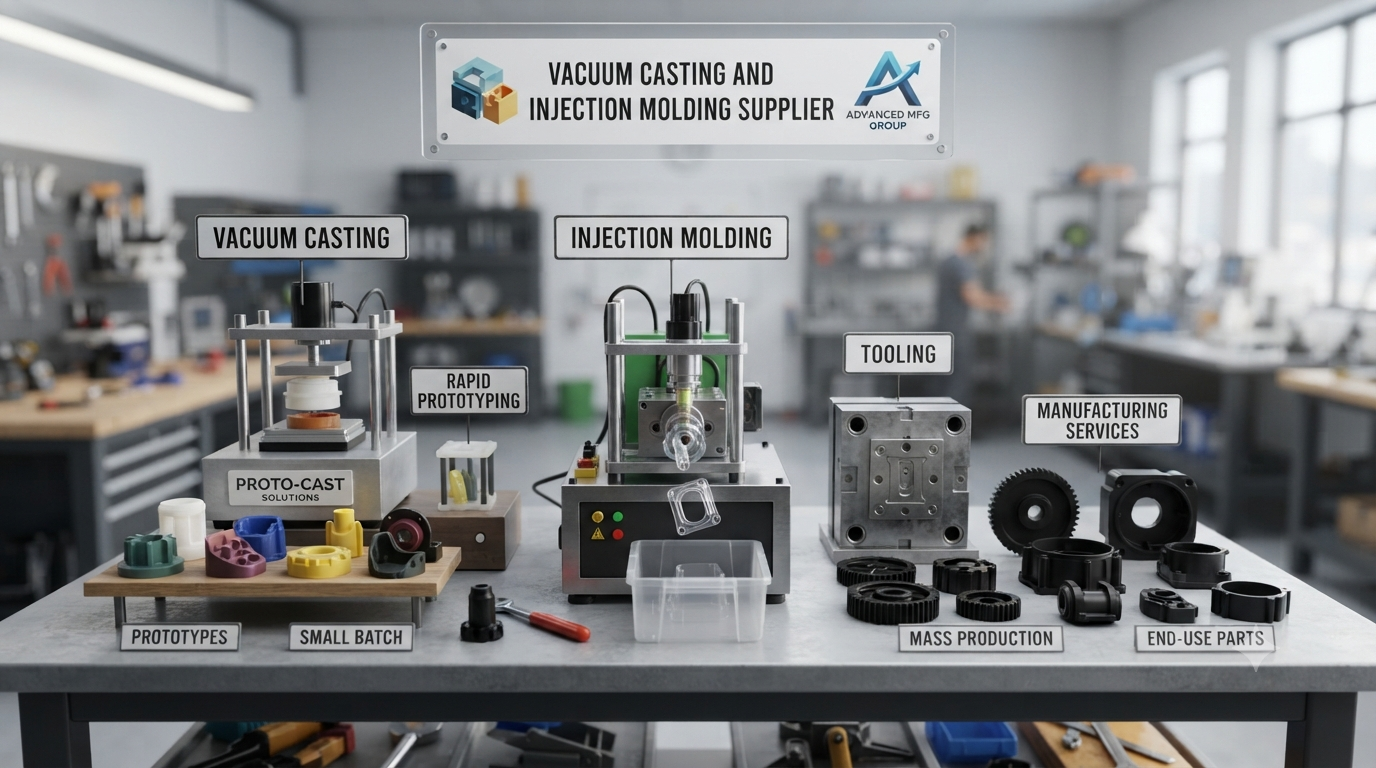
Every plastic product has a manufacturing story behind it. Before a housing, component, cover or functional plastic part reaches the market, it usually passes through several stages of design, testing, modification and production planning. Choosing the right process during these stages can influence development time, tooling investment and final product quality.
Two solutions frequently considered are vacuum casting and services offered by an injection molding supplier. Vacuum casting is useful when a business needs realistic parts in smaller quantities, while injection moulding is generally selected when the product is mature enough for repeatable production.
Knowing how to use both processes strategically can help manufacturers avoid investing in permanent tooling too early while creating a clearer route towards commercial production.
Why Manufacturing Strategy Should Start With Production Quantity
One of the first questions for any new plastic component should be: how many parts are actually required?
A company requiring 20 prototypes has very different manufacturing needs from one planning to produce 200,000 units.
Low quantities rarely justify the same tooling strategy as mass production. At the same time, producing thousands of components through a prototype-oriented method would normally be inefficient.
This is where vacuum casting and injection moulding occupy different positions.
Vacuum casting is primarily suited to development and small-batch requirements. Injection moulding requires greater initial tooling investment but becomes increasingly valuable when repeatability and production volume matter.
What Happens Inside the Vacuum Casting Process?
Vacuum casting starts with an accurately manufactured master model. This master represents the geometry and surface characteristics that need to be reproduced.
The master is typically created using CNC machining or high-resolution 3D printing. Silicone is poured around it and allowed to cure.
After curing, the mould is opened and the master pattern is removed. This leaves a detailed cavity inside the silicone.
A polyurethane resin is then prepared and cast into the mould under vacuum conditions. The vacuum helps minimise trapped air and allows the material to reproduce detailed areas.
After the resin cures, the component is removed, trimmed and inspected.
Additional finishing can include:
- Painting
- Polishing
- Sanding
- Surface texturing
- Printing
- Colour matching
- Component assembly
The result can be a highly presentable part suitable for engineering evaluation or customer-facing applications.
Where Vacuum Casting Provides the Most Value
The value of vacuum casting is not simply that it can produce plastic-like parts. Its real advantage is the ability to create multiple physical components while the product design is still flexible.
Suppose a manufacturer develops a new electronic monitoring device.
A 3D-printed prototype confirms the general shape, but the company requires 30 units for customer testing. Building production tooling at this stage could be risky because customer feedback may still result in design changes.
Vacuum casting allows the manufacturer to create the required batch first.
The units can then be evaluated for:
- Assembly
- Appearance
- Handling
- Component positioning
- Functional performance
- Customer response
Any useful feedback can be incorporated before production tooling begins.
Why Injection Moulding Requires More Preparation
Injection moulding is designed for repeated manufacturing rather than flexible experimentation.
An injection molding supplier manufactures a precision metal mould based on the approved component design. Thermoplastic material is heated and injected into the mould cavity under controlled conditions.
After cooling, the finished component is ejected and the cycle repeats.
Because tooling is specifically engineered for the component, late design changes may involve modifications to the mould.
This makes preparation especially important.
Before tooling begins, manufacturers should have a clear understanding of:
- Final component geometry
- Expected production quantities
- Material specification
- Critical tolerances
- Surface requirements
- Assembly requirements
- Product operating conditions
The more stable these requirements are, the more confidently a project can move towards production tooling.
Vacuum Casting vs Injection Moulding: Understanding the Economics
The cheapest manufacturing process depends heavily on quantity.
| Consideration | Vacuum Casting | Injection Moulding |
| Tool type | Silicone | Aluminium or steel |
| Upfront tooling | Relatively low | Higher |
| Production quantity | Small batches | Medium to high volume |
| Tool life | Limited | Extended |
| Design modification | Relatively easy | Can require tool changes |
| Production material | Casting resin | Thermoplastics |
| Automation | Lower | Higher |
| Repeatability | Good | Very high |
| Production speed | Moderate | Fast after setup |
| Main purpose | Validation/low volume | Scalable production |
For 30 components, silicone tooling may make economic sense. For tens of thousands of components, injection moulding generally offers a fundamentally different production model.
What Separates a Good Injection Molding Supplier From a Basic Vendor?
Manufacturing capability should not be judged only by the number of moulding machines in a factory.
A capable injection molding supplier contributes technical knowledge before production starts.
The supplier should be able to examine the design and identify features that could influence mould construction, material flow, cooling, ejection or component quality.
This engineering review is commonly referred to as Design for Manufacturing.
DFM Can Identify Problems Before Tooling Begins
A DFM review may examine several areas.
Wall Thickness
Plastic parts should be designed with material flow and cooling in mind. Large thickness variations can contribute to manufacturing difficulties.
Draft
Suitable draft angles help components release from the mould after cooling.
Parting Lines
The supplier needs to determine where different sections of the mould meet. Parting-line location may also affect the appearance of the final component.
Undercuts
Some geometries require additional mould mechanisms such as sliders or lifters.
Reducing unnecessary undercuts can simplify tooling.
Gate Locations
The position where molten plastic enters the mould can influence filling behaviour and cosmetic appearance.
An experienced injection molding supplier should discuss significant DFM findings before manufacturing the tool.
Production Material Should Match the Application
One of the advantages of injection moulding is access to a broad selection of commercial thermoplastics.
Common choices include:
- ABS
- Polypropylene
- Polyethylene
- Polycarbonate
- Nylon
- POM
- PMMA
- TPU
- TPE
- Reinforced engineering polymers
However, there is no universally “best” injection moulding material.
Material selection should be connected to actual performance requirements.
For example, manufacturers may need to evaluate:
- Impact strength
- Heat resistance
- Chemical resistance
- UV stability
- Flexibility
- Wear resistance
- Transparency
- Dimensional stability
- Surface appearance
An injection molding supplier can provide processing guidance, while engineering teams should define the product’s functional requirements.
Can Vacuum Casting Replace Injection Moulding?
This is a common question, but the answer depends on what “replace” means.
For prototypes or limited quantities, vacuum casting may eliminate the immediate need for injection mould tooling.
For large-scale commercial production, however, silicone tooling has limitations.
Silicone moulds wear with repeated use, while metal injection moulds are engineered for significantly longer production programmes.
Therefore, the two processes are better viewed as complementary technologies.
A logical product development sequence could be:
CAD Design → Initial Prototype → Vacuum Casting → Product Testing → Design Approval → DFM → Tool Manufacturing → Injection Moulding
Each manufacturing method solves a different problem within that sequence.
Industries Where Both Processes Are Relevant
A wide range of industries can benefit from combining prototype and production technologies.
Consumer Electronics
Enclosures, smart-device housings, controls and accessories can require multiple physical prototypes before final production.
Automotive
Interior components, control housings and development parts can be evaluated using low-volume manufacturing before tooling.
Industrial Products
Protective covers, machine components and control equipment often require fit and assembly testing.
Consumer Goods
Household products, accessories and lifestyle products can benefit from visual and ergonomic evaluation.
Medical Equipment
Prototype housings and equipment components may require extensive physical evaluation, while production must account for applicable regulatory requirements.
Choosing an Injection Molding Supplier Based on Capability
Price matters, but tooling decisions should not be based solely on the lowest quotation.
When evaluating an injection molding supplier, consider:
- DFM expertise
- Tool design capability
- Mould manufacturing experience
- Material knowledge
- Quality management
- Dimensional inspection
- Production equipment
- Prototype services
- Finishing options
- Assembly capabilities
- Engineering communication
- Production capacity
The objective should be to find a manufacturing partner capable of supporting both the component and the broader production programme.
What Information Should Be Included in a Request for Quotation?
A detailed RFQ helps suppliers provide more accurate technical and commercial feedback.
Include:
- 3D CAD data
- 2D engineering drawings
- Prototype quantity
- Expected annual quantity
- Material specification
- Critical dimensions
- Tolerances
- Surface texture
- Colour
- Assembly details
- Operating environment
- Target production date
If the material has not yet been selected, provide information about how the product will be used rather than simply asking for the cheapest plastic.
Frequently Asked Questions
1. Why is vacuum casting used?
Vacuum casting is used to manufacture detailed prototypes, evaluation samples and low-volume plastic-like components.
2. What type of mould does vacuum casting use?
It typically uses a silicone mould created from a master pattern.
3. Does vacuum casting require expensive tooling?
Its silicone tooling generally requires less initial investment than conventional production injection mould tooling.
4. How accurate is vacuum casting?
Accuracy depends on the master model, geometry, material, mould quality and process control. Critical tolerances should always be discussed with the manufacturer.
5. What is an injection molding supplier?
An injection molding supplier manufactures thermoplastic components using precision moulds and injection moulding equipment.
6. Why choose injection moulding for high quantities?
Once tooling is established, injection moulding provides fast, repeatable manufacturing suitable for larger production requirements.
7. Can vacuum casting produce transparent components?
Certain casting systems can create transparent or translucent prototypes, depending on project requirements and manufacturing capability.
8. What is DFM in injection moulding?
Design for Manufacturing reviews a component to identify geometry that could affect tooling complexity, moulding performance or final quality.
9. Which injection moulding material should I choose?
Selection depends on mechanical, environmental, cosmetic and regulatory requirements rather than one material being suitable for every application.
10. Can vacuum casting and injection moulding use identical materials?
Not usually. Vacuum casting commonly uses polyurethane-based systems, while injection moulding processes production thermoplastics.
https://newsgrow.blogspot.com/2026/08/rapid-injection-molding-and-china-rapid.html
https://newsgrow.blogspot.com/2026/08/aluminum-prototype-and-sheet-metal.html
https://newsgrow.blogspot.com/2026/08/deep-information-about-sheet-metal.html
https://newsgrow.blogspot.com/2026/08/vacuum-casting-and-injection-molding.html