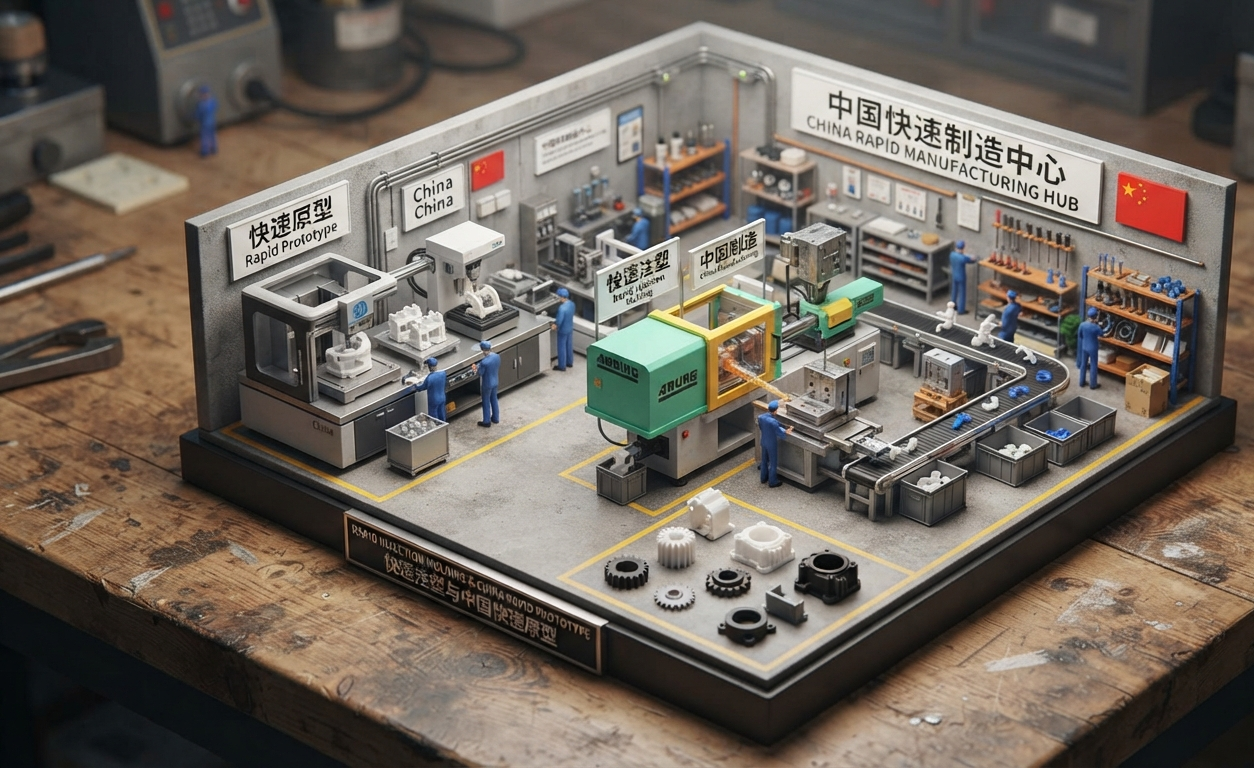
Developing a new physical product involves a series of decisions long before mass production begins. Engineers must confirm whether the design works, whether individual components fit together, whether the chosen material performs correctly and whether the product can be manufactured economically. Rapid injection molding and china rapid prototype services help companies answer these questions before making major production investments.
These technologies are widely relevant to businesses developing plastic housings, automotive components, electronic products, industrial parts, consumer goods and specialised engineering products. By combining prototype manufacturing with rapid tooling, companies can move progressively from an initial CAD model towards production-ready components.
Understanding the Role of China Rapid Prototype Manufacturing
A china rapid prototype is not necessarily a single type of prototype. The term covers a range of manufacturing technologies used to transform digital product designs into physical components.
Depending on the project’s purpose, a manufacturer may recommend CNC machining, 3D printing, vacuum casting, sheet-metal fabrication or rapid tooling.
For example, a product designer who wants to evaluate the shape of a new electronic enclosure may start with 3D printing. If precise dimensions and functional assembly become important, CNC machining may be more appropriate. Once the design is stable, injection-moulded samples can provide a more realistic representation of the final product.
The most common prototype technologies include:
- CNC machining for precise functional components
- SLA printing for detailed prototype models
- SLS printing for durable complex parts
- Vacuum casting for small batches
- Sheet-metal prototyping for brackets and enclosures
- Rapid tooling for moulded plastic components
The best process depends on material, geometry, quantity, tolerance, surface finish and the purpose of the prototype.
What Is Rapid Injection Molding?
Rapid injection molding is an approach to injection moulding that focuses on reducing the time required to manufacture tooling and produce moulded plastic components.
The actual moulding cycle follows established injection-moulding principles. Thermoplastic material is heated and injected into a mould cavity. Once the material cools and solidifies, the mould opens and the component is removed.
What makes the approach different is the tooling strategy.
Instead of immediately developing a complex production mould intended for very high manufacturing volumes, rapid tooling can be designed according to prototype, pilot or low-volume production requirements.
Depending on component complexity, material and expected quantities, aluminium or suitable steel tooling may be considered.
Why Combine Prototyping With Rapid Molding?
The biggest benefit comes from using the two technologies at different stages of development.
A china rapid prototype can help engineers discover design problems while modifications remain relatively straightforward. Rapid injection molding can then provide production-representative components once the design has matured.
A typical development sequence might include:
- Create the 3D CAD design.
- Manufacture an early prototype.
- Check size, shape and ergonomics.
- Perform assembly tests.
- Correct identified design problems.
- Complete a Design for Manufacturing review.
- Manufacture rapid tooling.
- Produce moulded samples.
- Test material and functional performance.
- Approve the product for the next production stage.
This approach helps companies increase their manufacturing commitment gradually instead of investing heavily before the product has been sufficiently tested.
Major Benefits of Rapid Injection Molding
One important advantage of rapid injection molding is access to realistic moulded parts.
Early prototypes can be extremely useful, but their manufacturing process may differ significantly from that of the final product. A 3D-printed component, for example, can reproduce geometry effectively but may behave differently from an injection-moulded thermoplastic component.
Rapid moulding provides several potential benefits:
- Production-representative materials
- Repeatable component geometry
- Functional assembly testing
- Pilot-production capability
- Surface-finish evaluation
- Bridge manufacturing
- Low-volume production
These benefits make the process particularly valuable once basic product geometry has already been validated.
Selecting the Right Plastic Material
Material selection can influence strength, flexibility, durability, appearance and manufacturing behaviour.
Common materials used in injection moulding include:
| Material | Typical Characteristics |
| ABS | Rigidity, general-purpose performance and good appearance |
| Polypropylene | Flexibility and chemical resistance |
| Polycarbonate | Impact resistance and transparency for suitable grades |
| Nylon | Mechanical performance and wear resistance |
| POM | Dimensional stability and low friction |
| TPE | Flexible, rubber-like characteristics |
Material selection should never be based solely on price.
Engineers should consider operating temperature, mechanical stress, chemicals, moisture, UV exposure, regulatory requirements and expected product life.
A china rapid prototype supplier can provide manufacturing guidance, but material specifications should ultimately reflect the engineering requirements of the final product.
Design for Manufacturing Before Creating the Mould
Design for Manufacturing, or DFM, is one of the most important stages before rapid injection molding begins.
A component can look excellent in CAD software while being unnecessarily difficult to mould.
Several design areas deserve careful attention.
Wall Thickness
Large differences in wall thickness may result in uneven cooling, shrinkage or cosmetic defects. Appropriate wall design can improve moulding consistency.
Draft Angles
Draft helps the moulded component release from tooling. Insufficient draft may create ejection difficulties.
Ribs and Bosses
Ribs can increase structural stiffness without making an entire wall thicker. Bosses are commonly used for screws and assembly points.
Undercuts
Undercuts may require sliders, lifters or other mould mechanisms. Unnecessary undercuts should therefore be reconsidered during DFM.
Gates, Ejectors and Parting Lines
These tooling features may leave visible evidence on a finished component. Their location becomes especially important for cosmetic products.
When Should a Company Use Rapid Injection Molding?
Rapid moulding is not automatically the right solution for every prototype.
If a business requires only one or two concept models, 3D printing may provide a more practical solution. CNC machining may be suitable when a small number of precise functional components are required.
Rapid injection molding becomes more attractive when the project needs repeated moulded components or when engineers must test the intended production material.
Common applications include:
- Functional validation
- Engineering testing
- Certification samples
- Assembly trials
- Pilot manufacturing
- Market-testing batches
- Bridge production
- Low-volume commercial production
The decision should be based on both engineering requirements and total project economics.
How to Choose a China Rapid Prototype Manufacturer
Supplier selection can determine whether a project progresses smoothly or becomes a cycle of repeated corrections.
A good manufacturer should do more than accept a CAD file and provide a price.
Technical teams should be able to review the design, discuss potential manufacturing problems and recommend an appropriate process.
Before choosing a supplier, consider:
- Prototype manufacturing capabilities
- Injection-moulding experience
- DFM support
- Mould-making capabilities
- Inspection equipment
- Material knowledge
- Quality-control procedures
- Communication standards
- Surface-finishing options
- Confidentiality practices
Ask specific technical questions. The quality of the answers can provide useful insight into the manufacturer’s engineering capabilities.
Factors Affecting Rapid Molding Cost
There is no standard cost for rapid injection molding because each component requires a different mould and production strategy.
Important cost factors include component dimensions, geometry, cavity quantity, tool material, undercuts, tolerance, surface finish and plastic resin.
Complexity can be particularly important.
A simple open-and-shut mould may require relatively straightforward machining. A component containing several undercuts may require sliders or other moving mechanisms, increasing tooling complexity.
Buyers should therefore compare the complete scope of quotations rather than focusing only on the initial mould price.
Maintaining Quality During Rapid Manufacturing
Faster production should not mean reduced quality control.
The buyer and manufacturer should establish clear acceptance criteria before manufacturing begins.
Important requirements may include:
- Critical dimensions and tolerances
- Material grade
- Surface texture
- Colour
- Cosmetic expectations
- Assembly requirements
- Functional performance
A 2D engineering drawing can be particularly useful for identifying dimensions that require tighter control.
Finished components can then undergo dimensional inspection, visual examination, assembly verification and functional testing.
Frequently Asked Questions
What is rapid injection molding?
It is an injection-moulding approach using rapidly developed tooling for prototypes, engineering validation, pilot runs and certain lower-volume production requirements.
What does china rapid prototype mean?
It refers to prototype manufacturing services in China using technologies such as CNC machining, 3D printing, vacuum casting and rapid tooling.
What is the main advantage of rapid prototyping?
It allows physical testing and design improvement before substantial production investment.
Is rapid injection molding suitable for functional parts?
Yes. It can produce functional components from appropriate production-grade thermoplastics.
Can rapid moulds be used for commercial production?
Yes, provided the tool specification and expected service life are suitable for the required production quantity.
Is CNC machining better than 3D printing?
Neither is universally better. The correct choice depends on material, tolerance, geometry, quantity and testing requirements.
Why is DFM important?
DFM identifies features that could make manufacturing unnecessarily difficult, expensive or inconsistent.
Which materials can be injection moulded?
ABS, polypropylene, polycarbonate, nylon, POM, TPE and many other thermoplastics may be suitable.
What files are required for a quotation?
Manufacturers commonly require 3D CAD data, 2D drawings, material specifications, quantities, tolerances and finishing requirements.
Can prototyping reduce tooling risk?
Yes. Testing physical components can reveal design problems before production tooling is finalised.
What determines mould cost?
Size, complexity, cavities, material, undercuts, tolerances and surface requirements are major factors.
How should a china rapid prototype supplier be selected?
Consider engineering expertise, manufacturing processes, quality control, communication, inspection capability and experience rather than price alone.
https://newsgrow.blogspot.com/2026/08/rapid-injection-molding-and-china-rapid.html