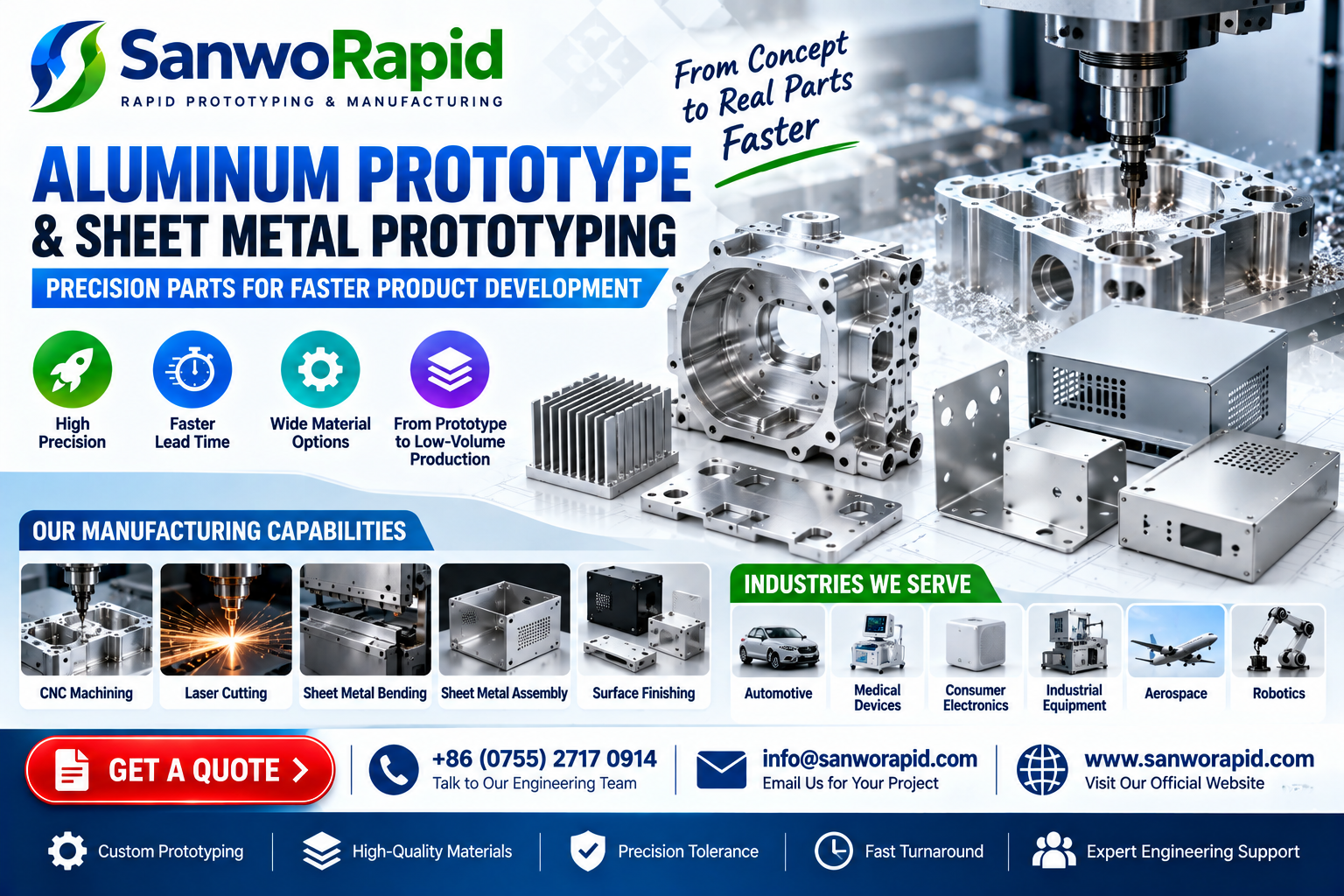
As product-development cycles become shorter and companies seek more flexible ways to validate designs, demand for aluminum prototype manufacturing and sheet metal prototyping continues to grow across automotive, aerospace, medical devices, robotics, electronics, industrial equipment, and consumer products.
Both methods help engineering teams test form, fit, function, materials, and assembly before committing to large-scale tooling or mass production. Aluminum prototypes are especially valuable for machined structural and mechanical components, while sheet metal prototyping supports enclosures, brackets, panels, housings, and formed metal parts.
What Is an Aluminum Prototype?
An aluminum prototype is a development-stage component manufactured from aluminum to evaluate a product before full-scale production.
It may be created through:
- CNC milling
- CNC turning
- Drilling
- Tapping
- Multi-axis machining
- Surface finishing
- Precision inspection
Because aluminum can closely represent the material used in many final products, these prototypes are useful for functional testing rather than appearance alone.
Typical applications include:
- Mechanical housings
- Brackets
- Mounting plates
- Frames
- Heat sinks
- Structural parts
- Equipment components
Why Aluminum Is Popular for Prototyping
Aluminum combines several useful properties.
Lightweight Construction
Aluminum offers a favorable strength-to-weight ratio for many engineering applications.
Good Machinability
It can be machined efficiently using modern CNC equipment.
Corrosion Resistance
Many aluminum alloys provide useful resistance to environmental exposure.
Surface Finish Options
Parts can be anodized, polished, painted, sandblasted, or powder coated.
Functional Testing
An aluminum prototype can often be installed into a real assembly and tested under realistic conditions.
Common Aluminum Grades Used in Prototyping
Different projects require different alloys.
Aluminum 6061
Frequently used because of its machinability, versatility, and general mechanical performance.
Aluminum 7075
Often chosen when higher strength is important.
Aluminum 5052
Commonly used in fabricated and sheet-metal applications where formability and corrosion resistance are useful.
Material selection should consider the final operating environment, not simply cost or availability.
CNC Machining for Aluminum Prototype Development
CNC machining is one of the most common methods for producing an aluminum prototype.
The process begins with CAD data, which is converted into machining instructions through CAM software.
The workflow may include:
- Reviewing CAD files.
- Selecting aluminum stock.
- Programming the machine.
- Milling or turning the component.
- Inspecting critical dimensions.
- Applying finishing if required.
This method can create precise parts without requiring dedicated molding tools.
Functional Testing with Aluminum Prototypes
A machined prototype can help evaluate:
- Mechanical fit
- Assembly alignment
- Fastener access
- Strength
- Weight
- Heat transfer
- Surface finish
This makes aluminum especially useful for engineering-focused products.
A component that appears correct in CAD may still reveal interference, access, or installation issues once physically manufactured.
What Is Sheet Metal Prototyping?
Sheet metal prototyping is the production of small quantities of fabricated metal components for design validation, testing, or early-stage production.
The process can include:
- Laser cutting
- CNC punching
- Bending
- Forming
- Welding
- Riveting
- Hardware installation
- Surface finishing
Sheet metal parts are commonly used for:
- Enclosures
- Brackets
- Covers
- Chassis
- Panels
- Frames
- Equipment housings
It is particularly useful when the final product will already be manufactured from formed metal.
Why Sheet Metal Prototyping Is Important
A 3D model can show how a component should look, but sheet metal prototyping allows teams to test how the actual fabricated part behaves.
Engineers can evaluate:
Bend Accuracy
Are the formed angles correct?
Hole Alignment
Do mounting holes line up with other components?
Assembly Clearance
Can hardware be installed easily?
Structural Rigidity
Is the part strong enough for its intended function?
Appearance
Does the finished component meet visual expectations?
These checks can reduce costly redesign later.
Laser Cutting in Sheet Metal Prototyping
Laser cutting is widely used to create accurate profiles from sheet metal.
It can produce:
- External shapes
- Holes
- Slots
- Ventilation patterns
- Cutouts
Because the process is digitally controlled, design revisions can often be introduced quickly.
This makes it suitable for short development cycles.
Sheet Metal Bending and Forming
After cutting, flat metal sheets are commonly bent into three-dimensional shapes using press brakes or other forming equipment.
Important design considerations include:
- Bend radius
- Material thickness
- Bend allowance
- Hole distance from bends
- Flange length
Poor design around these factors can cause cracking, distortion, or dimensional errors.
A manufacturability review is therefore valuable before fabrication begins.
Aluminum Prototype vs Sheet Metal Prototyping
Both approaches are useful, but they serve different design needs.
Choose an aluminum prototype when the part requires:
- Complex machined geometry
- Precision holes
- Thick structural sections
- Tight tolerances
- Functional mechanical testing
Choose sheet metal prototyping when the product needs:
- Thin walls
- Bent forms
- Enclosures
- Covers
- Brackets
- Chassis or panels
Some products combine both.
For example, an electronic device may use a CNC-machined aluminum frame with a fabricated sheet-metal cover.
Surface Finishing Options
Both prototype types can receive production-style finishes.
Common options include:
- Anodizing
- Powder coating
- Painting
- Sandblasting
- Polishing
- Plating
- Brushing
These finishes can help teams evaluate final appearance and corrosion resistance.
They also make prototypes more useful for customer demonstrations and pre-production samples.
Aluminum Prototype Applications in Automotive Development
Automotive engineering frequently uses aluminum prototypes for:
- Mounting brackets
- Sensor housings
- Structural parts
- Test fixtures
- Custom performance components
Functional prototypes can be installed and evaluated before production methods are finalized.
This is especially useful for low-volume and specialty vehicle programs.
Sheet Metal Prototyping in Electronics
Electronics products often rely heavily on formed sheet-metal parts.
Applications may include:
- Server enclosures
- Control cabinets
- Device housings
- Power-supply chassis
- Equipment panels
Sheet metal prototyping helps verify mounting points, cable access, ventilation, and assembly before larger production runs begin.
Aerospace and Robotics Applications
Aerospace development often requires lightweight, accurate components.
Aluminum can be used for:
- Structural brackets
- Instrument housings
- Test hardware
Sheet metal can be used for:
- Covers
- Panels
- Enclosures
- Lightweight assemblies
Robotics projects also use both methods because designs often change during development.
Flexible prototype manufacturing allows engineers to test new revisions without expensive dedicated tooling.
Low-Volume Production After Prototyping
Both machining and sheet-metal fabrication can support low-volume manufacturing after validation.
This allows businesses to:
- Launch pilot products
- Produce engineering samples
- Test customer demand
- Support pre-production builds
- Manufacture specialty components
The transition from prototype to small-batch production can therefore be relatively direct.
Design for Manufacturability Matters
Good prototypes begin with manufacturable design.
For CNC aluminum parts, engineers should consider:
- Tool access
- Internal corner radii
- Pocket depth
- Tolerances
For sheet metal prototyping, important factors include:
- Bend radii
- Material thickness
- Hole placement
- Flange size
- Forming direction
Early engineering review can reduce unnecessary production complexity.
Quality Inspection for Prototype Parts
Prototype manufacturing still requires quality control.
Inspection methods may include:
- Calipers
- Micrometers
- Height gauges
- Thread gauges
- Coordinate measuring machines
- Optical inspection
For sheet metal, inspection may also verify:
- Bend angles
- Flatness
- Hole location
- Overall dimensions
Critical requirements should be identified clearly in drawings.
Choosing a Prototype Manufacturing Partner
Businesses should evaluate suppliers based on:
- CNC capability
- Sheet metal fabrication equipment
- Material availability
- Tolerance capability
- Surface finishing
- Quality inspection
- Engineering support
- Lead time
- Communication
A supplier capable of handling multiple processes can simplify projects that combine machined and fabricated parts.
Frequently Asked Questions
What is an aluminum prototype?
An aluminum prototype is a development-stage aluminum component produced for engineering testing, design validation, assembly checks, or low-volume use.
How are aluminum prototypes manufactured?
They are commonly produced using CNC milling, turning, drilling, and finishing processes.
What is sheet metal prototyping?
Sheet metal prototyping is the fabrication of small quantities of formed metal parts for testing and product development.
What types of parts can be made from sheet metal?
Common examples include brackets, enclosures, covers, panels, frames, and chassis.
Can prototypes use production-grade materials?
Yes. Aluminum and sheet-metal prototypes can often use the same or similar materials intended for final production.
Is aluminum suitable for functional testing?
Yes. Aluminum components can be used for fit, load, assembly, and thermal testing depending on the design.
Can sheet metal prototypes be powder coated?
Yes. Powder coating and other finishing options can be applied to many fabricated prototypes.
Is CNC machining suitable for low-volume production?
Yes. It is commonly used for prototypes and small production batches.
What files are required for a quotation?
Manufacturers generally need 3D CAD files, 2D drawings, material specifications, quantities, tolerances, and finishing requirements.
Can one supplier handle both processes?
Yes. Many rapid manufacturing companies support both CNC machining and sheet-metal fabrication.
Media Contact
Rapid Prototyping & Manufacturing Enquiries
Contact: +86 (0755) 2717 0914
Email: info@sanworapid.com
Official Website: https://www.sanworapid.com/