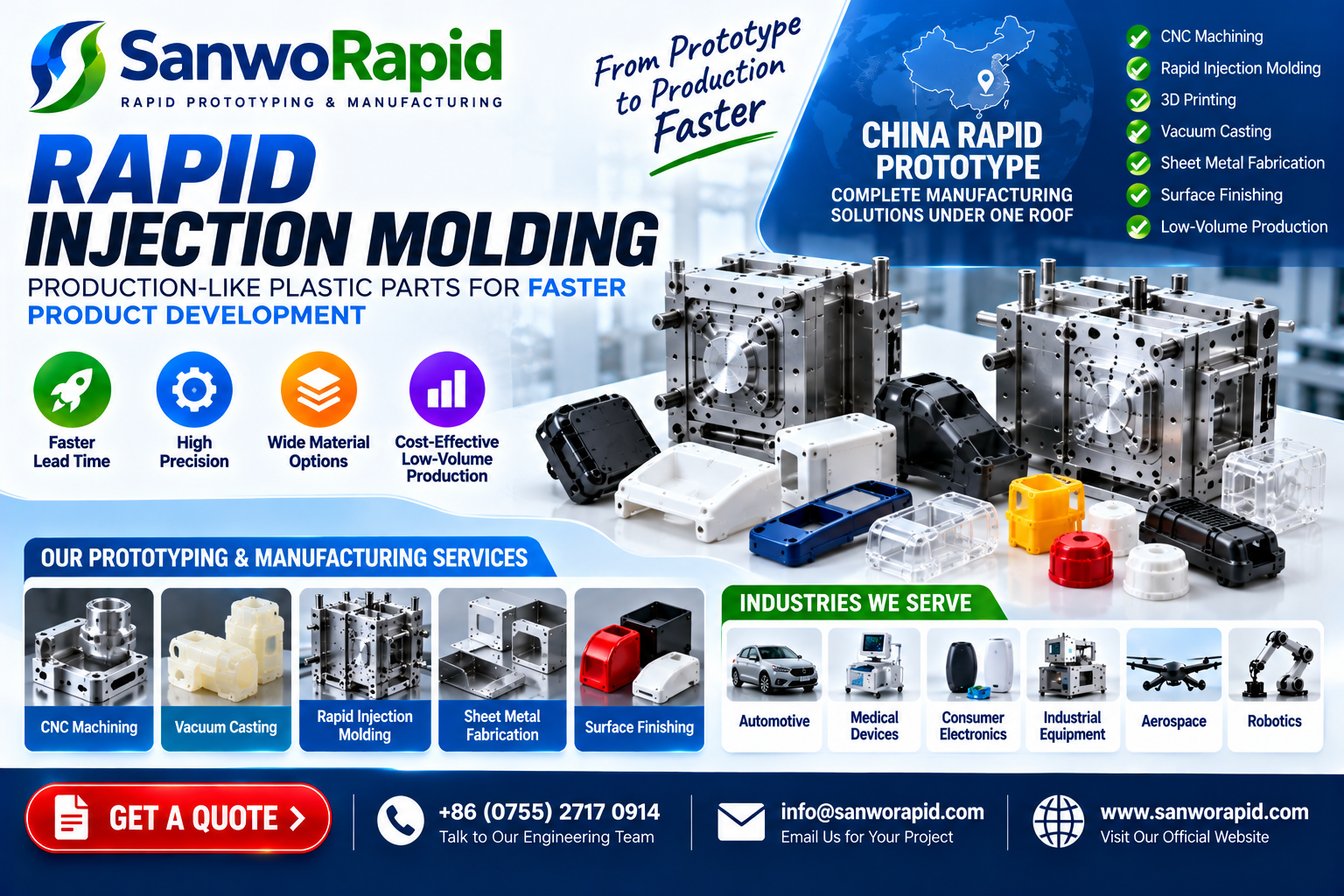
As companies shorten product-development cycles and compete to bring new products to market faster, rapid injection molding and china rapid prototype services are becoming increasingly important for engineers, startups, product designers, and global manufacturers.
From automotive components and medical-device housings to electronics, robotics, industrial equipment, and consumer products, rapid manufacturing gives businesses a practical way to test designs, validate materials, produce pilot quantities, and prepare for mass production without immediately committing to expensive conventional tooling.
What Is Rapid Injection Molding?
Rapid injection molding is a manufacturing method that uses accelerated tooling strategies to produce molded plastic components faster than traditional high-volume injection molding programs.
The basic process remains similar to conventional injection molding. Thermoplastic material is heated until it can flow, injected into a mold cavity under pressure, cooled, and then ejected as a finished component.
The difference is primarily in tooling strategy and project lead time.
Rapid molds may be developed for:
- Functional prototypes
- Engineering samples
- Low-volume production
- Pilot manufacturing
- Market testing
- Bridge production
- Pre-production validation
This approach can provide real molded components without requiring a full-scale production investment at the earliest development stage.
Why Rapid Injection Molding Is Valuable
Product teams frequently need more than a single prototype.
They may require dozens or hundreds of parts for assembly testing, customer trials, certification work, or limited product launches.
Rapid injection molding can offer several advantages.
Production-Grade Materials
Unlike some prototype processes, injection molding can use many thermoplastics intended for final production.
Repeatability
Once the mold is established, multiple similar parts can be produced with consistent geometry.
Functional Testing
Engineers can evaluate snap fits, bosses, mounting points, wall thickness, and assembly behavior.
Lower Initial Tooling Commitment
Rapid tooling can often reduce upfront investment compared with long-life production molds.
Faster Development
A shorter tooling cycle can allow product teams to begin real-world testing earlier.
How the Rapid Injection Molding Process Works
A typical project begins with digital design files.
The manufacturer reviews the CAD model and examines whether the part is suitable for molding.
The workflow may include:
- CAD and drawing review.
- Design-for-manufacturability analysis.
- Material selection.
- Mold design.
- Rapid tool manufacturing.
- Trial molding.
- Dimensional inspection.
- Sample approval.
- Low-volume or bridge production.
This structured approach helps identify design problems before larger quantities are manufactured.
What Is a China Rapid Prototype Service?
A china rapid prototype service typically refers to a manufacturing supplier in China that supports fast-turn prototype and low-volume production.
Capabilities may include:
- CNC machining
- 3D printing
- Vacuum casting
- Rapid injection molding
- Sheet metal fabrication
- Rapid tooling
- Surface finishing
The ability to combine several manufacturing methods is particularly valuable because different prototype stages often require different processes.
An early visual model may be 3D printed, while a later functional component may be CNC machined or injection molded.
Why Businesses Use China Rapid Prototype Suppliers
Companies evaluating a china rapid prototype partner often look for a combination of production capability, engineering support, cost efficiency, and scalability.
Potential advantages include:
Multiple Manufacturing Processes
A single project may require machined metal parts, molded plastics, and fabricated sheet metal.
Flexible Quantities
Suppliers can often support one-off prototypes, small batches, and pilot production.
Prototype-to-Production Support
Once the design is validated, some manufacturers can help transition the project into larger production volumes.
Surface Finishing
Parts may be anodized, painted, polished, textured, coated, or otherwise finished to represent final production appearance.
Rapid Injection Molding vs 3D Printing
Both technologies are useful, but they serve different development stages.
3D printing is particularly effective for:
- Early concept models
- Complex one-off shapes
- Fast visual evaluation
- Very small quantities
Rapid injection molding becomes attractive when businesses need multiple production-like plastic parts.
Molded parts allow engineers to examine characteristics such as:
- Actual thermoplastic behavior
- Mold shrinkage
- Surface quality
- Wall thickness
- Snap-fit performance
- Assembly consistency
For later-stage development, this information can be critical.
Rapid Injection Molding vs Vacuum Casting
Vacuum casting is another popular prototype method.
It uses silicone molds and casting resins to produce relatively small batches.
Vacuum casting may be appropriate when:
- Quantities are low
- Appearance is important
- Production thermoplastics are not essential
Injection molding may be preferred when:
- More parts are required
- Final thermoplastic materials are important
- Greater repeatability is needed
- Production-style geometry must be tested
A capable china rapid prototype supplier may recommend either process depending on project goals.
Choosing the Right Plastic Material
Material choice strongly influences part performance.
Common injection-molding plastics include:
ABS
Suitable for housings, covers, and general consumer products.
Polycarbonate
Used where impact resistance and strength are important.
Nylon
Common in functional mechanical components.
Polypropylene
Suitable for lightweight products and flexible features.
POM
Often selected for precision mechanical parts.
Engineering teams should consider temperature, chemical exposure, stiffness, appearance, impact strength, and operating environment before selecting the resin.
Design for Manufacturability Is Critical
A well-designed part can reduce tooling complexity and improve production reliability.
Important design considerations include:
- Uniform wall thickness
- Appropriate draft angles
- Practical rib dimensions
- Correct boss design
- Manageable undercuts
- Suitable gate locations
- Clear parting lines
- Reliable ejection
Poorly designed wall transitions can create sink marks or warpage.
Complex undercuts may require side actions, slides, or lifters, increasing tooling cost and lead time.
Early design review can therefore save significant time later.
Rapid Molding for Bridge Production
One of the most practical uses of rapid injection molding is bridge manufacturing.
A company may need production-quality components before permanent high-volume tooling is completed.
Rapid tooling can provide parts for:
- Early commercial launches
- Customer trials
- Product demonstrations
- Certification testing
- Pilot programs
This enables businesses to move forward while the final manufacturing system is still being prepared.
Applications Across Industries
Rapid manufacturing is valuable across many sectors.
Automotive
Applications may include clips, interior parts, housings, brackets, and electronic components.
Medical Devices
Prototypes may be used for housings, test equipment, instrument components, and assembly evaluation.
Consumer Electronics
Developers can manufacture device enclosures, buttons, mounting components, and structural parts.
Robotics
Projects may require custom covers, sensor housings, connectors, or mechanical interfaces.
Industrial Equipment
Manufacturers can test control housings, machine components, and specialized product parts before volume production.
Quality Inspection and Prototype Validation
Fast manufacturing should never mean skipping quality control.
Inspection may include:
- Dimensional measurements
- Visual examination
- Material verification
- Surface inspection
- Assembly testing
- Functional testing
Critical dimensions should be identified clearly on engineering drawings.
For high-precision parts, coordinate measuring equipment or optical inspection systems may also be used.
Frequently Asked Questions
What is rapid injection molding?
Rapid injection molding is an accelerated tooling and molding process used to manufacture production-like plastic parts for prototypes, pilot runs, and low-volume manufacturing.
What is a china rapid prototype service?
A china rapid prototype service provides rapid manufacturing processes such as CNC machining, 3D printing, vacuum casting, molding, and sheet metal fabrication.
Is rapid injection molding suitable for functional testing?
Yes. Production-grade thermoplastics can often be used to create functional components.
How does rapid molding differ from conventional injection molding?
The main difference is generally faster tooling development and a focus on prototype or lower production volumes.
Can rapid molds produce hundreds of parts?
Yes, depending on tool material, part design, resin, and production requirements.
Which plastics can be used?
Common options include ABS, PC, nylon, PP, POM, and other engineering thermoplastics.
Is rapid injection molding better than 3D printing?
Neither is universally better. 3D printing is useful for very early prototypes, while rapid molding is valuable for production-like plastic parts.
What files are normally required?
3D CAD files, engineering drawings, quantity, material specifications, tolerance requirements, and finish information are commonly requested.
Can surface textures be added?
Yes. Molded parts may support polished, matte, or textured finishes depending on tooling requirements.
Can rapid manufacturing support later mass production?
Yes. A well-managed project can transition from prototype and rapid tooling into larger production programs.
Media Contact
Rapid Prototyping & Manufacturing Enquiries
Contact: +86 (0755) 2717 0914
Email: info@sanworapid.com
Official Website: https://www.sanworapid.com/