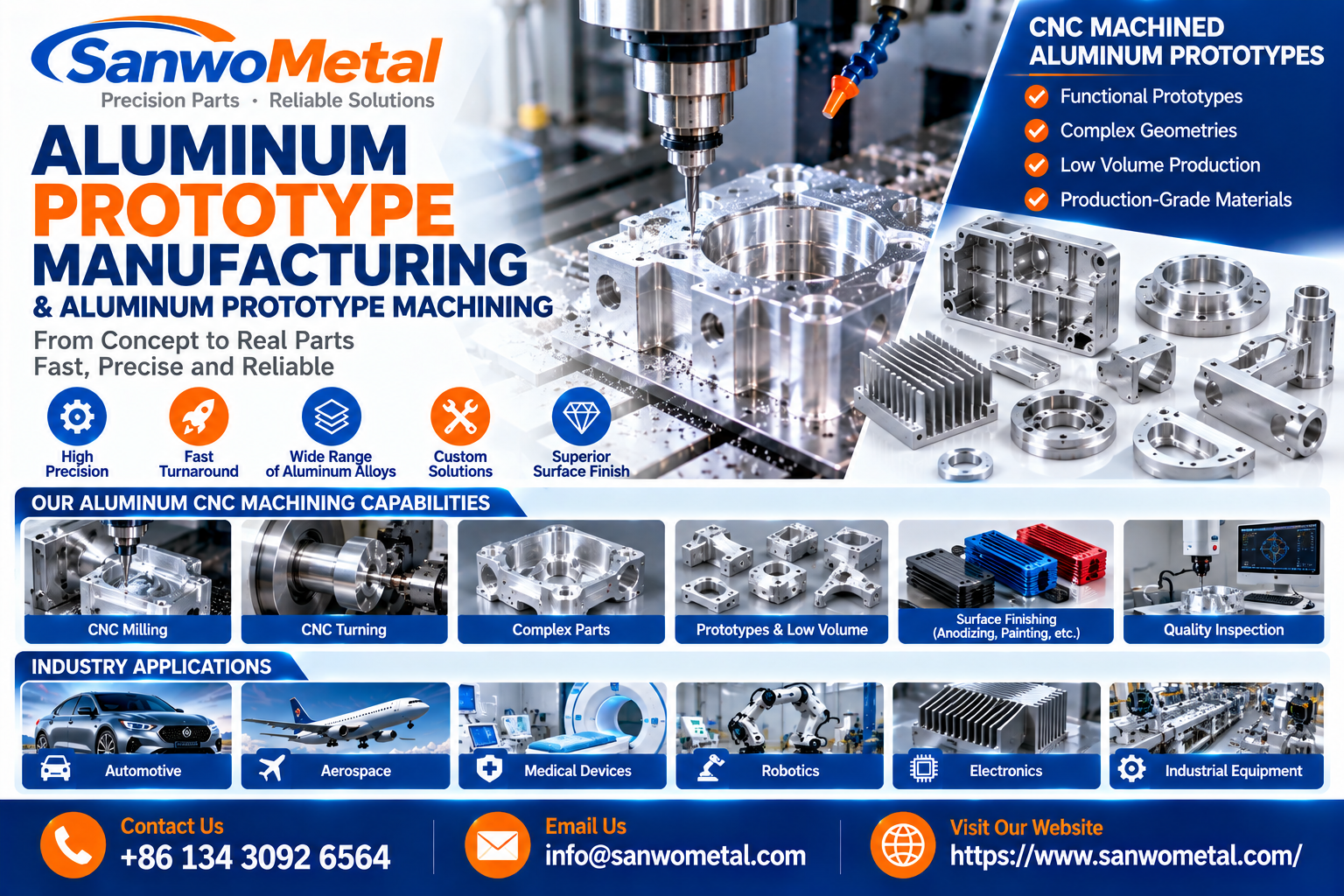
As engineering teams work to reduce development time, improve design validation, and bring products to market faster, aluminum prototype manufacturing and aluminum prototype machining are becoming increasingly important across automotive, aerospace, robotics, medical devices, electronics, industrial equipment, and consumer-product development.
Aluminum is widely used for prototypes because it combines relatively low weight, good machinability, useful strength, corrosion resistance, and broad availability. When paired with CNC machining, it allows engineers to create accurate, production-like parts for testing before committing to tooling or high-volume manufacturing.
What Is Aluminum Prototype Manufacturing?
Aluminum prototype manufacturing refers to producing small quantities of aluminum parts for testing, evaluation, engineering validation, or pre-production use.
These parts may be created using methods such as:
- CNC milling
- CNC turning
- Drilling
- Tapping
- Multi-axis machining
- Surface finishing
- Precision inspection
The goal is usually to create a functional component that closely represents the intended production part.
Unlike visual mockups, aluminum prototypes can often be assembled, measured, loaded, fitted, and tested under realistic conditions.
Why Aluminum Is Popular for Prototypes
Aluminum offers several advantages during product development.
Lightweight Structure
Its relatively low density makes it suitable for applications where weight matters.
Good Machinability
Aluminum can often be machined efficiently using CNC equipment.
Useful Strength
Different aluminum grades provide varying levels of mechanical performance.
Corrosion Resistance
Many aluminum alloys offer useful corrosion resistance, which can be further improved through finishing.
Surface Finishing Options
Aluminum can be anodized, polished, painted, powder coated, or otherwise finished to improve appearance or performance.
What Is Aluminum Prototype Machining?
Aluminum prototype machining is the use of CNC machines to manufacture prototype components directly from aluminum stock.
A typical process begins with:
- A 3D CAD model.
- CAM programming.
- Material preparation.
- CNC milling or turning.
- Dimensional inspection.
- Optional finishing.
This process is especially useful when the prototype requires tight dimensions, complex geometry, threaded holes, mounting features, or functional surfaces.
CNC Milling for Aluminum Prototypes
CNC milling is one of the most common methods used in aluminum prototype manufacturing.
A rotating cutting tool removes material from a fixed workpiece.
Milling can produce:
- Pockets
- Slots
- Holes
- Mounting surfaces
- Complex contours
- Internal features
Three-axis machines can produce many common components, while four-axis and five-axis machining can reduce setups for more complicated geometries.
Fewer setups may improve consistency and reduce alignment errors.
CNC Turning for Cylindrical Components
CNC turning is commonly used for round or rotationally symmetrical parts.
Typical aluminum prototype components may include:
- Shafts
- Sleeves
- Bushings
- Housings
- Threaded parts
- Round connectors
The workpiece rotates while cutting tools remove material.
Modern turning centers may also include live tooling, allowing drilling or milling to be completed in the same setup.
Common Aluminum Grades for Prototyping
Material selection depends on mechanical, thermal, cosmetic, and machining requirements.
Aluminum 6061
A widely used alloy known for good machinability, strength, and general-purpose performance.
Aluminum 7075
Often selected where higher strength is required.
Aluminum 5052
Frequently considered for applications requiring good corrosion resistance and formability.
The correct grade should be selected based on the final application rather than simply availability.
For aluminum prototype machining, using the intended production alloy can make testing more representative.
Functional Prototypes vs Appearance Models
Not all prototypes serve the same purpose.
Appearance Prototype
Primarily used to evaluate:
- Shape
- Size
- Styling
- Visual proportions
Functional Prototype
Used to test:
- Mechanical fit
- Strength
- Movement
- Assembly
- Thermal behavior
- Interface compatibility
Aluminum is particularly useful for functional prototypes because it can simulate the feel and behavior of many production parts.
Why Machined Prototypes Help Reduce Risk
A digital model can look perfect on-screen but still reveal unexpected issues in real use.
aluminum prototype manufacturing allows engineering teams to physically evaluate:
- Assembly clearances
- Fastener access
- Component alignment
- Wall thickness
- Mechanical interference
- Surface quality
Discovering these issues early can reduce redesign costs later.
A small prototype investment can prevent much larger production problems.
Tight Tolerances and Engineering Validation
One advantage of aluminum prototype machining is the ability to produce parts with controlled dimensions.
However, tighter tolerances generally increase machining and inspection requirements.
Critical dimensions may include:
- Bearing fits
- Pin holes
- Mating surfaces
- Thread locations
- Alignment features
Designers should avoid applying unnecessarily tight tolerances to every feature.
Using practical tolerances can reduce cost and lead time while maintaining product function.
Surface Finishing for Aluminum Prototypes
Machined aluminum parts can receive several finishing treatments.
Common options include:
Anodizing
Can improve corrosion resistance and create different visual finishes.
Sandblasting
Produces a uniform matte surface.
Polishing
Creates a smoother, more reflective appearance.
Powder Coating
Adds a durable colored coating.
Painting
Can be useful for cosmetic prototype presentation.
Finishing may also help teams evaluate how the final product will look and feel before full production.
Aluminum Prototypes for Automotive Development
Automotive engineering uses aluminum prototypes for a wide range of parts, including:
- Mounting brackets
- Housings
- Structural components
- Test fixtures
- Performance parts
- Sensor mounts
Prototype machining allows engineers to test fit, vibration behavior, and mechanical interaction before production processes are finalized.
Low-volume aluminum machining is also useful for specialty vehicles and motorsport applications.
Aerospace Applications
Aerospace products often require lightweight, accurate components.
Possible prototype applications include:
- Instrument housings
- Structural brackets
- Mounting plates
- Test hardware
- Equipment interfaces
Because aluminum is commonly used in aerospace products, aluminum prototype machining can provide realistic engineering samples during development.
Dimensional inspection and traceability may be particularly important for these projects.
Robotics and Automation Applications
Robotics depends heavily on custom mechanical parts.
Aluminum prototypes may be used for:
- Robot frames
- Motor mounts
- Joint components
- Sensor brackets
- Actuator housings
- End-effector components
Because robotic systems often change during development, CNC machining allows engineers to revise components quickly.
A new CAD revision can often be manufactured without creating new molds.
Medical and Electronics Applications
Medical equipment developers may use aluminum prototypes for:
- Device housings
- Instrument components
- Test fixtures
- Mechanical frames
Electronics companies may use machined aluminum for:
- Enclosures
- Heat sinks
- Mounting plates
- Connector housings
Aluminum can provide both structural support and thermal performance, making it useful for electronics prototypes.
Aluminum Prototype Manufacturing for Bridge Production
Sometimes a design is complete but production tooling is not yet ready.
In this case, aluminum prototype manufacturing can support bridge production.
Small batches may be produced while teams:
- Complete tooling
- Validate market demand
- Finalize certifications
- Improve design details
- Prepare supply chains
This approach can shorten the gap between prototype completion and commercial launch.
Design for CNC Machining
Good design can reduce prototype cost significantly.
Engineers should consider:
- Tool access
- Internal corner radii
- Pocket depth
- Hole depth
- Wall thickness
- Setup requirements
Sharp internal corners can be difficult to machine because cutting tools are round.
Very deep pockets may require longer tools and slower machining.
Early design-for-manufacturing review can simplify production without changing product function.
Quality Control for Aluminum Prototypes
Prototype accuracy should be verified before testing.
Common inspection equipment includes:
- Calipers
- Micrometers
- Height gauges
- Thread gauges
- Coordinate Measuring Machines
- Optical inspection systems
For critical projects, dimensional inspection reports may also be requested.
Inspection requirements should be communicated before manufacturing begins.
Frequently Asked Questions
What is aluminum prototype manufacturing?
Aluminum prototype manufacturing is the production of aluminum components in small quantities for product development, testing, validation, or low-volume use.
What is aluminum prototype machining?
Aluminum prototype machining uses CNC milling, turning, and related processes to create precision aluminum prototypes from digital designs.
Why is aluminum used for prototypes?
Aluminum is lightweight, machinable, relatively strong, corrosion resistant, and suitable for many finishing methods.
Which aluminum grades are commonly used?
6061 and 7075 are common choices, although the correct grade depends on the application.
Can aluminum prototypes be functional?
Yes. Machined prototypes can be used for mechanical, assembly, dimensional, and performance testing.
Is CNC machining suitable for one-off parts?
Yes. CNC machining is well suited to one-off prototypes and small production quantities.
Can aluminum prototypes be anodized?
Yes. Many aluminum parts can be anodized depending on alloy and finish requirements.
What files are needed for a quotation?
Manufacturers typically require 3D CAD files, drawings, material specifications, quantities, tolerances, and finish requirements.
Can CNC machining produce complex shapes?
Yes. Multi-axis CNC machines can produce complex geometry and access multiple sides of a part.
How can prototype machining costs be reduced?
Using practical tolerances, accessible geometry, standard materials, and efficient design can help reduce cost.
Media Contact
Aluminum Prototype & CNC Machining Enquiries
Contact: +86 134 3092 6564
Email: info@sanwometal.com
Official Website: https://www.sanwometal.com/