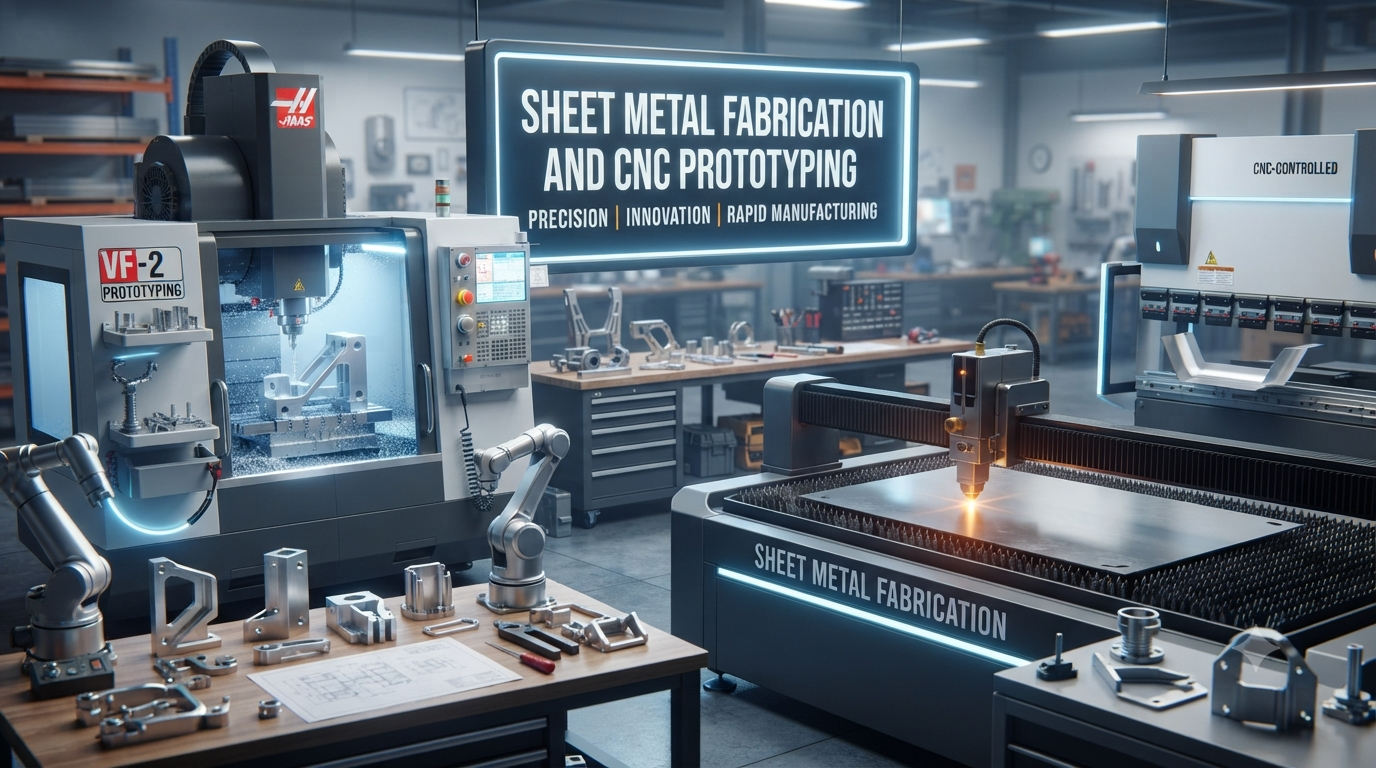
Sheet metal fabrication is the process of turning flat sheets of metal into precise, functional components through cutting, forming, joining and finishing. It is widely used across engineering, manufacturing, construction, electronics, automotive, industrial equipment and product development.
For businesses developing a new product or requiring low- to medium-volume components, fabrication can offer a practical route from design concept to finished part. When speed and design validation are important, CNC prototyping can also be incorporated into the development process to produce accurate prototype components before committing to larger production runs.
What Is Sheet Metal Fabrication?
Sheet metal fabrication involves converting metal sheet into components with specific dimensions, shapes and functional characteristics.
Depending on the application, the process may include:
- Laser or plasma cutting
- CNC punching
- CNC bending and forming
- Rolling
- Welding
- Riveting and mechanical fastening
- Deburring
- Grinding
- Surface finishing
- Powder coating or painting
- Assembly
A typical project begins with a CAD drawing or 3D model. The fabricator reviews the design, selects an appropriate material and thickness, determines the manufacturing sequence and produces the component according to the required specifications.
The quality of the finished part depends not only on the machinery used but also on material selection, tolerances, tooling, fabrication methods and inspection procedures.
How Does the Sheet Metal Fabrication Process Work?
Although the exact workflow varies according to the component, a typical fabrication project follows several stages.
1. Design and Engineering Review
The process starts with engineering drawings, CAD files or product specifications.
At this stage, the manufacturer may review:
- Material requirements
- Sheet thickness
- Bend locations
- Hole sizes and positions
- Required tolerances
- Surface finish
- Assembly requirements
- Production quantity
Design-for-manufacturing considerations are particularly important because a component that looks suitable on screen may require modifications to be economical or technically practical to manufacture.
2. Material Selection
The right material depends on the component’s environment, strength requirements, appearance and budget.
Common sheet metal materials include:
- Mild steel
- Stainless steel
- Aluminium
- Galvanised steel
- Copper
- Brass
For example, stainless steel may be appropriate where corrosion resistance is important, while aluminium can be useful when lower weight is a priority.
3. Cutting
The selected sheet is cut into the required profile.
Common cutting technologies include CNC laser cutting, plasma cutting and CNC punching.
Laser cutting is particularly useful for producing detailed profiles, openings and holes with repeatable accuracy.
4. Bending and Forming
After cutting, the flat sheet may need to be formed into the required three-dimensional shape.
CNC press brakes are commonly used to create accurate bends. The bending sequence must be carefully planned because bend allowance, material thickness, tooling and grain direction can influence the final dimensions.
5. Joining
Some assemblies require multiple fabricated pieces to be joined together.
Depending on the design, manufacturers may use:
- MIG welding
- TIG welding
- Spot welding
- Riveting
- Bolting
- Threaded inserts
The best joining method depends on the material, component design, required strength and appearance.
6. Finishing and Inspection
The final stage can include deburring, grinding, polishing, powder coating, painting or other surface treatments.
Inspection is then carried out to confirm that important dimensions and specifications meet the requirements of the project.
What Are the Main Types of Sheet Metal Fabrication?
There is no single fabrication method suitable for every component. Manufacturers generally combine several processes to achieve the required result.
Laser Cutting
Laser cutting uses a concentrated beam to cut sheet material according to a programmed profile.
It is commonly used for:
- Enclosures
- Brackets
- Panels
- Mounting plates
- Precision components
- Prototypes
It can be particularly useful for complex profiles and repeated production work.
CNC Punching
CNC punching uses programmed tooling to create holes, slots and other features in sheet metal.
It can be efficient for components containing repeated openings or standard punched features.
CNC Bending
CNC bending uses controlled tooling to form sheet into angles and shapes.
Accurate bending is essential for components such as electrical enclosures, cabinets, brackets and machine covers.
Welding and Assembly
Fabricated parts often need to be joined into complete assemblies. Welding can provide a strong permanent connection, while mechanical fastening may be preferable when components need to be removed or serviced.
What Is CNC Prototyping?
CNC prototyping is the use of computer-controlled machining or manufacturing equipment to produce prototype parts directly from digital designs.
CNC prototyping is valuable when engineers need to evaluate a physical component before moving into full production.
A prototype can help teams assess:
- Physical dimensions
- Fit and assembly
- Functional performance
- Design weaknesses
- Interference between components
- Material suitability
- Manufacturing requirements
For some projects, CNC-machined prototypes and sheet metal prototypes can be used together. For example, a product may contain a fabricated metal enclosure alongside precision-machined mounting components.
Sheet Metal Fabrication vs CNC Prototyping
The two approaches serve different manufacturing requirements, although they can complement each other.
| Feature | Sheet Metal Fabrication | CNC Prototyping |
| Typical starting material | Metal sheet | Metal or other machinable material |
| Main processes | Cutting, bending, forming, joining | CNC milling, turning or related machining |
| Suitable for | Panels, brackets, enclosures and formed components | Detailed prototype and precision-machined parts |
| Best suited to | Components made from sheet | Components requiring machining from solid stock |
| Common purpose | Prototypes through production | Design validation and prototype development |
The appropriate method depends on the geometry, material, tolerances, quantity and intended application.
Why Design for Manufacturing Matters
A well-designed component is not necessarily a well-designed manufacturing component.
Small changes to a CAD design can sometimes simplify fabrication, reduce waste or make assembly easier.
For sheet metal parts, designers should consider:
- Minimum bend radii
- Material thickness
- Hole-to-edge distances
- Bend clearances
- Tolerances
- Grain direction
- Fastener placement
- Welding access
- Surface finishing requirements
Early collaboration between the designer and fabricator can prevent avoidable revisions later in the project.
Common Applications of Sheet Metal Fabrication
Sheet metal components are found in many industries.
Industrial Equipment
Fabrication is used for machine guards, brackets, panels, frames, housings and equipment enclosures.
Electrical and Electronics
Metal fabrication is commonly used for electrical cabinets, control panels, server enclosures, equipment housings and mounting components.
Automotive
Applications can include brackets, structural components, covers, panels and prototype parts.
Construction
Fabricated metal components can be used for architectural features, supports, ductwork, protective covers and specialist installations.
Product Development
Manufacturers and engineering teams often use fabrication for prototype enclosures, brackets and functional components during new product development.
How Much Does Sheet Metal Fabrication Cost?
There is no universal price for sheet metal fabrication because project costs depend on several variables.
Important cost factors include:
- Material type
- Sheet thickness
- Component dimensions
- Quantity
- Number of bends
- Cutting complexity
- Tolerance requirements
- Welding and assembly
- Surface finishing
- Tooling
- Packaging and delivery
For example, a simple laser-cut bracket produced in volume will generally have very different manufacturing economics from a one-off welded enclosure requiring multiple bends and a specialist finish.
The best way to obtain an accurate quotation is to provide the manufacturer with the relevant CAD drawings, material specifications, quantities and finishing requirements.
How to Choose a Sheet Metal Fabrication Company
Choosing a fabricator based solely on the lowest quotation can create problems later. Quality, communication and manufacturing capability are equally important.
Before selecting a supplier, consider:
Manufacturing Capability
Check whether the company has the equipment and technical expertise required for your component.
Material Expertise
Confirm that the supplier regularly works with your required material and thickness.
Quality Control
Ask how dimensions, tolerances and finished components are inspected.
Prototype and Production Support
If your project is still under development, a supplier capable of supporting prototypes and subsequent production can simplify the manufacturing process.
Engineering Communication
A good fabricator should be willing to discuss manufacturability rather than simply manufacture a drawing without identifying potential problems.
Lead Times
Ask for realistic production and delivery times before placing an order, particularly when components are required for a larger assembly.
What Information Should You Provide for a Fabrication Quote?
A quotation is easier to prepare when the manufacturer receives complete technical information.
Ideally, provide:
- CAD files or engineering drawings
- Material specification
- Sheet thickness
- Required quantity
- Surface finish
- Critical dimensions and tolerances
- Welding or assembly requirements
- Delivery location
- Target production schedule
If the design is still being developed, explain this upfront. The manufacturer may be able to recommend changes that make the final component easier to fabricate.
Frequently Asked Questions
What is sheet metal fabrication used for?
Sheet metal fabrication is used to manufacture components such as brackets, panels, enclosures, cabinets, machine covers, equipment housings and structural parts.
What metals can be used for sheet metal fabrication?
Common options include mild steel, stainless steel, aluminium, galvanised steel, copper and brass. The most suitable material depends on the application’s strength, corrosion, weight, electrical and appearance requirements.
Is sheet metal fabrication suitable for prototypes?
Yes. Sheet metal fabrication can be used for functional prototypes, particularly when the final production component will also be manufactured from sheet metal.
What is the difference between CNC machining and sheet metal fabrication?
CNC machining typically removes material from a solid workpiece using cutting tools, while sheet metal fabrication generally starts with flat metal sheet and uses processes such as cutting, bending and forming.
When should I use CNC prototyping?
CNC prototyping can be useful when a design requires a physical prototype for dimensional checking, fit testing, functional evaluation or design validation before production.
Can sheet metal fabrication and CNC machining be used together?
Yes. A product may combine fabricated sheet metal components with CNC-machined parts. Using both processes can be useful when different components have different geometry or precision requirements.