Among the most widely used decorative metal products are Forged Elements and Wrought Iron Components. These components are valued because they combine functionality with artistic detailing. Fabricators, architects, contractors, interior designers, and property owners use them for residential, commercial, hospitality, and landscape projects.
Modern production methods have made decorative ironwork easier to customize, manufacture, install, and maintain. As a result, forged decorative parts are now used in both traditional and contemporary metal designs.
What Makes Forged Elements Different?
Forged Elements are metal components that are shaped through processes such as heating, hammering, pressing, twisting, bending, or rolling.
Unlike simple cut metal pieces, forged components can have curves, textures, tapered sections, twists, decorative patterns, and dimensional surfaces.
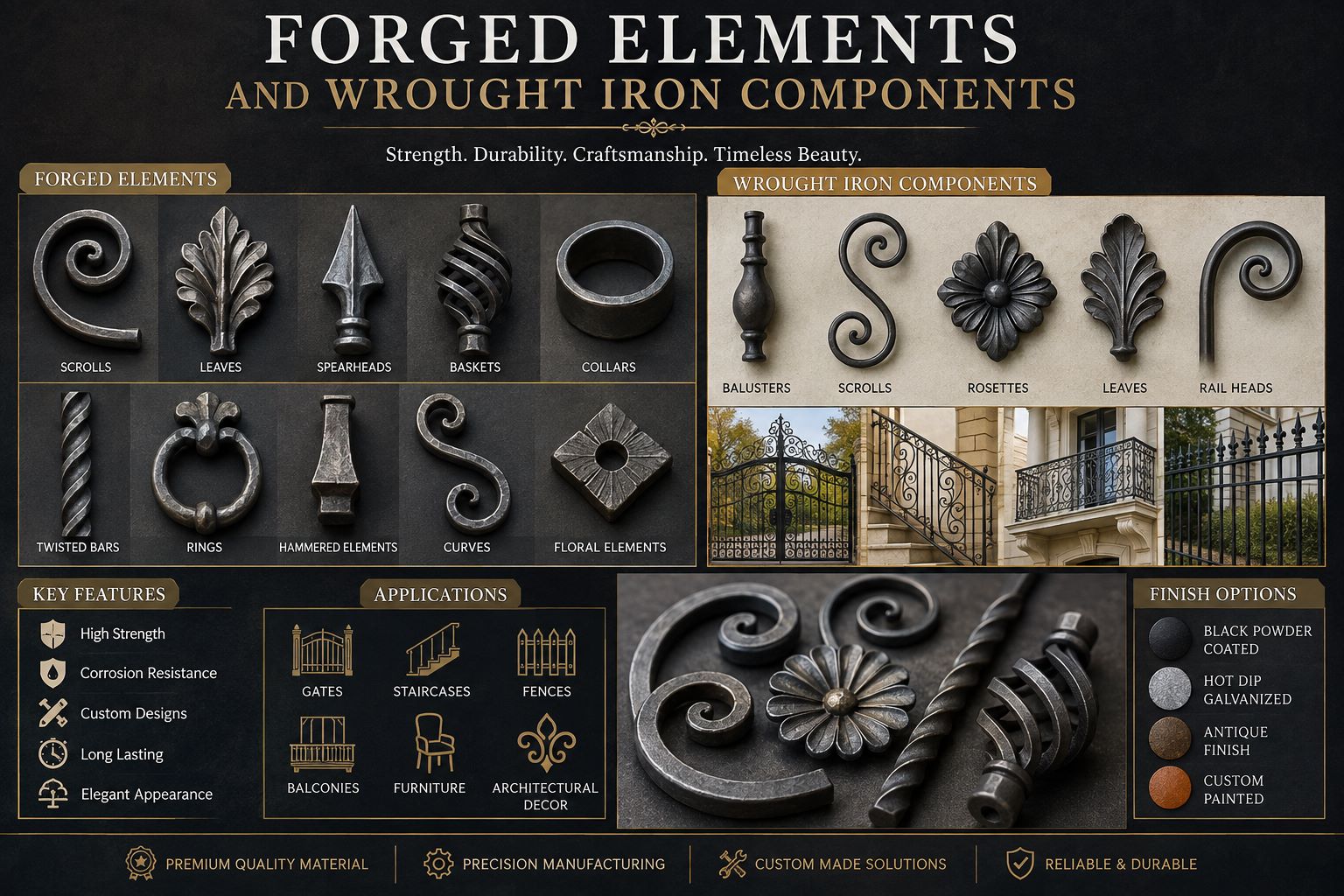
Some commonly used forged products include:
- Decorative scrolls
- Forged leaves
- Metal flowers
- Rings and collars
- Spearheads
- Finials
- Twisted bars
- Hammered bars
- Decorative baskets
- Rosettes
These elements are usually combined with metal frames to produce gates, railings, fencing systems, furniture, and other architectural features.
Why Wrought Iron Components Remain Popular
Wrought Iron Components are popular because they give metal structures a strong decorative identity.
Traditional wrought iron was produced using a specialized iron-making process. However, many modern decorative products described as wrought iron are manufactured from mild steel because it is widely available and easy to weld, form, coat, and fabricate.
What makes these products attractive is their ability to recreate the timeless appearance associated with handcrafted ironwork.
A simple steel gate can look completely different when decorative scrolls, leaves, collars, and spearheads are incorporated into its design.
Where Forged Elements Are Commonly Used
The versatility of Forged Elements allows them to be used across different types of architecture and fabrication projects.
Some common applications include:
- Main entrance gates
- Balcony railings
- Staircase balustrades
- Security fences
- Window grills
- Garden gates
- Pergolas
- Decorative partitions
- Metal furniture
- Commercial property entrances
They can also be used in hotels, villas, resorts, restaurants, offices, heritage buildings, and luxury residential developments.
The choice of component depends largely on the overall architectural concept.
Transforming Ordinary Gates into Decorative Features
Entrance gates are one of the best examples of how Wrought Iron Components can enhance design.
Instead of using only plain vertical bars, fabricators can introduce decorative patterns using scrolls, rings, leaves, and ornamental centerpieces.
For example, a traditional gate may use:
- Large symmetrical scrolls
- Spearhead tops
- Forged floral decorations
- Twisted vertical bars
- Decorative collars
A modern gate may use fewer decorative components and focus on clean geometric forged shapes.
This flexibility allows designers to achieve different visual styles without completely changing the structural framework.
Decorative Components for Railings and Balconies
Railings need to provide safety, but they can also become an important architectural feature.
Forged Elements can be placed between vertical bars to create patterns that complement staircases, balconies, and terraces.
Scroll designs are particularly popular because they provide flowing lines without making the structure look overly heavy.
Twisted bars and decorative rings can also add visual detail while maintaining a balanced appearance.
When selecting railing components, designers should also consider local safety regulations, spacing requirements, railing height, and structural performance.
Traditional and Modern Ironwork Compared
| Feature | Traditional Style | Modern Style |
| Design | Decorative and detailed | Clean and minimal |
| Common elements | Scrolls, leaves, flowers | Geometric forged shapes |
| Bar patterns | Twisted and curved | Straight and symmetrical |
| Visual appearance | Classic and artistic | Contemporary and simple |
| Typical projects | Villas, heritage buildings | Modern homes, offices |
Both design approaches can make effective use of Wrought Iron Components.
The difference mainly comes from how many decorative pieces are used and how they are arranged.
Why Fabricators Prefer Ready-Made Components
Producing every decorative component manually can require significant time and skilled labor.
Ready-made Forged Elements give metal fabrication workshops a faster alternative.
Instead of manually creating every scroll or spearhead, fabricators can select standardized components and weld them directly into the structure.
This offers several advantages:
- Faster fabrication
- Better pattern consistency
- Reduced manual forming
- Easier project planning
- Consistent dimensions
- Greater design flexibility
- Lower production complexity
For projects involving multiple gates or long fencing sections, this consistency can be particularly valuable.
Choosing the Right Forged Elements for a Project
Decorative components should not be selected only because they look attractive individually.
They should match the size, proportions, material thickness, and overall style of the structure.
Important factors to consider include:
- Component size
- Material thickness
- Bar dimensions
- Frame dimensions
- Welding compatibility
- Overall design theme
- Installation location
- Indoor or outdoor use
- Required finish
- Maintenance expectations
Large decorative elements may overpower small gates, while very small pieces may appear lost on large entrance structures.
Balanced proportion creates better visual results.
The Importance of Surface Protection
Outdoor Wrought Iron Components are constantly exposed to environmental conditions such as rain, moisture, sunlight, dust, and pollution.
Without proper surface treatment, steel may gradually develop corrosion.
Several protective finishing options are available.
These include:
- Anti-corrosion primer
- Protective paint
- Powder coating
- Zinc coating
- Hot-dip galvanizing
- Galvanizing followed by painting
The correct treatment depends on environmental exposure and expected service life.
Coastal and highly humid environments may require stronger corrosion protection than dry indoor applications.
How Quality Affects the Finished Metalwork
Good decorative design can still look poor if component quality is inconsistent.
Before purchasing large quantities of Forged Elements, fabricators should inspect sample pieces carefully.
Check for:
- Consistent dimensions
- Smooth curves
- Proper symmetry
- Clean edges
- Excessive surface scale
- Cracks
- Distortion
- Suitable welding surfaces
When identical components are used repeatedly across a large gate or fence, even small dimensional differences can become noticeable.
Therefore, consistency is an important quality factor.
Custom Wrought Iron Components for Unique Designs
Some architectural projects require designs that cannot be created using standard components.
Custom Wrought Iron Components allow architects and fabricators to develop unique decorative patterns.
Manufacturers may produce components based on:
- CAD drawings
- Technical drawings
- Reference samples
- Sketches
- Photographs
- Custom dimensions
Personalized components can include company logos, monograms, floral patterns, decorative emblems, unique scrolls, or heritage-style reproductions.
Frequently Asked Questions
What are Forged Elements?
They are metal components shaped through forging, hammering, pressing, twisting, bending, or related forming techniques.
Where are Wrought Iron Components commonly used?
They are commonly used in gates, railings, fencing, balconies, grills, furniture, and decorative architectural structures.
Can forged elements be used outdoors?
Yes. They should receive appropriate corrosion-resistant finishing for outdoor applications.
Are modern wrought iron products made from genuine wrought iron?
Many modern decorative components are manufactured from mild steel while maintaining a traditional wrought iron appearance.
Can decorative forged parts be welded?
Yes. Many steel-based forged products are suitable for conventional welding techniques.
What are popular forged decorative shapes?
Scrolls, leaves, flowers, rings, collars, spearheads, finials, baskets, and twisted bars are commonly used.
Can forged elements be customized?
Yes. Manufacturers can produce custom shapes, dimensions, patterns, and decorative designs.
Which finish is suitable for exterior metalwork?
Powder coating, painting, galvanizing, or combined protective coating systems are commonly used.
Are forged components suitable for modern buildings?
Yes. Minimal and geometric forged components can work effectively with contemporary architectural styles.
What should buyers check before ordering?
Material quality, dimensions, surface finish, weldability, consistency, customization capability, and corrosion protection should all be considered.