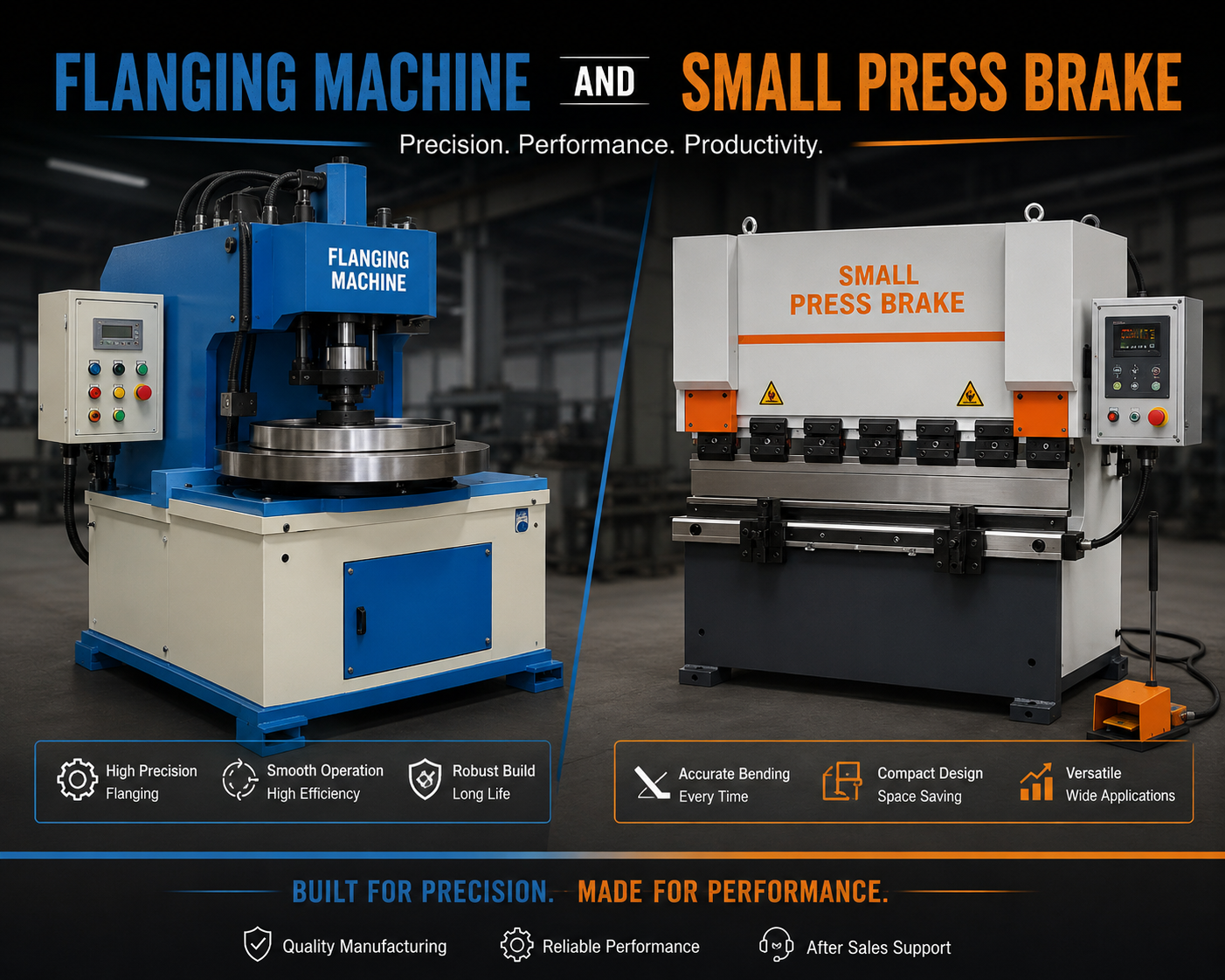
To remain productive, workshops need machines that can perform specific forming operations accurately while keeping setup and handling simple.
Two valuable solutions are the flanging machine and small press brake. Although both are used to shape metal, they serve very different production purposes. A flanging machine is mainly selected for creating reinforced or functional edges, while a small press brake is used for producing controlled bends in sheet metal.
For fabrication companies planning to improve productivity, understanding the role of each machine can make equipment selection much more practical.
Why Production Efficiency Starts with the Right Machine
A common fabrication mistake is trying to perform every operation using the same piece of equipment. While multipurpose machinery can be useful, specialized machines often provide better results for repetitive or technically demanding operations.
Using suitable equipment can help a workshop achieve:
- Faster job completion
- Better dimensional control
- Less manual adjustment
- Reduced material waste
- More consistent output
- Improved worker productivity
- Easier quality inspection
Both the flanging machine and small press brake can contribute to these improvements when used for the correct applications.
What Makes Flanging an Important Manufacturing Process?
Flanging involves forming the edge of a metal workpiece into a controlled profile. Depending on the product design, the flange may extend outward, inward, upward, or around a curved section.
The purpose is not always decorative. A correctly formed flange can provide significant functional benefits.
It may be used to:
- Add stiffness to a component
- Create an assembly surface
- Support mechanical fastening
- Prepare parts for welding
- Improve edge safety
- Provide a sealing area
- Improve dimensional stability
Because of these advantages, flanging machines are widely used where formed edges are an essential part of the final product.
Applications Where Flanging Machines Perform Well
Flanging equipment is commonly found in manufacturing environments that produce cylindrical and circular components.
Examples include:
- Tank ends
- Round metal covers
- Air ducts
- Industrial vessels
- Exhaust components
- Metal barrels
- Ventilation fittings
- Container parts
- HVAC accessories
- Fabricated rings
A dedicated flanging machine can produce these edges more consistently than manual hammering or improvised forming techniques.
Why Controlled Edge Forming Matters
During flanging, metal around the edge must stretch or compress depending on the shape being created.
If the process is too aggressive, the material may develop:
- Cracks
- Wrinkles
- Uneven radii
- Distorted edges
- Inconsistent flange widths
This is why machine setup and tooling selection are important.
Progressive forming can allow the material to reach the desired shape gradually, reducing unnecessary stress.
Small Press Brake as a Flexible Workshop Machine
Unlike a machine dedicated to edge forming, a small press brake is designed for broader bending operations.
Sheet metal is positioned between a punch and die. The punch applies controlled pressure, forcing the sheet into the required bend.
The simplicity of this principle allows manufacturers to produce many component designs by changing tooling and workpiece positioning.
This versatility makes compact press brakes highly useful for custom and mixed-production workshops.
Products Commonly Made on a Small Press Brake
A small press brake may be used to manufacture:
- Equipment brackets
- Electrical enclosure panels
- Metal trays
- Mounting plates
- Small channels
- Machine guards
- Cabinets
- Shelving parts
- Automotive brackets
- Custom fabricated sections
This broad range of applications can make the machine useful even in workshops that rarely produce the same component every day.
Why Compact Press Brakes Suit Smaller Production Facilities
Large industrial press brakes are designed for substantial components and demanding production environments.
However, many workshops primarily process smaller parts.
In these situations, a small press brake may provide practical advantages such as:
- Reduced floor space
- Easier operator access
- Faster small-part handling
- Lower installation complexity
- Flexible tooling
- Efficient short-batch production
- Convenient prototype development
Selecting equipment according to real component sizes can prevent unnecessary investment in oversized machinery.
How the Two Machines Fit into Different Production Tasks
| Production Task | Flanging Machine | Small Press Brake |
| Forming circular edges | Highly suitable | Limited |
| Producing brackets | Not primary use | Highly suitable |
| Creating reinforced rims | Excellent | Application dependent |
| Bending flat panels | Limited | Excellent |
| Producing channels | Limited | Very suitable |
| Tank manufacturing | Commonly used | Used for supporting parts |
| Multi-angle fabrication | Limited | Highly flexible |
| Specialized edge work | Excellent | Moderate |
This comparison shows why many fabrication facilities benefit from having access to both technologies.
Material Characteristics Should Guide Machine Setup
The same machine setting cannot always be used for every type of sheet metal.
Different materials respond differently to forming pressure.
Mild Steel
Mild steel is widely used because it generally offers predictable bending and forming behavior.
Stainless Steel
Stainless steel typically has greater strength and may require more force. It can also experience greater springback.
Aluminum
Aluminum can be easy to form, but certain alloys are more sensitive to tight bend radii.
Copper and Brass
These metals can be formed successfully, but surface protection and tooling condition may be especially important where appearance matters.
Understanding the material helps manufacturers choose the correct forming pressure, radius, and tooling configuration.
Key Specifications for Choosing a Flanging Machine
Before purchasing a flanging machine, manufacturers should identify their normal workpiece range.
Important specifications include:
- Maximum material thickness
- Maximum and minimum workpiece diameter
- Flange width capability
- Forming angle
- Suitable material grades
- Roller or die adjustment
- Machine drive system
- Production speed
A manufacturer producing only small circular components may have very different requirements from a company manufacturing large industrial vessels.
Key Specifications for Choosing a Small Press Brake
A small press brake should be selected according to actual bending requirements.
Important factors include:
Working Length
The machine must accommodate the widest component expected in normal production.
Tonnage
Available force should be sufficient for the material, thickness, die opening, and bend length.
Backgauge
A reliable backgauge helps position material correctly and maintain consistent bend dimensions.
Tooling System
Easy access to compatible punches and dies increases the range of products the machine can manufacture.
Reducing Production Costs Through Better Setup
Machine productivity depends heavily on how efficiently jobs are prepared.
Fabrication businesses can reduce unnecessary time by:
- Keeping frequently used tooling organized
- Recording successful machine parameters
- Standardizing common jobs
- Checking material before production
- Preparing drawings in advance
- Inspecting the first finished component
- Grouping similar jobs together
Good setup planning can sometimes improve output more effectively than simply increasing machine speed.
Why First-Piece Inspection Is Essential
One of the easiest ways to prevent expensive fabrication errors is to inspect the first completed component carefully.
Operators should check:
- Bend angle
- Flange dimensions
- Overall length
- Surface condition
- Hole alignment
- Component fit
If a mistake is identified after the first part, the machine can be corrected immediately.
If the same mistake is discovered after 100 parts, the cost becomes considerably higher.
Maintenance Protects Accuracy
Over time, tool wear, loose components, lubrication problems, or misalignment can affect machine performance.
Regular maintenance should include:
- Cleaning forming surfaces
- Checking hydraulic systems
- Inspecting punches and dies
- Examining flanging rollers
- Maintaining lubrication
- Checking electrical systems
- Testing safety devices
A maintained machine is more likely to produce consistent components and experience fewer unexpected stoppages.
Frequently Asked Questions
1. What does a flanging machine do?
A flanging machine forms the edge of metal components into a required flange, rim, or reinforced profile.
2. What industries use flanging machines?
They are commonly used in HVAC, tank manufacturing, ventilation, metal containers, automotive fabrication, and industrial engineering.
3. What is a small press brake?
A small press brake is compact bending equipment used to form sheet metal into angles and different profiles.
4. Why use a small press brake?
It provides flexible bending capability while requiring less floor space than many larger industrial machines.
5. Can both machines process stainless steel?
Yes, provided their capacity, tooling, and settings are appropriate for the selected thickness and stainless steel grade.
6. Are flanging machines suitable for flat sheets?
Some models can work with flat or preformed components, depending on machine design and tooling.
7. What is the importance of press brake tooling?
Tooling determines bend radius, angle, surface condition, and the types of profiles that can be manufactured.
8. Why does a bend angle sometimes change after forming?
This is usually caused by springback, where the metal partially recovers after forming force is removed.
9. Can small press brakes handle production batches?
Yes. They can be suitable for repeated production when components fall within the machine’s capacity.
10. How can flanging defects be reduced?
Correct tooling, controlled forming pressure, suitable radii, and proper material selection can reduce defects.