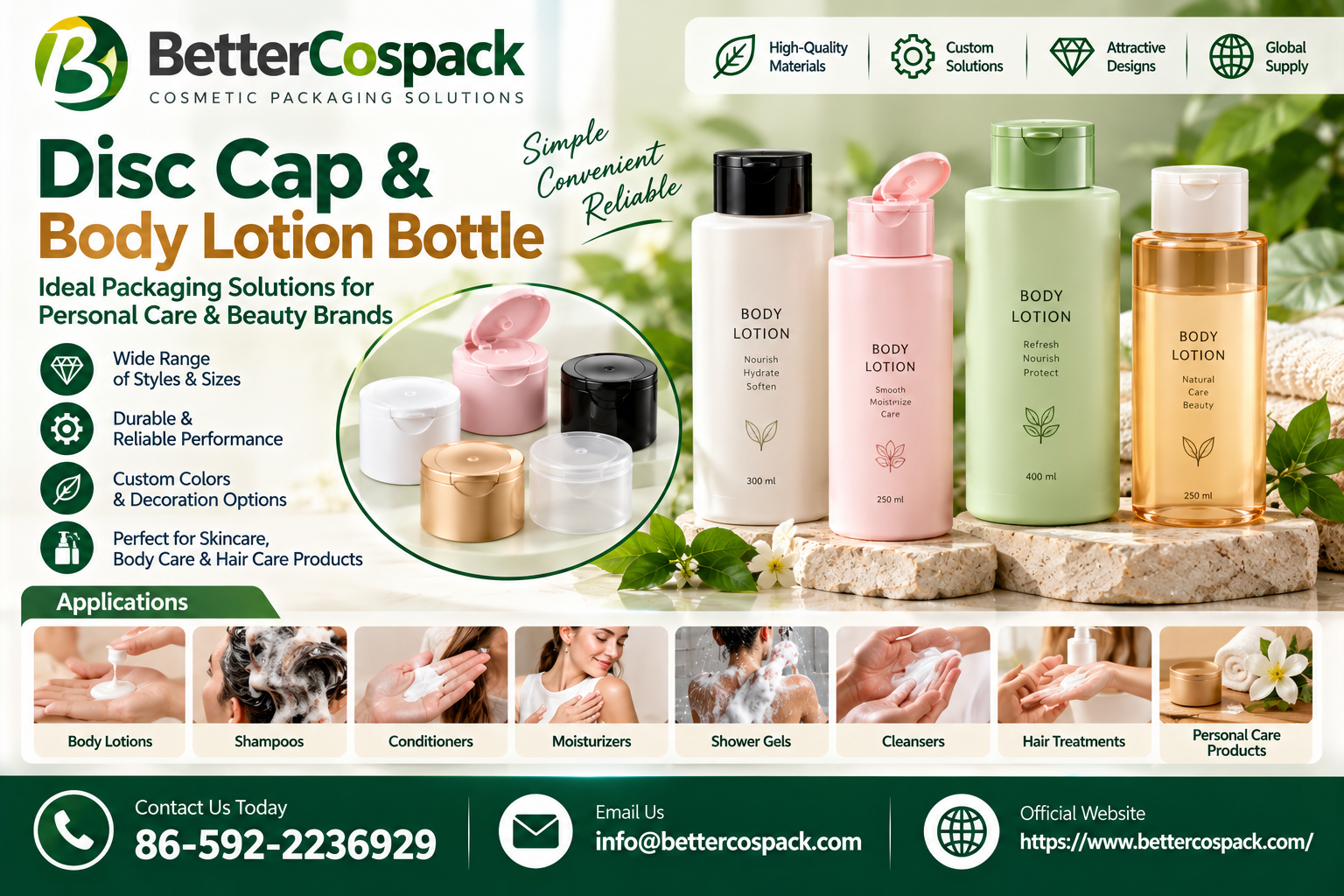
As skincare brands and personal care manufacturers focus on convenient dispensing, product safety, and attractive packaging, bottle closures are becoming an important consideration in cosmetic product development.
A disc cap provides a simple dispensing mechanism for suitable liquid and lotion formulations, while a carefully designed body lotion bottle supports convenient product handling, brand presentation, and effective storage.
From everyday moisturizers to premium body care products, the combination of appropriate bottle materials and reliable dispensing closures can influence customer satisfaction and packaging performance.
Understanding closure compatibility, bottle construction, material selection, and manufacturing quality helps cosmetic businesses choose packaging that meets both practical and commercial requirements.
What Is a Disc Cap?
A disc cap, commonly known as a disc-top cap, is a plastic dispensing closure that opens and closes through a pressing action.
The top contains a movable disc. Pressing one side exposes the dispensing opening, allowing the product to flow when the container is squeezed or tilted.
Pressing the opposite side closes the outlet.
Key Benefits of Disc Caps
- Convenient Dispensing: Enables product access without removing the complete closure.
- Compact Appearance: Provides a clean, streamlined packaging design.
- Controlled Opening: Helps consumers dispense suitable quantities.
- Customizable Design: Available in different colours, dimensions, and finishes.
- Bottle Compatibility: Can be matched with appropriate neck specifications.
- Practical Handling: Suitable for many everyday personal care applications.
Understanding Body Lotion Bottle Packaging
A body lotion bottle is a container designed to hold moisturizing lotions and similar skincare formulations.
Depending on its design, it may incorporate a disc-top closure, flip-top cap, lotion pump, or another suitable dispensing system.
Bottle selection depends on product viscosity, ingredient compatibility, target consumers, and packaging preferences.
Common Body Lotion Bottle Designs
Squeezable Plastic Bottles: Allow users to dispense compatible lotions by applying pressure.
Pump Bottles: Provide mechanical dispensing for suitable formulations.
Travel-Size Bottles: Offer compact packaging for convenient transportation.
Premium Decorative Bottles: Use selected colours, finishes, and shapes to support brand positioning.
Refillable Bottle Systems: Allow repeated use when designed with appropriate cleaning and refill procedures.
Each option offers different advantages and limitations.
Why Disc Caps Are Suitable for Lotion Packaging
Disc caps are particularly useful for certain lotions that can flow through a suitably sized dispensing opening.
Their simple construction allows users to open the bottle with a pressing action.
However, not every lotion is suitable for disc-top dispensing.
Very thick creams may require larger openings, pumps, jars, or other packaging formats.
Formulators should evaluate product viscosity, bottle flexibility, closure dimensions, and dispensing performance before approving the packaging design.
Materials Used in Body Lotion Bottles
Material selection influences appearance, durability, flexibility, and product compatibility.
High-Density Polyethylene (HDPE)
HDPE is commonly used for personal care bottles because of its useful chemical resistance and durability.
Polyethylene Terephthalate (PET)
PET offers clarity and an attractive appearance for suitable cosmetic formulations.
Polypropylene (PP)
PP is frequently used for dispensing closures, including certain disc-top caps.
Low-Density Polyethylene (LDPE)
LDPE may be used in flexible, squeezable packaging applications.
Decorative Materials
Selected packaging designs incorporate additional components or coatings for a premium appearance.
The final packaging must be evaluated against the complete lotion formulation.
Disc Cap vs. Lotion Pump: Which Is Better?
Both dispensing systems offer practical benefits.
| Feature | Disc Cap | Lotion Pump |
| Dispensing method | Press and squeeze or pour | Press pump actuator |
| Suitable products | Compatible flowing lotions | Compatible liquid or cream formulations |
| Construction | Relatively simple closure | Multiple mechanical components |
| Portion control | Depends on user pressure | Depends on pump output |
| Packaging design | Compact appearance | Prominent dispensing actuator |
| Key consideration | Opening size and bottle flexibility | Pump priming and viscosity compatibility |
Neither solution is universally better.
The appropriate selection depends on formulation behaviour, packaging design, and consumer expectations.
How Disc Caps Are Manufactured
Disc-top closures are commonly produced using plastic injection moulding.
The manufacturing process generally includes several stages.
Design Development
Engineers establish the closure dimensions, opening mechanism, and bottle-neck requirements.
Material Selection
Suitable plastic grades are chosen according to mechanical performance and formulation compatibility.
Injection Moulding
Plastic components are formed using controlled moulding equipment.
Assembly and Finishing
Closure components are assembled and prepared according to the product design.
Quality Inspection
Finished caps are evaluated for dimensions, operation, fit, and visible defects.
Manufacturing consistency is essential for maintaining dependable closure performance.
Importance of Bottle and Cap Compatibility
A well-manufactured cap will not function properly if it does not fit the intended container.
The bottle-neck finish, thread design, sealing surface, and closure dimensions must be compatible.
For a body lotion bottle, the dispensing opening should also accommodate the product’s flow characteristics.
Essential Compatibility Checks
- Bottle-neck dimensions and thread specification.
- Closure fit and sealing performance.
- Lotion viscosity and dispensing behaviour.
- Bottle squeezing resistance and recovery.
- Leakage during transportation.
- Compatibility with formulation ingredients.
- Opening and closing durability.
- Performance under intended storage conditions.
These evaluations help minimize packaging failures during commercial distribution.
Customization Opportunities for Cosmetic Brands
Packaging appearance contributes to product recognition and brand identity.
Manufacturers may offer customized bottle shapes, decorative caps, printed labels, and specialized colours.
A coordinated disc cap and bottle design can create a consistent visual identity across body lotion collections.
Brands can also consider matte finishes, transparent bottles, embossed details, and appropriate decorative printing.
Customization should support product usability rather than interfere with dispensing performance.
Quality Testing and Product Protection
Professional cosmetic packaging development involves testing the complete bottle-and-closure assembly.
Important evaluations include leakage resistance, closure functionality, dimensional accuracy, drop performance, and formulation compatibility.
Cosmetic stability testing helps determine whether packaging materials interact with the lotion during storage.
A disc cap does not guarantee that a product remains sterile after opening.
Appropriate formulation preservation, manufacturing hygiene, and finished-product testing remain necessary.
Sustainability Considerations in Lotion Packaging
Cosmetic brands increasingly examine packaging material use and recycling compatibility.
Lightweight plastic bottles can offer material-efficiency advantages in selected applications.
However, actual environmental performance depends on material composition, manufacturing, transportation, and disposal.
Compatible mono-material packaging and refill systems may support certain sustainability objectives.
Recyclability should be evaluated according to local collection and recycling capabilities rather than assumed from the plastic type alone.
Frequently Asked Questions (FAQs)
1. What is a disc cap?
A disc cap is a press-to-open plastic closure used to dispense suitable liquid and lotion products.
2. What is a body lotion bottle?
It is a packaging container designed to store and dispense moisturizing lotions and related skincare formulations.
3. Can disc caps be used for body lotion bottles?
Yes, when the lotion’s viscosity and the bottle-and-cap design are compatible.
4. What materials are used for disc caps?
Polypropylene is commonly used, although material selection depends on product requirements.
5. Can body lotion bottles be customized?
Yes. Brands may customize bottle shapes, colours, dimensions, labels, and closures.
6. Are disc caps better than lotion pumps?
Neither is universally better. Suitability depends on product viscosity, dispensing preferences, and packaging requirements.
7. Are plastic lotion bottles recyclable?
Recyclability depends on the material and available recycling infrastructure.
8. What causes lotion bottles to leak?
Possible causes include incompatible closures, damaged seals, manufacturing defects, or unsuitable handling conditions.
9. How is disc cap quality tested?
Testing may include dimensional inspection, opening performance, closure fit, and leakage evaluation.
10. How should cosmetic brands select packaging suppliers?
Evaluate material quality, customization options, product compatibility, testing capabilities, pricing, and delivery reliability.
Media Contact
Department: Cosmetic Bottles and Packaging Solutions Communications
Email: info@bettercospack.com
Contact: 86-592-2236727
Official Website: https://www.bettercospack.com/