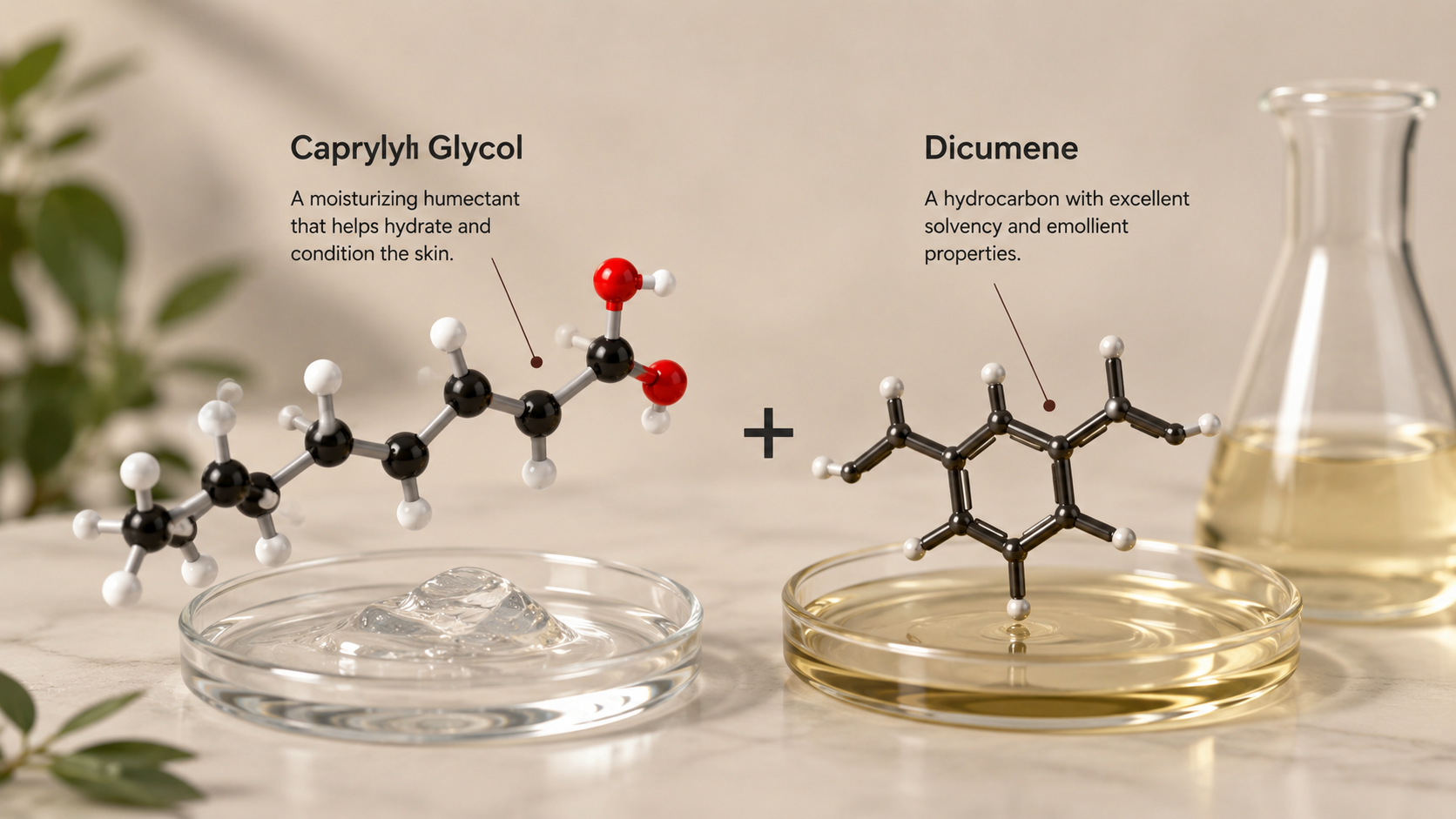
Caprylyl Glycol is widely used in cosmetics and personal-care products, where it supports moisture retention, skin conditioning, texture, and preservation. Dicumene, also known as 2,3-dimethyl-2,3-diphenylbutane, is mainly an industrial polymer additive associated with radical chemistry, polymer modification, and selected flame-retardant systems.
Although they belong to different chemical families and industries, both show how multifunctional ingredients can improve product performance when chosen and processed correctly.
What Is Caprylyl Glycol?
Caprylyl Glycol is an eight-carbon diol with the formula C8H18O2 and the INCI name Caprylyl Glycol. It is also called 1,2-octanediol. In cosmetics, it is valued because a single ingredient can support several formulation goals.
It functions primarily as a humectant, emollient, skin-conditioning agent, and preservative booster. Its structure contains both water-attracting hydroxyl groups and an oil-compatible carbon chain, helping it influence moisturization, spreadability, emulsion behavior, and antimicrobial performance.
Key Functions of Caprylyl Glycol
The main benefits of Caprylyl Glycol include:
- Helping attract and retain moisture at the skin surface.
- Improving the smooth feel of creams and lotions.
- Supporting the effectiveness of a preservative system.
- Improving product texture and spreadability.
- Working alongside preservatives such as phenoxyethanol.
- Supporting formulation stability when properly incorporated.
Caprylyl Glycol should not automatically be treated as a universal stand-alone preservative. Its antimicrobial contribution is useful, but water-based products normally require a complete preservation strategy validated for the finished formula.
Where Is Caprylyl Glycol Used?
It may appear in moisturizers, facial serums, cleansers, foundations, shampoos, conditioners, deodorants, body lotions, and other personal-care products. Its appeal comes from combining sensory, conditioning, and preservation-support functions in one material.
What Is Dicumene?
Dicumene is a common name for 2,3-dimethyl-2,3-diphenylbutane, a hydrocarbon with the formula C18H22 and CAS number 1889-67-4. NIST lists Dicumene and Dicumyl among its alternative names. It should not be confused with dicumyl peroxide, which is a different chemical.
Dicumene is mainly relevant to plastics and polymer processing. At elevated temperatures, it can participate in radical chemistry, making it useful in applications involving grafting, crosslinking, copolymerization, and polymer modification.
Major Industrial Uses of Dicumene
Important applications of Dicumene include:
- Polymer modification where radical reactions are needed.
- Grafting processes involving polyolefins such as polyethylene.
- Crosslinking and copolymerization systems.
- Flame-retardant formulations where it can act as a synergistic additive.
- High-temperature processing designed to modify polymer properties.
Dicumene has been described for flame-retardant synergist applications in materials including polypropylene and polystyrene. Actual performance depends on resin type, additive package, processing conditions, and finished-product requirements.
Why Dicumene Matters in Polymer Technology
Its value comes from controlled thermal behavior. At sufficiently high temperatures, Dicumene can generate radicals that participate in polymer reactions, supporting processes such as grafting and modification.
Caprylyl Glycol vs Dicumene: Key Differences
| Feature | Caprylyl Glycol | Dicumene |
| Chemical type | Diol | Aromatic hydrocarbon |
| Formula | C8H18O2 | C18H22 |
| Primary sector | Cosmetics and personal care | Plastics and polymers |
| Main role | Humectant, conditioning agent, preservative booster | Radical source, polymer modifier, FR synergist |
| Typical uses | Creams, serums, cleansers, hair care | PP, PE, PS/EPS and polymer processing |
| Main benefit | Moisture, feel and preservation support | Polymer modification and additive synergy |
The two materials are not substitutes. Their chemistry, handling, applications, and performance targets are fundamentally different.
Formulation and Processing Considerations
When using Caprylyl Glycol, formulators should evaluate concentration, solubility, emulsifier system, preservative compatibility, pH, packaging, and microbiological challenge testing. Preservative performance depends on the entire formulation, so laboratory validation is essential.
For Dicumene, manufacturers should assess processing temperature, polymer grade, residence time, additive interactions, thermal behavior, and target mechanical or flame-retardant properties. Supplier technical and safety documentation should guide industrial use.
Safety and Quality Control
Both chemicals should be handled according to their intended application. Cosmetic-grade Caprylyl Glycol should meet relevant purity and cosmetic requirements. Industrial Dicumene requires appropriate assessment for handling, storage, thermal processing, and compatibility.
Quality checks may include chemical identity, assay, appearance, batch consistency, storage stability, and application-specific testing.
How to Select the Right Grade
Buyers should compare more than price. Important checkpoints include:
- CAS number and chemical identity.
- Assay or purity specification.
- Certificate of analysis.
- Technical and safety data sheets.
- Recommended storage conditions.
- Application compatibility.
- Batch consistency.
- Supplier traceability.
Correct documentation helps reduce sourcing errors, especially when chemicals have similar commercial names.
Frequently Asked Questions
1. What is Caprylyl Glycol mainly used for?
Caprylyl Glycol is used as a humectant, conditioning ingredient, emollient, and preservative booster in personal-care formulations.
2. Is Caprylyl Glycol a preservative?
It has antimicrobial and preservative-boosting properties, but it is commonly used as part of a broader preservation system.
3. Is Caprylyl Glycol the same as glycerin?
No. Both can support moisturization, but their chemistry and formulation behavior differ.
4. Which products may contain Caprylyl Glycol?
It may be found in creams, serums, cleansers, makeup, deodorants, shampoos, conditioners, and lotions.
5. What is Dicumene?
Dicumene is 2,3-dimethyl-2,3-diphenylbutane, an industrial hydrocarbon mainly used in polymer-related applications.
6. Is Dicumene the same as dicumyl peroxide?
No. They are distinct chemicals with different structures and handling characteristics.
7. Where is Dicumene used?
It can be used in polymer grafting, crosslinking, copolymerization, modification, and selected flame-retardant systems.
8. Is Dicumene a cosmetic ingredient?
Its established commercial role is mainly in industrial polymer applications rather than conventional cosmetic formulation.
9. Why is purity important?
Purity affects consistency, processing behavior, product performance, safety assessment, and specification compliance.
10. How should a chemical supplier be selected?
Choose suppliers offering reliable specifications, certificates of analysis, safety documentation, traceability, and consistent quality.