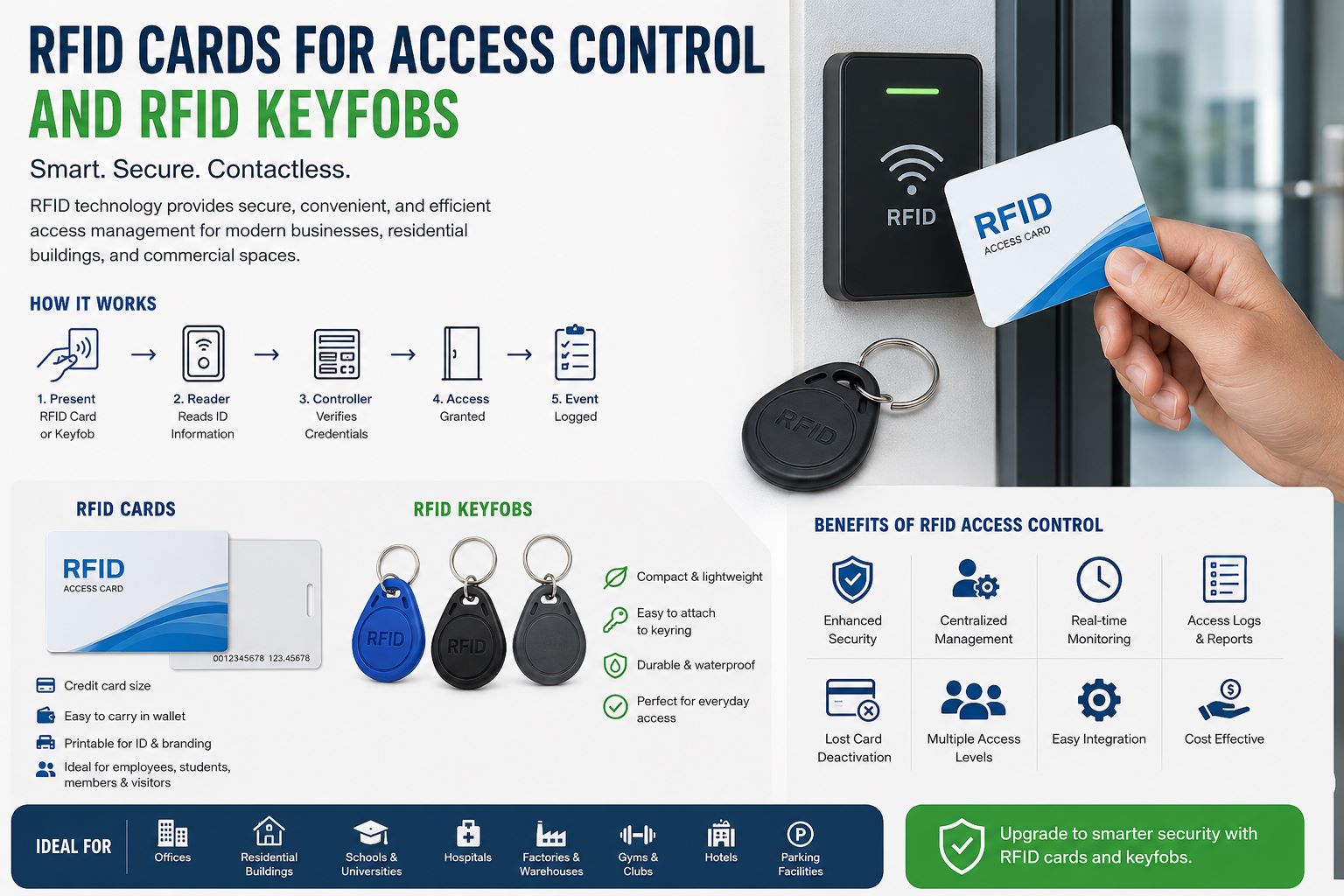
Modern access security is moving beyond traditional metal keys. Businesses, residential communities, hotels, educational institutions, healthcare facilities and industrial sites increasingly need credentials that are convenient for authorised users while helping administrators manage access efficiently. RFID cards for access control and RFID keyfobs have become practical options for meeting these requirements.
Both technologies use radio frequency identification to communicate with compatible readers. Instead of inserting a physical key into a lock, users simply present their card or keyfob near an RFID reader. The system verifies the credential and determines whether access should be granted.
However, cards and keyfobs are not identical. Understanding their characteristics, applications and security considerations can help organisations select the right RFID credential for their access control environment.
How RFID Access Control Works
An RFID access control system typically includes a credential, reader, controller and access management software. Each authorised card or keyfob contains identification information that can be recognised by a compatible reader.
The process usually follows four steps:
- The user presents an RFID credential near the reader.
- The reader detects and communicates with the credential.
- The access control system checks whether the credential has permission.
- The connected door or entry point unlocks when access is authorised.
This process can happen almost instantly, making RFID particularly useful in environments where many employees, residents or visitors enter throughout the day.
Unlike conventional keys, access permissions can generally be managed electronically. When an employee leaves an organisation, for example, their credential can be disabled without replacing every physical lock.
What Are RFID Cards for Access Control?
RFID cards for access control are contactless credentials designed to identify authorised users at secured entry points. They are commonly shaped like standard ID or bank cards, which makes them easy to carry in wallets, badge holders and lanyards.
Businesses often combine RFID functionality with printed employee identification. A single card may therefore serve as both a visible staff ID and an electronic access credential.
Depending on the technology used, RFID access cards may support different frequencies, memory capabilities and security features. Compatibility with existing readers and access control infrastructure is therefore an important consideration when purchasing new credentials.
Common applications include corporate offices, factories, universities, hospitals, apartment buildings, laboratories and restricted departments.
What Are RFID Keyfobs?
RFID keyfobs provide similar contactless identification functionality in a smaller form factor. They are generally designed to attach directly to a keyring, making them convenient for users who do not want to carry an additional card.
A keyfob usually contains an RFID chip and antenna enclosed within a durable plastic or other protective housing. When brought within the operating distance of a compatible reader, it communicates its credential information to the system.
RFID keyfobs are especially popular for:
- Residential buildings and gated communities
- Fitness centres and membership facilities
- Office access
- Storage areas
- Car parks
- Hotels and hospitality facilities
- Small commercial premises
- Shared workplaces
Their compact design can make them practical for environments where users already carry keys regularly.
RFID Cards for Access Control vs RFID Keyfobs
Although both credentials can perform the same fundamental access-control function, their physical design creates differences in everyday use.
| Feature | RFID Cards for Access Control | RFID Keyfobs |
| Form | Flat, card-shaped credential | Small keyring credential |
| Carrying Method | Wallet, lanyard or badge holder | Attached to keys |
| Printing Space | Excellent for logos, names and photos | Limited |
| Employee Identification | Highly suitable | Less suitable |
| Portability | Convenient | Very compact |
| Typical Application | Offices, schools, hospitals | Homes, gyms, apartments |
| Branding Potential | High | Moderate |
| Access Convenience | High | High |
Neither solution is automatically better. The right choice depends on the organisation’s operational requirements and how users will carry and use their credentials.
Why Businesses Use RFID Credentials
The value of RFID access control goes beyond replacing physical keys. Electronic credentials provide administrators with greater flexibility in controlling who can enter specific locations.
For example, a company might allow all employees into its main office while restricting server rooms to IT personnel. Cleaning contractors could receive access only during designated periods, while management might have permission for multiple departments.
This level of credential-based management can make access policies easier to administer.
Another practical advantage is credential cancellation. A missing mechanical master key may require expensive lock changes. A lost RFID credential can usually be deactivated in the access management system and replaced.
Security Considerations When Selecting RFID Technology
Not every RFID credential provides the same security capabilities. Older credential technologies may rely primarily on a fixed identification number, while newer systems can incorporate stronger authentication or encryption mechanisms.
Organisations evaluating RFID cards for access control should therefore consider more than appearance and price.
Important factors include credential technology, reader compatibility, encryption capabilities, system architecture, credential management procedures and the sensitivity of the protected location.
The complete access-control system matters as much as the credential itself. Secure installation, appropriate administrator permissions and prompt removal of lost or inactive credentials all contribute to effective access management.
Choosing the Correct RFID Frequency and Technology
RFID systems operate using different frequency ranges and communication standards. Access credentials are commonly associated with low-frequency and high-frequency technologies, although specifications vary between systems.
This means an RFID card or keyfob should never be purchased simply because it looks compatible.
Before ordering credentials, confirm:
- Operating frequency
- Chip or credential technology
- Reader compatibility
- Required memory or identification format
- Access controller requirements
- Security features
- Programming or enrolment method
Using compatible credentials reduces deployment problems and avoids purchasing cards or fobs that existing readers cannot recognise.
RFID Cards for Employee Identification
One major advantage of RFID cards is their printable surface. Organisations can customise them with photographs, employee names, ID numbers, departments, company logos and branding.
This allows RFID cards for access control to serve two purposes simultaneously: electronic authentication and visual identification.
In environments where employees must display identification clearly, cards are often more practical than keyfobs.
They can also potentially be integrated into broader credential ecosystems involving attendance management, visitor systems or other authorised applications when compatible infrastructure is available.
When RFID Keyfobs Are the Better Option
RFID keyfobs become particularly attractive when visual identification is unnecessary.
Consider an apartment complex where residents only need a credential to open the entrance gate. Carrying an employee-style ID card would add little value. A compact keyfob attached to house or vehicle keys may be much more convenient.
Similarly, gyms, clubs and recreational facilities frequently use RFID keyfobs because members can keep them alongside their everyday keys.
Durability should still be evaluated carefully, particularly where credentials will experience frequent outdoor exposure or heavy daily handling.
Best Practices for Managing RFID Credentials
Successful RFID access management requires more than installing readers. Organisations should establish a clear credential lifecycle.
New credentials should be issued only after user verification. Access privileges should match the person’s role rather than automatically providing unnecessary permissions.
Lost cards or fobs should be reported and deactivated quickly. Temporary users should receive limited access where appropriate, and credentials belonging to former employees or members should be removed promptly.
Regular audits can also help administrators identify inactive credentials, excessive privileges or outdated access permissions.
Frequently Asked Questions About RFID Cards and Keyfobs
1. What are RFID cards for access control?
They are electronic contactless credentials that communicate with compatible RFID readers to identify users and help an access control system determine whether entry should be permitted.
2. What is an RFID keyfob?
An RFID keyfob is a compact RFID credential, typically attached to a keyring, that can be presented near a compatible reader for identification.
3. Are RFID cards and keyfobs the same?
They can perform similar functions, but their physical formats differ. Cards provide more space for printing, while keyfobs offer compact portability.
4. Can any RFID card work with any reader?
No. Frequency, technology, credential format and system configuration must be compatible with the reader and access control platform.
5. Can RFID cards contain employee photographs?
Yes. Printable access cards can be personalised with photographs, names, employee numbers, company branding and other identification details.
6. What happens when an RFID card is lost?
Administrators can typically deactivate the credential through the access control system so it can no longer be used, depending on system capabilities and configuration.
7. Are RFID keyfobs suitable for apartments?
Yes. Their compact design makes them popular for residential entrances, gates and shared facilities when used with compatible systems.
8. Do RFID credentials require physical contact with a reader?
Usually not. RFID communication is contactless, although the required reading distance depends on the specific technology and system.
9. Which is better for employees: cards or keyfobs?
Cards are often preferable when visible identification or employee photos are required. Keyfobs may be better when compactness is the priority.
10. Can businesses customise RFID cards?
Yes. Many RFID card formats can be professionally printed with logos, staff information, colours, barcodes or other visual elements, subject to card specifications.