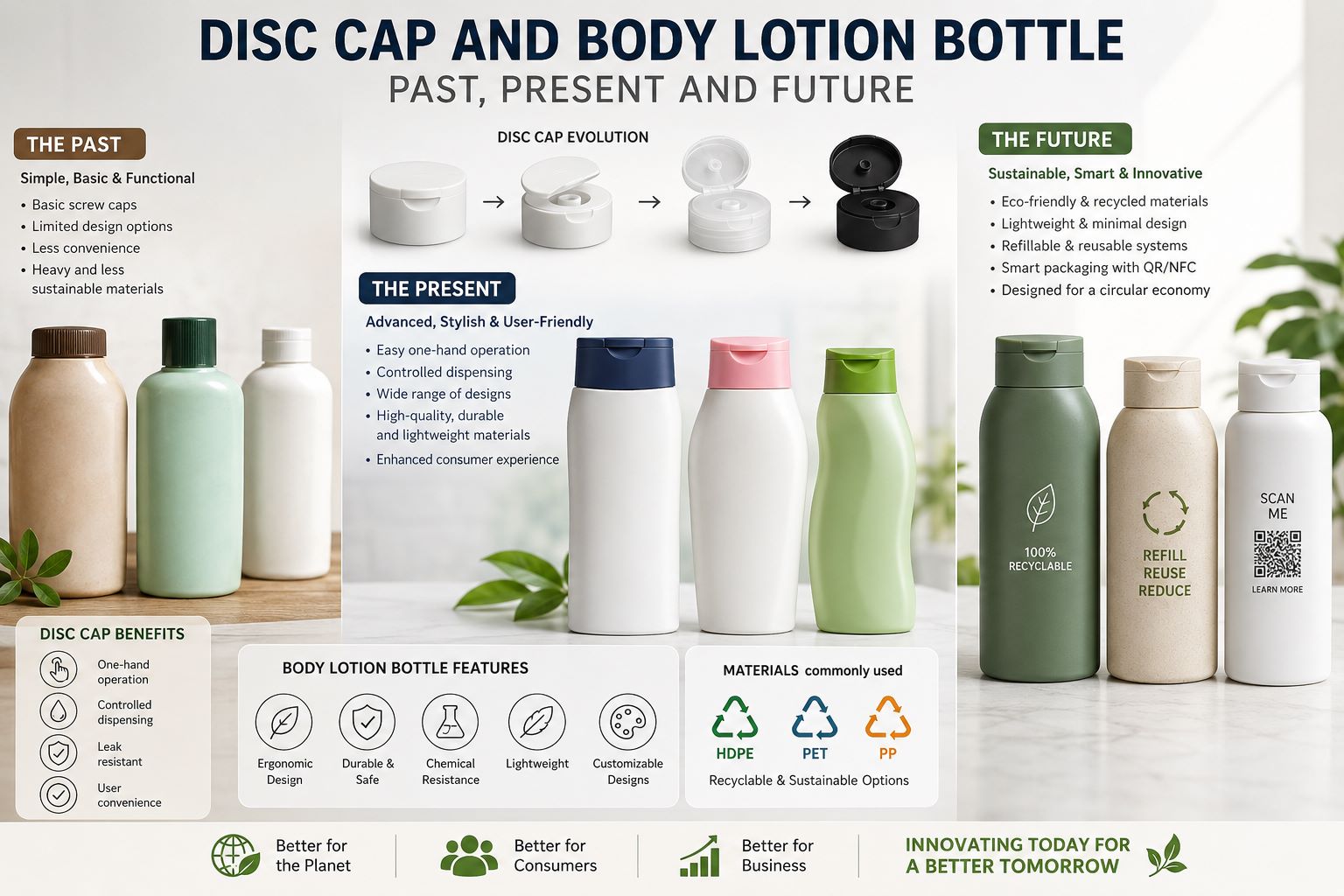
Packaging plays a much bigger role in personal care products than simply holding the formula. For lotions, moisturisers, body creams, shampoos, conditioners, and similar products, the combination of a disc cap and body lotion bottle can directly influence convenience, hygiene, product protection, branding, and customer satisfaction.
Brands therefore need to evaluate packaging as carefully as the formulation itself. A well-designed body lotion bottle with a compatible disc cap provides controlled dispensing while helping create an attractive, professional appearance on retail shelves and e-commerce platforms.
What Is a Disc Cap?
A disc cap, sometimes called a disc-top closure, is a dispensing closure commonly used for cosmetic and personal care packaging. The top contains a movable disc. Pressing one side causes the opposite side to rise, revealing the dispensing opening.
Users can then squeeze or tilt the bottle to dispense the required quantity.
Disc caps are widely used for products including:
- Body lotion
- Shampoo and conditioner
- Hand cream
- Facial cleansers
- Hair-care products
- Shower gel
- Cosmetic creams
- Personal care formulations
Their convenient one-handed operation makes them particularly suitable for products used frequently.
How Does a Disc Cap Work?
The functionality of a disc cap is relatively simple but effective. Pressure applied to one side of the top opens the dispensing outlet. Once the required lotion or cosmetic product has been dispensed, pressing the raised portion closes the opening.
This mechanism offers several practical advantages. It eliminates the need to completely remove a closure whenever the product is used and reduces the possibility of losing a separate cap.
A properly manufactured closure should open smoothly, close securely, and remain functional throughout the expected life of the package.
What Is a Body Lotion Bottle?
A body lotion bottle is packaging designed specifically for storing and dispensing moisturisers, lotions, creams, and other personal care formulations.
Manufacturers can produce lotion bottles using different plastic materials and in numerous shapes, capacities, neck sizes, colours, and finishes. Packaging selection typically depends on formula viscosity, target consumers, branding requirements, distribution conditions, and dispensing system.
Common bottle styles include cylindrical bottles, oval bottles, rectangular containers, squeezable bottles, travel-size containers, and premium cosmetic packaging.
Why Disc Caps Are Suitable for Body Lotion Bottles
Combining a disc cap with a body lotion bottle creates a practical packaging solution for many medium-viscosity personal care formulations.
Unlike conventional screw caps that need to be removed before every application, disc-top closures provide quick dispensing. Consumers simply press the closure, dispense lotion, and close it again.
This combination can provide controlled dispensing, convenient operation, cleaner application, reduced product exposure, and attractive presentation.
For manufacturers, another important advantage is versatility. The same closure concept can potentially be adapted across several personal care product ranges when neck specifications and formulation requirements are compatible.
Disc Cap vs Other Lotion Bottle Closures
| Feature | Disc Cap | Pump | Screw Cap |
| Operation | Press and dispense | Press pump | Remove manually |
| One-hand use | Excellent | Excellent | Limited |
| Packaging simplicity | High | Moderate | High |
| Controlled dispensing | Good | Excellent | Limited |
| Suitable for travel | Good when securely closed | Depends on locking system | Good |
| Common application | Lotion, shampoo, gel | Lotion, serum, soap | Creams and general liquids |
No closure is automatically best for every product. The ideal choice depends on formulation viscosity, bottle construction, usage pattern, desired dosage, cost, and consumer expectations.
Materials Used for Disc Caps and Lotion Bottles
Packaging manufacturers frequently use plastic materials because they provide lightweight construction, design flexibility, durability, and manufacturing efficiency.
Polypropylene is commonly associated with many closure applications because of its useful mechanical properties, while polyethylene and PET are frequently encountered in personal care bottles.
However, brands should never choose packaging material based only on appearance. Compatibility testing is important because fragrances, oils, active ingredients, solvents, and other formulation components may interact differently with packaging materials.
Testing the complete bottle, closure, and formula combination before commercial production helps minimise leakage, deformation, dispensing, and compatibility problems.
Important Features to Consider When Choosing Packaging
Selecting the right body lotion bottle and disc cap requires attention to both technical performance and branding.
First, check neck compatibility. The closure must accurately match the bottle’s neck specifications to achieve reliable fitting and sealing.
Second, evaluate formula viscosity. A dispensing opening appropriate for a light lotion might perform differently with a thick body cream.
Third, conduct leakage testing. Filled packages may experience vibration, temperature changes, stacking, and different orientations during transportation.
Finally, examine consumer usability. Opening force, squeezing effort, dispensing control, closure reliability, and bottle grip can influence the overall user experience.
Branding and Customisation Opportunities
Modern cosmetic packaging is also an important marketing tool. The appearance of a body lotion bottle can help consumers distinguish one brand from competing products.
Depending on manufacturing capabilities and order requirements, customisation may include bottle colours, closure colours, printing, labels, decorative finishes, embossing, surface treatments, and distinctive bottle shapes.
Brands should maintain visual consistency between the bottle, disc cap, label, logo, and overall product identity.
Premium brands might prefer minimalist packaging and sophisticated finishes, while family-oriented products may prioritise durability, easy handling, and straightforward communication.
Sustainability Considerations
Sustainability has become increasingly relevant when designing personal care packaging. Instead of relying only on environmental marketing claims, businesses should examine the complete packaging system.
Important considerations include reducing unnecessary material, optimising packaging weight, investigating recyclable structures where practical, evaluating recycled-content options, and designing components that are easier to separate or process.
Actual recyclability depends on materials, components, local collection infrastructure, and recycling systems. Therefore, environmental claims should be accurate, specific, and supported by appropriate evidence.
How to Choose a Disc Cap and Body Lotion Bottle Supplier
A dependable packaging supplier should provide more than an attractive catalogue. Technical consistency is especially important when bottles and closures are ordered at commercial scale.
Before placing a large order, businesses should evaluate samples and confirm dimensions, neck specifications, material options, colour consistency, closure operation, minimum order quantities, decoration capabilities, production timelines, and quality-control procedures.
Product testing with the actual formulation is strongly recommended before final approval.
Frequently Asked Questions About Disc Cap and Body Lotion Bottle
1. What is a disc cap used for?
A disc cap provides convenient dispensing for lotions, shampoos, conditioners, gels, cleansers, and many other personal care products.
2. Can a disc cap be used for body lotion?
Yes. It is commonly suitable for lotions when the closure opening, bottle design, and formula viscosity are compatible.
3. Is a body lotion bottle reusable?
Some bottles may technically be reusable, but suitability depends on their material, design, cleanliness, formulation, and intended application.
4. Which material is suitable for lotion bottles?
PET and different polyethylene materials are commonly considered, although the correct choice depends on formulation and packaging requirements.
5. Are disc caps leakproof?
Properly designed and fitted closures can provide effective sealing, but actual performance should be confirmed through filled-package testing.
6. Can disc caps be customised?
Manufacturers may offer custom colours, finishes, or other options depending on production capability and order quantity.
7. What bottle sizes are available?
Body lotion bottles are produced in travel, standard, and bulk capacities, with availability varying between manufacturers.
8. Are disc caps better than pumps?
Neither is universally better. Disc caps provide simplicity, while pumps can provide more controlled dosage for certain formulations.
9. Can lotion bottles carry printed branding?
Yes. Depending on the bottle material and supplier capabilities, brands can use labels, printing, sleeves, and other decoration techniques.
10. How should brands test lotion packaging?
They should assess compatibility, dispensing performance, leakage, closure fit, stability, transportation conditions, and consumer usability before mass production.