Architecture becomes memorable when functional elements also contribute to visual character. Wrought Iron Components and Decorative Iron Work offer exactly this combination. From elegant balcony railings and ornamental gates to staircases, fences, furniture, and architectural accents, ironwork can add strength, detail, and enduring appeal to residential and commercial properties.
Modern metalworking techniques allow designers, fabricators, architects, and homeowners to combine traditional iron aesthetics with precise manufacturing. Understanding the available components, finishes, applications, and quality considerations makes it easier to select ironwork that performs reliably while complementing the architecture.
What Are Wrought Iron Components?
Wrought Iron Components are individual metal elements used to construct or decorate gates, railings, fences, balconies, staircases, furniture, and architectural structures. Components may be produced through forging, bending, rolling, casting, machining, or other fabrication techniques depending on the required appearance and application.
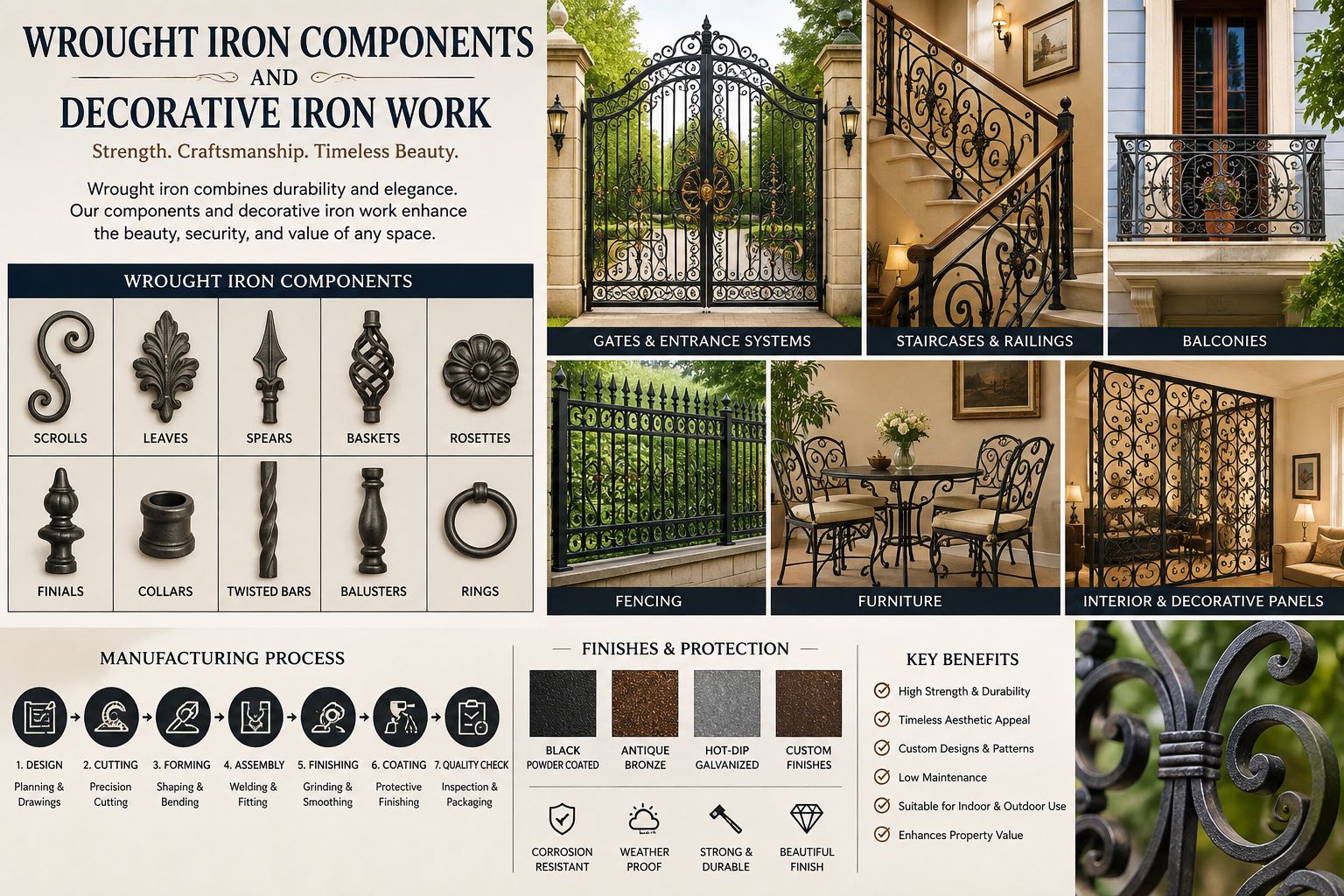
Common decorative components include scrolls, leaves, baskets, collars, spearheads, rosettes, rings, balusters, panels, decorative bars, and ornamental connectors.
Rather than fabricating every decorative shape from scratch, metalworkers can combine accurately manufactured components to create custom designs efficiently.
Well-selected components provide:
- Consistent decorative patterns
- Strong structural integration
- Greater design flexibility
- Faster fabrication
- Easier customisation
- Professional finishing
The final durability depends on material quality, fabrication method, welding quality, installation, surface preparation, and protective coating.
Understanding Decorative Iron Work
Decorative Iron Work refers to artistic or ornamental metal fabrication designed to enhance the appearance of architectural spaces while often performing a practical function.
A decorative entrance gate, for example, provides access control and security while creating an attractive first impression. Similarly, balcony railings prevent falls while their scrollwork, geometric patterns, or floral details enhance the building façade.
Decorative ironwork can follow numerous design directions, including traditional European ornamentation, minimalist geometry, Mediterranean patterns, contemporary architecture, Victorian-inspired details, or completely customised artwork.
This adaptability makes decorative metalwork appropriate for villas, apartments, hotels, restaurants, offices, heritage properties, gardens, public buildings, and luxury developments.
Popular Types of Wrought Iron Components
Different Wrought Iron Components help fabricators create distinctive designs without compromising functionality.
Decorative scrolls are among the most recognisable elements. Their curved shapes work beautifully within gates, railings, window grills, and wall panels.
Iron leaves and flowers introduce botanical details suitable for traditional and artistic projects. Baskets and twisted bars provide three-dimensional texture, while decorative collars can conceal joints or enhance vertical bars.
Spearheads and finials are frequently positioned at the top of fences and gates, creating a distinctive architectural finish. Balusters form repeating vertical patterns in staircases and balconies.
Rosettes and medallions can become central focal points within larger metal panels.
Combining these elements intelligently allows fabricators to achieve customised results without making a design visually excessive.
Wrought Iron Components vs Decorative Iron Work
| Feature | Wrought Iron Components | Decorative Iron Work |
| Meaning | Individual ornamental metal parts | Complete decorative fabrication |
| Examples | Scrolls, leaves, baskets, finials | Gates, balconies, railings |
| Purpose | Building or embellishing designs | Functional and aesthetic installation |
| Customisation | Components can be combined | Entire design can be customised |
| Users | Fabricators, manufacturers, welders | Architects, contractors, property owners |
| Application | Used within metal structures | Installed as finished architectural work |
The two concepts are closely connected. Components provide the decorative vocabulary, while finished ironwork turns those individual pieces into a complete architectural feature.
Where Decorative Iron Work Is Used
The versatility of Decorative Iron Work makes it suitable for both interior and exterior applications.
Entrance gates remain one of the most popular applications. Custom patterns can transform an ordinary property boundary into an architectural statement.
Stair railings are another important application. Decorative balusters and handrail details can turn a functional staircase into an interior focal point.
Balconies frequently use repeating scrolls, geometric patterns, floral elements, or vertical bars. Garden architecture can incorporate decorative benches, arches, trellises, pergolas, fencing, and plant supports.
Commercial buildings may use ornamental metal panels, partitions, signage frames, reception features, window protection, or exterior façades.
The important principle is balancing appearance with engineering requirements. Decorative details should never interfere with structural integrity, accessibility, safety, or applicable building regulations.
How to Choose Quality Wrought Iron Components
Selecting components based only on appearance can create problems during fabrication or long-term use. Buyers should consider several practical factors.
First, check dimensional consistency. Components used repeatedly across a railing or fence should have uniform shapes and sizes.
Second, evaluate material thickness and construction. Decorative pieces must be suitable for the intended welding, fixing, and installation process.
Third, examine surface condition. Clean components reduce preparation work and help achieve better coating results.
Fourth, consider the environment. Outdoor installations require effective corrosion protection, particularly in humid, coastal, industrial, or high-rainfall locations.
Finally, choose components that complement the overall architecture. Highly ornate Victorian-style scrollwork may look appropriate on a heritage property but uncomfortable on a minimalist contemporary building.
Finishing and Corrosion Protection
The appearance of Decorative Iron Work depends heavily on surface preparation and finishing.
Powder coating is widely used because it offers a clean decorative surface and multiple colour possibilities. Paint systems can also provide attractive finishes when properly prepared and maintained.
Depending on the fabrication and environment, galvanising may provide additional corrosion protection before a decorative topcoat is applied.
Regular inspection remains important regardless of the coating system. Scratches, damaged coatings, moisture-trapping joints, and early rust spots should be repaired before corrosion spreads.
For exterior ironwork, thoughtful drainage and installation details are equally important because standing water can accelerate deterioration.
Custom Decorative Iron Work for Architectural Projects
Customisation is one of ironwork’s greatest strengths. Fabricators can modify component combinations, dimensions, spacing, patterns, finishes, and ornamental themes to suit individual projects.
A successful custom project generally begins with:
- Identifying the architectural style.
- Measuring the installation area accurately.
- Selecting suitable structural sections.
- Choosing complementary decorative components.
- Preparing drawings or design layouts.
- Fabricating and checking the assembly.
- Applying corrosion-resistant finishing.
- Installing the finished work securely.
Collaboration between the designer, fabricator, engineer, and installer is particularly important for large gates, balconies, stairs, and other safety-critical installations.
Benefits of Decorative Iron Work
Quality Decorative Iron Work offers more than attractive ornamentation. It can provide long-term functional and architectural value.
Its key advantages include excellent design flexibility, compatibility with many architectural styles, the ability to combine security with aesthetics, suitability for customised fabrication, and the potential for restoration or refinishing.
Unlike mass-produced decorative alternatives, metalwork can be designed specifically around a property’s proportions and visual identity.
Frequently Asked Questions
1. What are wrought iron components used for?
They are used for manufacturing decorative gates, railings, fences, balconies, staircases, grills, furniture, garden structures, and architectural features.
2. What are the most common decorative iron components?
Popular options include scrolls, leaves, flowers, baskets, collars, rings, rosettes, finials, spearheads, balusters, and ornamental bars.
3. Can decorative iron work be customised?
Yes. Dimensions, patterns, decorative elements, spacing, finishes, and complete compositions can be customised according to architectural requirements.
4. Is decorative ironwork suitable for outdoor use?
Yes, provided appropriate material preparation, corrosion protection, coating, installation, and maintenance methods are used.
5. How can ironwork be protected from rust?
Proper surface preparation followed by suitable protective systems such as galvanising, primers, paint, or powder coating can significantly improve corrosion resistance.
6. Can wrought iron components be welded?
Many decorative metal components are designed for welding into gates, fences, railings, and other fabricated structures. The correct welding process depends on the actual material and construction.
7. Where can decorative ironwork be installed?
It can be used in homes, villas, hotels, offices, restaurants, gardens, apartments, public buildings, commercial developments, and heritage properties.
8. Are decorative gates only suitable for traditional buildings?
No. Contemporary ironwork can use simple lines, symmetrical geometry, abstract forms, and minimalist patterns suitable for modern architecture.
9. How should decorative ironwork be maintained?
Inspect the surface periodically, clean accumulated dirt, repair damaged coatings promptly, and address early signs of corrosion before they spread.
10. Why are quality components important?
Consistent, correctly manufactured components help fabricators achieve better alignment, cleaner fabrication, attractive repetition, and professional finished installations.