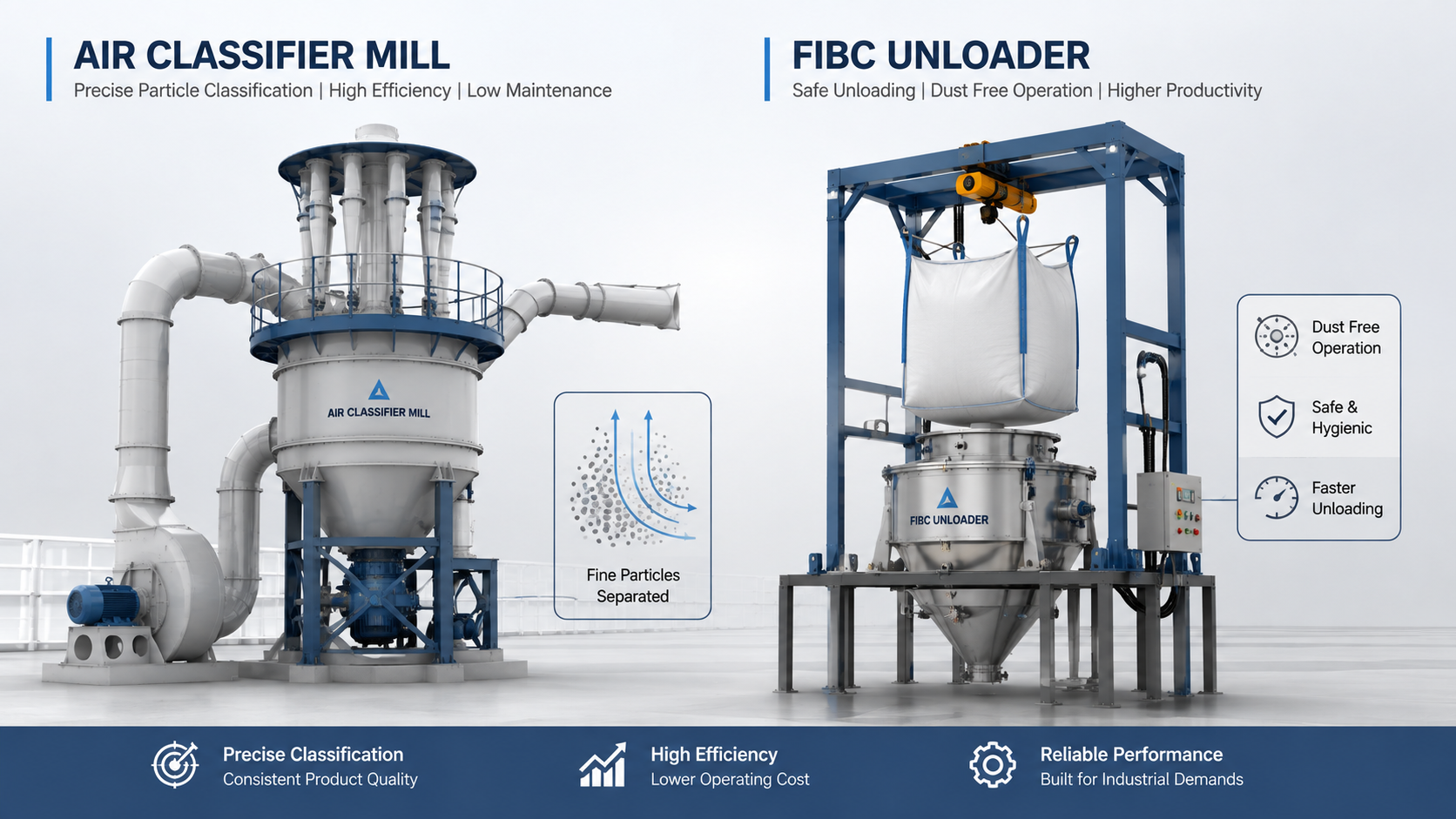
Powder processing is rarely just about making particles smaller. In a modern production facility, manufacturers must consider particle uniformity, material flow, dust containment, productivity, operator safety, and reliable transfer between different processing stages. This is where an air classifier mill and FIBC unloader can play important roles.
An air classifier mill is designed to grind materials while simultaneously controlling the size of the finished particles. An FIBC unloader, meanwhile, provides a controlled way to discharge powders, granules, and other dry materials from flexible bulk bags.
Used independently or as part of an integrated production line, these systems can help manufacturers create a more organised and efficient powder-handling process.
Why Modern Powder Processing Requires Better Control
Traditional powder handling can involve several disconnected operations. Material may need to be manually emptied, transported, milled, screened, collected, and transferred again.
Every additional handling stage can introduce challenges such as:
- Dust escaping into the working environment
- Material losses during transfer
- Inconsistent feeding
- Cross-contamination
- Excessive operator involvement
- Production delays
- Irregular particle sizes
Modern powder-processing plants therefore increasingly focus on controlled material movement. The objective is to maintain consistent processing conditions from raw-material unloading through to finished-product collection.
Air Classifier Mill for Controlled Particle Reduction
An air classifier mill combines size reduction and classification inside one processing system.
Raw material enters the grinding chamber, where rotating components create the mechanical forces necessary to break particles down. Instead of allowing every particle to leave the mill immediately, an integrated air-classification mechanism determines which particles have reached the required size.
Fine particles are carried through the classifier towards the collection system. Larger particles remain within the milling process until they are sufficiently reduced.
This creates a continuous grinding and classification cycle.
What Makes Air Classification Different?
Conventional milling may require a separate screening stage to remove oversized particles. Air classification introduces particle separation directly into the grinding process.
The classifier uses controlled airflow and rotational forces to separate particles according to their aerodynamic behaviour.
Operators can adjust processing parameters to achieve different product characteristics.
Important variables include:
- Grinding rotor speed
- Classifier wheel speed
- Material feed rate
- Air volume
- Desired throughput
- Raw-material characteristics
The correct combination depends on the product and required particle-size distribution.
Where Air Classifier Mills Add Value
Particle size can influence how a powder performs during subsequent manufacturing processes.
For example, excessively large particles may affect blending, coating, dissolution, chemical reactions, or finished-product appearance. Extremely fine particles may create handling or dust-control challenges.
An air classifier mill therefore provides value where manufacturers require controlled and repeatable powder specifications.
Common application areas include:
- Chemicals and speciality chemicals
- Pharmaceutical ingredients
- Food and nutritional powders
- Minerals and industrial fillers
- Pigments and colouring materials
- Agricultural products
- Powder coatings
- Plastics and polymers
- Functional additives
Equipment configuration should always be matched to the specific material rather than assuming one mill design will suit every powder.
Understanding the Role of an FIBC Unloader
Before material reaches the mill, it first needs to enter the processing line.
Many industrial powders are supplied in Flexible Intermediate Bulk Containers, commonly known as FIBCs, big bags, or bulk bags. Emptying these containers manually can be difficult, particularly when handling large quantities of fine or dusty material.
An FIBC unloader provides a dedicated station for supporting the bulk bag and discharging its contents into a hopper, feeder, conveyor, or processing machine.
This makes the unloading stage more controlled and reduces unnecessary manual handling.
How an FIBC Unloader Improves Material Flow
The bulk bag is normally positioned above a receiving hopper using a suitable lifting arrangement. Once secured, its discharge spout can be connected to the unloading interface.
Material then moves from the FIBC into the receiving system.
Free-flowing materials may discharge easily through gravity. However, some powders compact during transportation or storage.
For difficult materials, an FIBC unloader may incorporate:
- Bag massage mechanisms
- Vibrators
- Flow-assistance devices
- Agitation systems
- Dust extraction
- Enclosed discharge connections
- Metering feeders
- Load cells
These options allow the unloading station to be configured around the behaviour of the material.
Connecting Bulk Bag Unloading with Milling
The greatest process benefit can be achieved when material-handling and size-reduction equipment are considered as parts of one production system.
For example, raw powder arrives in an FIBC. The FIBC unloader transfers it into an intermediate hopper. A controlled feeder then delivers a measured quantity to the air classifier mill.
After grinding, classified powder moves into a collection system before proceeding to blending, storage, filling, or packaging.
A typical process sequence can be:
Bulk Bag → FIBC Unloader → Hopper → Metering Feeder → Air Classifier Mill → Collector → Finished Powder
This approach helps maintain more consistent material movement between processing stages.
Air Classifier Mill and FIBC Unloader Comparison
| Consideration | Air Classifier Mill | FIBC Unloader |
| Core operation | Grinding and classification | Bulk-material discharge |
| Processing stage | Size reduction | Raw-material handling |
| Main objective | Control particle fineness | Control material transfer |
| Typical material | Dry powders and particles | Powders, pellets and granules |
| Automation | Can be automated | Can be automated |
| Dust containment | System-dependent | System-dependent |
| Downstream integration | Collectors and packaging | Feeders and processing machines |
The systems perform different jobs but can operate together effectively.
Choosing Equipment According to the Material
Successful powder-processing equipment selection begins with understanding the material.
Flow Behaviour
Free-flowing granules behave very differently from cohesive powders. Materials that bridge, compact, or form lumps may require additional discharge assistance.
Target Particle Size
The required finished fineness influences classifier configuration, rotor operation, airflow, and overall mill design.
Production Volume
Manufacturers should consider both normal operating capacity and future production requirements.
Material Safety
Combustible, hazardous, or sensitive powders may require specialised containment, grounding, filtration, explosion protection, or other engineering controls.
Cleaning Requirements
Food, pharmaceutical, and speciality-product applications may demand frequent cleaning and product changeovers. Accessible equipment design can simplify inspection and sanitation procedures.
Improving Efficiency Across the Production Line
Equipment efficiency should not be measured by individual machine speed alone.
A high-capacity mill provides limited benefit if material cannot be supplied consistently. Similarly, an efficient unloading station cannot maximise productivity if downstream equipment frequently stops.
Manufacturers should therefore evaluate the complete process.
Consider:
- How quickly are FIBCs changed?
- Is material feeding consistent?
- Does powder bridge inside the hopper?
- Is excessive dust generated?
- Is particle size consistent?
- How much manual intervention is required?
- How easily can equipment be cleaned?
Answering these questions helps identify opportunities for process improvement.
Frequently Asked Questions
1. What does an air classifier mill do?
It combines mechanical grinding with air classification to produce powder within a controlled particle-size range.
2. Why is a classifier integrated into the mill?
The classifier prevents oversized particles from leaving until they have undergone sufficient grinding.
3. Can the finished particle size be changed?
Yes. Operational parameters such as classifier speed, rotor speed, airflow, and feed rate can be adjusted according to processing requirements.
4. What is an FIBC unloader?
It is equipment designed to discharge dry bulk materials from Flexible Intermediate Bulk Containers into a processing system.
5. Are FIBC unloaders only suitable for powders?
No. Depending on their design, they can handle powders, pellets, granules, flakes, and various other dry bulk materials.
6. How are compacted powders removed from an FIBC?
Bag massage, vibration, agitation, or other flow-assistance technologies can encourage difficult material to discharge.
7. Can an FIBC unloader feed a mill directly?
Potentially, although a controlled feeder or intermediate hopper is often incorporated to regulate material delivery.
8. Can dust be controlled during unloading?
Yes. Enclosed connections and properly designed dust-extraction systems can help minimise airborne material.
9. Which industries use air classifier milling?
Applications can be found across chemicals, pharmaceuticals, minerals, food ingredients, pigments, coatings, plastics, and other powder-processing industries.
10. What should buyers check before selecting equipment?
They should evaluate material properties, capacity, target particle size, flow behaviour, cleaning requirements, safety considerations, automation needs, and available installation space.