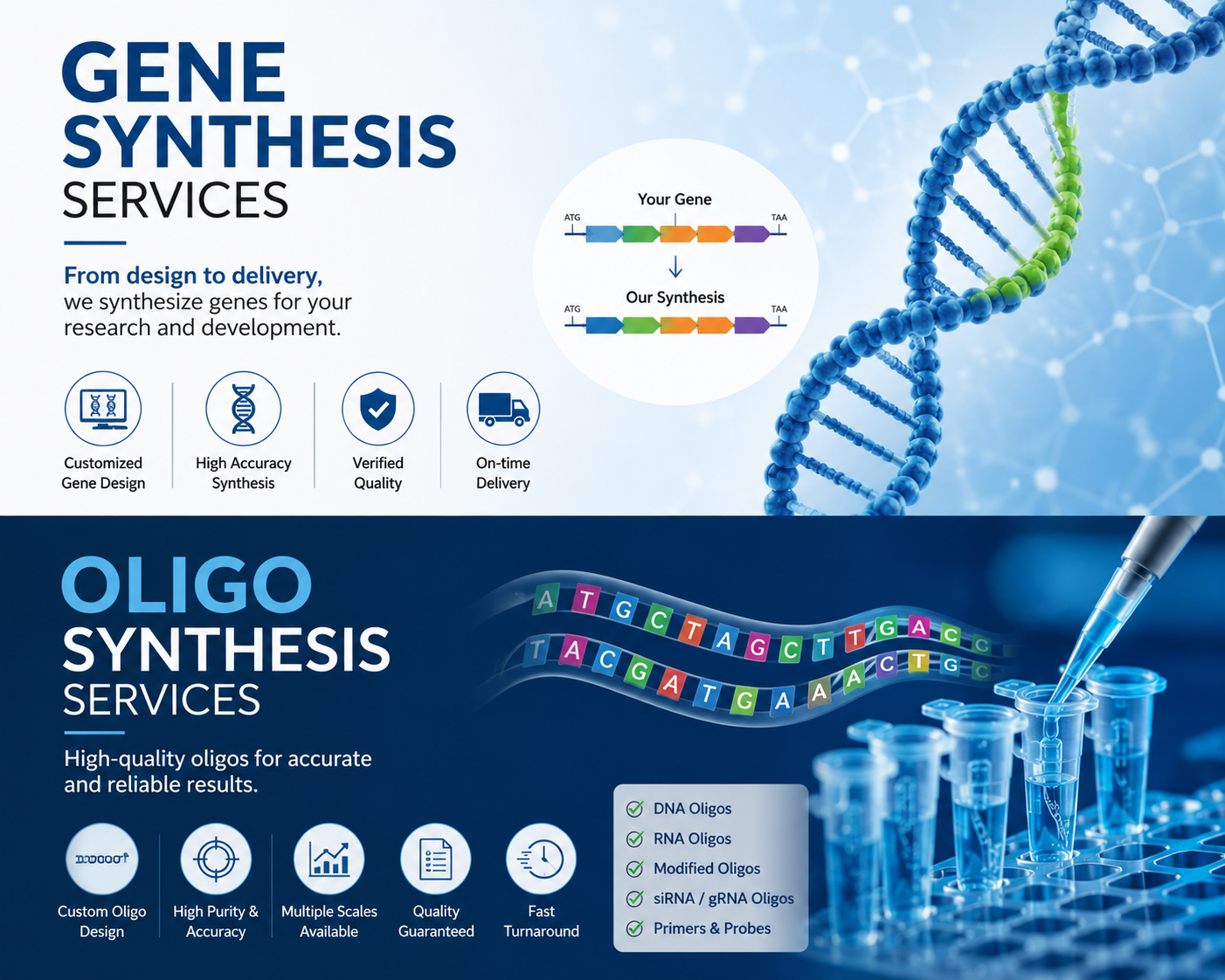
Modern life science research increasingly depends on accurately designed and manufactured DNA. From routine PCR experiments to synthetic biology and recombinant protein production, researchers need dependable nucleic acid materials that match precise experimental specifications. Oligo synthesis services and gene synthesis services provide two complementary approaches for producing customized DNA for research, diagnostics, biotechnology, and pharmaceutical development.
While oligonucleotide synthesis is commonly used for shorter DNA or RNA sequences, gene synthesis enables researchers to obtain longer, fully assembled genetic constructs. Understanding their differences, applications, quality considerations, and selection criteria can help laboratories design more efficient molecular biology workflows.
Understanding Oligo Synthesis Services
Oligo synthesis services manufacture short, custom-designed nucleotide sequences according to specifications provided by researchers. These synthetic oligonucleotides may consist of DNA, RNA, or chemically modified nucleic acids.
Scientists commonly order oligos for PCR primers, sequencing primers, probes, cloning experiments, mutagenesis, gene assembly, and molecular diagnostics.
The process generally includes sequence submission, chemical synthesis, purification, quality assessment, and delivery. Depending on the application, researchers can select different synthesis scales, purification methods, modifications, and labeling options.
Common Applications of Synthetic Oligonucleotides
Oligonucleotides support numerous laboratory applications, including:
- PCR and quantitative PCR
- DNA sequencing
- Molecular diagnostics
- Hybridization assays
- Site-directed mutagenesis
- CRISPR research
- Gene assembly
- DNA library construction
- RNA interference studies
- Synthetic biology research
Because experimental requirements differ considerably, professional synthesis providers usually offer customizable oligo lengths, concentrations, purification levels, and modifications.
Why Oligo Purity Matters
Purity can directly affect experimental reliability. Standard oligos may be suitable for routine PCR applications, while demanding experiments may require higher-purity products.
Common purification approaches include desalting, cartridge purification, high-performance liquid chromatography, and polyacrylamide gel electrophoresis.
Researchers should select purification according to oligo length, modification type, and downstream application rather than automatically choosing the highest available grade.
What Are Gene Synthesis Services?
Gene synthesis services create complete DNA sequences from digital sequence information without requiring an existing DNA template.
Instead of isolating a gene from biological material, researchers can design a sequence computationally and have it chemically constructed. This approach provides significant flexibility when natural templates are unavailable, difficult to obtain, or unsuitable for a particular expression system.
Synthetic genes may include optimized coding regions, regulatory sequences, restriction sites, tags, promoters, linkers, or other customized genetic elements.
How Gene Synthesis Supports Modern Research
Gene synthesis has become valuable across biotechnology because researchers are no longer limited to naturally occurring DNA sequences.
Typical applications include:
- Recombinant protein expression
- Vaccine research
- Antibody development
- Synthetic biology
- Metabolic engineering
- Gene-function studies
- Enzyme engineering
- Diagnostic assay development
- Genetic construct development
- Academic molecular biology research
Gene Optimization for Better Experimental Performance
A major advantage of gene synthesis services is the ability to redesign sequences before manufacturing.
Codon optimization, for example, can adapt a coding sequence for expression in a chosen host organism. Researchers may also modify problematic sequence characteristics while maintaining the intended protein sequence.
Sequence Design Considerations
Design optimization may evaluate factors such as:
- Codon usage
- GC content
- Repetitive DNA regions
- Restriction enzyme sites
- RNA secondary structures
- Sequence complexity
- Regulatory elements
- Cloning compatibility
Thoughtful sequence design can simplify downstream cloning and expression workflows.
Oligo Synthesis vs Gene Synthesis
Although these technologies are related, their purposes are different.
| Feature | Oligo Synthesis Services | Gene Synthesis Services |
| Typical product | Short nucleotide sequence | Longer assembled DNA sequence |
| Common use | Primers, probes, mutations | Complete genes and constructs |
| Template required | No | No |
| Sequence customization | High | Very high |
| Codon optimization | Usually unnecessary | Commonly available |
| Cloning options | Application dependent | Frequently available |
| Main research role | Supporting molecular assays | Creating complete genetic material |
Many research projects actually use both technologies. Synthetic oligonucleotides may help verify, amplify, modify, or sequence synthetic genes.
How to Choose a Reliable Synthesis Provider
Selecting the right provider involves more than comparing price.
Researchers should evaluate technical capability, quality documentation, customization options, communication, and manufacturing consistency.
Important considerations include:
- Supported sequence lengths
- Available synthesis scales
- Purification options
- Quality-control methods
- Turnaround capabilities
- DNA modification options
- Cloning support
- Sequence optimization assistance
- Documentation and traceability
- Technical customer support
A provider should also communicate clearly when a sequence presents manufacturing difficulties rather than simply accepting every design without review.
Quality Control in DNA Synthesis
Reliable quality control is essential because incorrect or contaminated nucleic acid material can affect downstream experiments.
For oligonucleotides, quality evaluation may involve analytical techniques that assess identity, purity, and concentration.
For synthetic genes, sequence verification is particularly important because researchers need confidence that the delivered construct corresponds to the approved design.
Good documentation also improves experimental traceability and reproducibility.
Benefits of Outsourcing DNA Synthesis
Producing customized DNA internally can require specialized equipment, chemistry, technical expertise, and quality-control infrastructure.
Professional oligo synthesis services and gene synthesis services allow research teams to focus more resources on experimental design and biological interpretation.
Key benefits include:
- Access to specialized manufacturing technology
- Consistent production workflows
- Multiple purification options
- Flexible sequence customization
- Reduced internal manufacturing requirements
- Scalable ordering for research projects
- Convenient access to modified nucleic acids
For many laboratories, outsourcing also simplifies procurement and experimental planning.
Applications Across Biotechnology and Life Sciences
Synthetic DNA technology supports research across numerous disciplines.
Academic laboratories use synthetic oligos for PCR, sequencing, and cloning. Biotechnology companies may use synthetic genes during protein engineering or assay development. Pharmaceutical researchers can incorporate synthesized genetic materials into early-stage discovery workflows.
Synthetic biology particularly benefits from the ability to move from digital sequence design to physical DNA.
As computational biology and automated laboratory technologies advance, the connection between sequence design and DNA manufacturing will become increasingly important.
Frequently Asked Questions
What are oligo synthesis services?
They are professional services that manufacture customized short DNA or RNA sequences for molecular biology, diagnostics, sequencing, PCR, and other research applications.
What are gene synthesis services?
Gene synthesis services manufacture longer customized DNA sequences directly from digitally designed sequence information.
What is the main difference between oligo and gene synthesis?
Oligo synthesis primarily produces shorter nucleotide sequences, while gene synthesis assembles longer DNA sequences such as complete genes or genetic constructs.
Are synthetic oligos commonly used as PCR primers?
Yes. PCR primers are among the most common applications of custom DNA oligonucleotides.
Can synthetic genes be codon optimized?
Yes. Many gene synthesis projects include codon optimization for the intended expression host.
Does gene synthesis require a DNA template?
No. The desired nucleotide sequence can be designed digitally and synthesized without obtaining the original biological template.
Why is oligo purification important?
Purification removes synthesis-related impurities and truncated sequences that may interfere with sensitive downstream experiments.
Can modifications be added to oligonucleotides?
Yes. Depending on manufacturing capabilities, oligos can incorporate fluorescent labels, spacers, affinity groups, modified bases, and other chemical modifications.
What should researchers check before ordering synthetic DNA?
Researchers should review sequence accuracy, required purity, concentration, modifications, cloning requirements, quality-control documentation, and downstream application needs.
Are oligo synthesis and gene synthesis used together?
Frequently. Oligos can be used to amplify, sequence, verify, or modify synthetic genes during molecular biology workflows.