The manufacturing industry is seeing growing interest in aluminum prototype development and sheet metal prototyping as engineering teams look for practical ways to turn digital designs into functional components before committing to large-scale production.
Advances in CNC machining, laser cutting, digital design and precision forming have changed the role of prototypes. What was once primarily a method for creating visual samples is increasingly being used for engineering validation, assembly testing, design improvement and preparation for low-volume production.
The trend is particularly relevant across automotive, electronics, robotics, aerospace, industrial machinery and specialised equipment manufacturing, where component accuracy and shorter development cycles remain important priorities.
Metal Prototyping Moves Closer to the Centre of Product Development
Modern engineering begins largely in a digital environment. Designers can create detailed CAD models and use simulation tools to evaluate many aspects of a component before manufacturing it.
However, physical production can still expose issues that are difficult to identify digitally.
A metal prototype can help engineers evaluate:
- Actual component fit
- Mounting-point accuracy
- Mechanical clearances
- Assembly accessibility
- Material behaviour
- Surface appearance
- Structural rigidity
- Manufacturing complexity
This has made aluminum prototype manufacturing and sheet metal prototyping valuable links between digital development and production.
Aluminum Prototype Manufacturing Supports Functional Testing
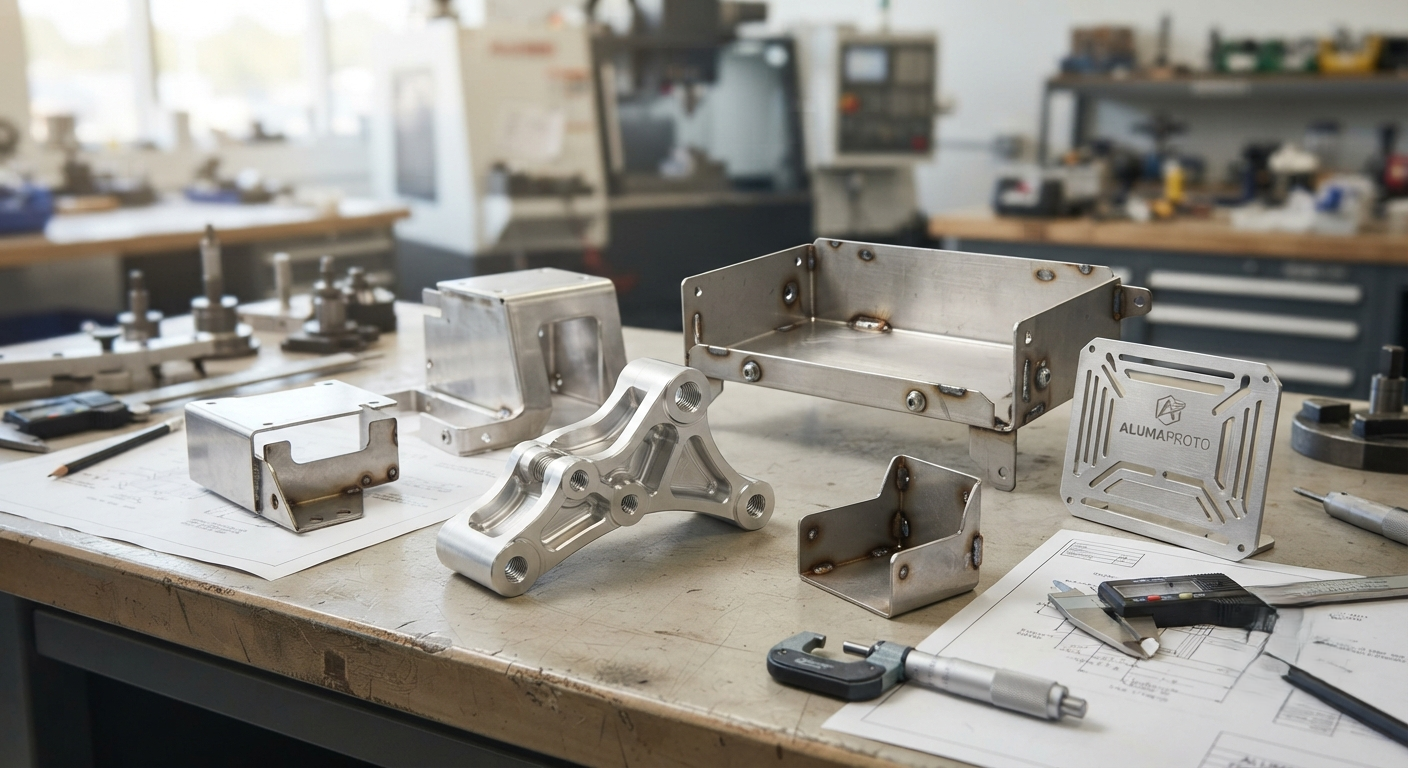
An aluminum prototype is generally manufactured when engineers need a physical metal component with accurate dimensions, detailed features or realistic mechanical properties.
CNC machining remains one of the widely used manufacturing methods for this purpose. Aluminium stock is progressively machined according to digital design data to create the required component.
The process can produce features including:
- Precision holes
- Internal pockets
- Threads
- Mounting surfaces
- Channels
- Slots
- Complex contours
These capabilities make CNC-machined aluminium particularly relevant for mechanical housings, fixtures, robotic components and other precision applications.
Aluminium Remains an Important Engineering Material
Aluminium continues to be selected for prototype applications because it offers a practical combination of relatively low weight, useful mechanical strength and good machinability.
Other characteristics include:
- Corrosion resistance
- Thermal conductivity
- Electrical conductivity
- Broad alloy availability
- Multiple surface-finishing possibilities
Aluminium 6061 is commonly considered for general engineering applications, while 7075 may be selected where higher mechanical strength is required.
Material choice for an aluminum prototype should nevertheless be based on actual operating conditions, component function and future production requirements.
Sheet Metal Prototyping Expands Opportunities for Fabricated Components
While CNC machining starts with solid material, sheet metal prototyping uses flat sheet stock that is cut and formed into three-dimensional components.
A typical fabrication process can include laser cutting, punching, bending, welding, mechanical fastening and finishing.
This manufacturing approach is particularly suited to products containing relatively large, thin surfaces.
Common applications include:
- Electronic enclosures
- Control cabinets
- Machine guards
- Battery housings
- Automotive brackets
- Server chassis
- Equipment covers
- Mounting panels
- Telecommunications housings
Aluminium, stainless steel, mild steel and other metals can be used according to the application.
Aluminum Prototype and Sheet Metal Prototyping Serve Different Needs
Although the two methods frequently appear within the same product-development programme, they address different manufacturing requirements.
| Manufacturing Factor | Aluminum Prototype | Sheet Metal Prototyping |
| Starting material | Solid aluminium stock | Flat metal sheet |
| Main process | CNC machining | Cutting and bending |
| Complex 3D geometry | Highly suitable | More restricted |
| Precision cavities | Excellent | Limited |
| Large thin components | Less efficient | Highly suitable |
| Enclosures | Possible | Excellent |
| Typical applications | Housings, mounts, mechanical parts | Cabinets, brackets, panels |
| Prototype production | Suitable | Suitable |
| Small-batch manufacturing | Suitable | Suitable |
Manufacturing specialists generally evaluate geometry, tolerance, material thickness, component function and expected production volume when selecting the appropriate process.
Design for Manufacturing Receives Greater Attention
The increased use of functional prototypes is also putting greater emphasis on Design for Manufacturing, commonly known as DFM.
Instead of evaluating only whether a component can be produced, DFM considers how efficiently and consistently it can be manufactured.
For an aluminum prototype, designers may need to reconsider deep cavities, extremely thin walls, inaccessible features or unnecessarily tight tolerances.
For sheet metal prototyping, important considerations include bend radii, flange dimensions, material thickness and the distance between holes and bend lines.
Early design evaluation can prevent apparently minor CAD features from creating unnecessary manufacturing complications.
Prototype Testing Reveals Issues Before Production
One of the strongest reasons behind the use of physical metal prototypes is the opportunity to discover design problems while modifications remain relatively straightforward.
Consider a newly designed electronic enclosure. Its CAD model may show sufficient internal space, but a physical sheet-metal version could reveal that a connector becomes difficult to access once the internal hardware is installed.
Similarly, an aluminum prototype of a motor housing could identify alignment or fastening problems during assembly.
Prototype testing can therefore examine:
- Component alignment
- Assembly sequence
- Fastener accessibility
- Structural behaviour
- Moving-part clearance
- Heat management
- Maintenance access
- Overall dimensions
The information collected can then be incorporated into subsequent design revisions.
Manufacturers Combine Multiple Prototyping Processes
Another notable development is the growing integration of different manufacturing methods within the same product.
An industrial automation system, for example, may require CNC-machined aluminium components for precision mounting and fabricated sheet metal for external protection.
A robotic system could similarly use an aluminum prototype for structural joints while relying on sheet metal prototyping for protective covers and electrical cabinets.
Selecting the most appropriate process for each component can provide greater design flexibility than attempting to manufacture an entire assembly through one method.
Surface Finishing Becomes Part of Prototype Evaluation
Metal prototypes are also increasingly being evaluated beyond dimensional and mechanical performance.
An aluminum prototype can receive finishes such as anodising, bead blasting, polishing, brushing or painting.
Sheet-metal components may receive powder coating, painting, plating or polishing.
Applying a finish similar to the intended production specification can help teams evaluate appearance and surface characteristics while also identifying potential effects on assembly and dimensional fit.
Digital Manufacturing Makes Design Iteration More Flexible
The connection between CAD systems and computer-controlled production equipment has made prototype modification considerably more flexible.
If testing identifies a design issue, engineers can revise the digital model and manufacture an updated version.
The development cycle can therefore follow a repeating pattern:
CAD Design → Prototype → Inspection → Testing → Modification → New Prototype → Final Validation
This iterative model allows engineers to treat each prototype as a source of technical information rather than expecting the first physical version to represent the final design.
Prototype Cost Depends on More Than Material Price
Manufacturing cost remains an important consideration, but component size alone does not determine prototype pricing.
An aluminum prototype may become more expensive when it requires multiple machining setups, difficult geometries, close tolerances or extensive inspection.
Important CNC cost factors include:
- Machining time
- Aluminium grade
- Component complexity
- Number of setups
- Tolerances
- Surface finish
For sheet metal prototyping, costs may be affected by cutting complexity, material thickness, number of bends, welding requirements, installed hardware and finishing.
Design simplification can therefore play an important role in controlling prototype costs.
Prototyping Creates a Bridge to Low-Volume Production
Flexible metal manufacturing methods are also providing companies with alternatives between a single prototype and full-scale production.
Once an aluminum prototype has been tested successfully, CNC machining may continue to support small production quantities when appropriate.
Likewise, the laser cutting and press-brake processes used for sheet metal prototyping can often be applied to low-volume production.
This can be useful for specialised equipment, new product launches, custom machinery and applications where demand does not initially justify dedicated mass-production tooling.
Frequently Asked Questions
1. What is an aluminum prototype?
An aluminum prototype is a physical aluminium component manufactured for design evaluation, functional testing or production preparation.
2. How are aluminum prototypes commonly manufactured?
CNC milling and turning are commonly used, depending on the geometry and specifications of the component.
3. What is sheet metal prototyping?
Sheet metal prototyping involves manufacturing prototype components by cutting, bending, joining and finishing flat metal sheets.
4. Which products commonly use sheet metal prototypes?
Enclosures, cabinets, chassis, brackets, panels, machine guards and equipment covers are common examples.
5. Why is aluminium popular for prototyping?
Aluminium offers good machinability, relatively low weight, useful strength, corrosion resistance and several finishing options.
6. Which method is suitable for complicated 3D geometry?
CNC-machined aluminium is generally more appropriate for detailed three-dimensional features and precision internal geometry.
7. Is sheet metal prototyping suitable for enclosures?
Yes. It is particularly well suited to thin-walled enclosures, cabinets, chassis and covers.
8. What role does DFM play in prototyping?
DFM helps identify features that may make a component unnecessarily difficult, costly or inconsistent to manufacture.
9. Can aluminum prototypes be anodised?
Yes. Anodising is one of several finishing options available for suitable aluminium components.
10. Can prototypes be used for functional testing?
Yes. Physical metal prototypes can be used for assembly, dimensional, mechanical and application-specific testing.
https://newsgrow.blogspot.com/2026/08/rapid-injection-molding-and-china-rapid.html
https://newsgrow.blogspot.com/2026/08/aluminum-prototype-and-sheet-metal.html