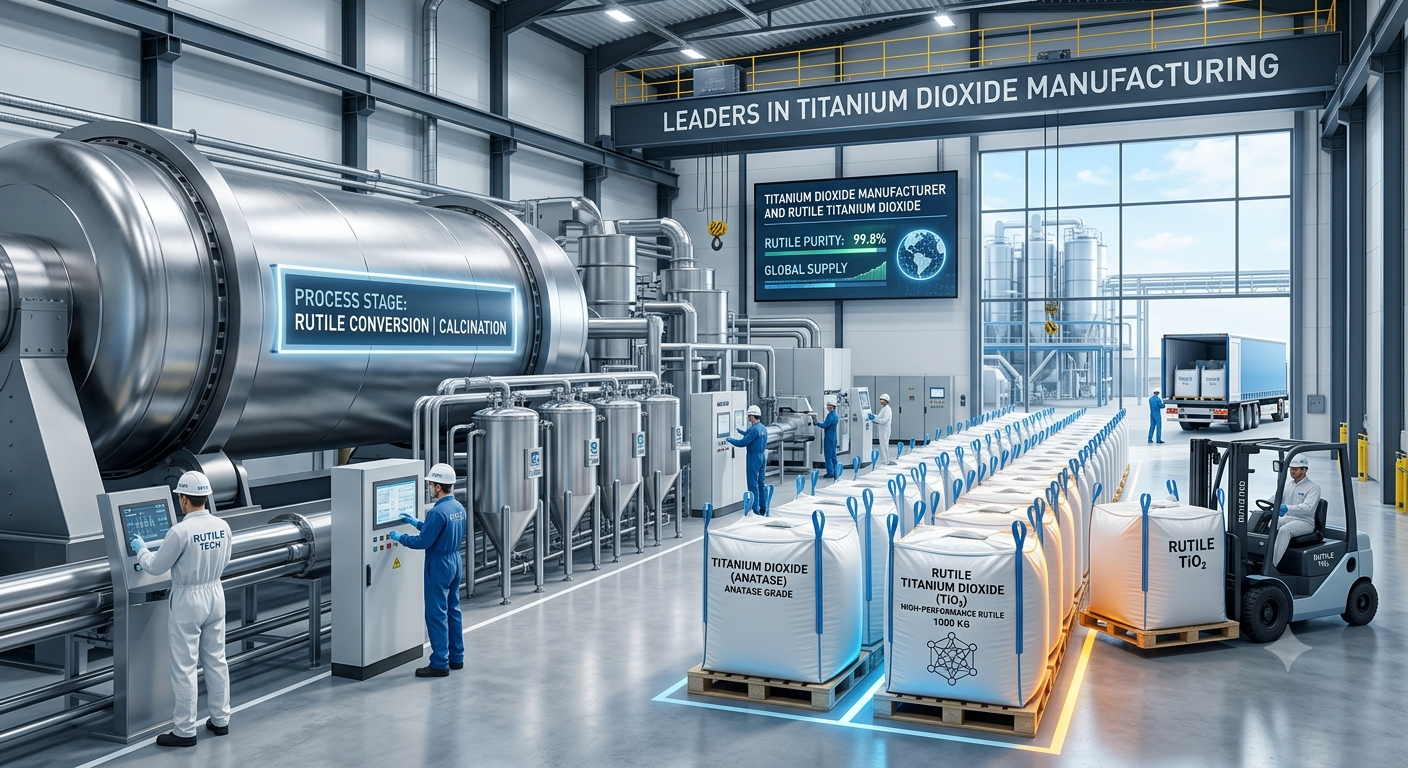
Titanium dioxide is one of the most widely used white pigments in modern manufacturing. Its high opacity, brightness, tinting strength and ability to improve the visual performance of finished products make it an important raw material across coatings, plastics, paints, inks, paper and several specialised applications.
For manufacturers and procurement teams, choosing the right Titanium Dioxide Manufacturer is about more than comparing price per kilogram. Product grade, pigment performance, consistency between batches, surface treatment, technical support, packaging, supply reliability and compliance can all affect the final product.
Among the available grades, Rutile Titanium Dioxide is particularly important for applications where high opacity, whiteness, durability and weather resistance are required.
This guide explains what to look for in a titanium dioxide supplier, how rutile titanium dioxide differs from other grades, where it is used, and which technical factors should be evaluated before placing a commercial order.
What Is Titanium Dioxide?
Titanium dioxide (TiO₂) is a white inorganic compound used primarily as a pigment. It is valued for its ability to scatter visible light efficiently, producing strong whiteness, brightness and opacity.
In industrial applications, titanium dioxide is commonly supplied in two crystalline forms:
- Rutile
- Anatase
Rutile generally has a higher refractive index than anatase, which makes it particularly effective when strong light scattering and opacity are important.
The performance of titanium dioxide, however, depends on more than crystal structure. Particle size, particle-size distribution, surface treatment, dispersion characteristics and manufacturing quality can all influence how the pigment behaves in a formulation.
What Does a Titanium Dioxide Manufacturer Do?
A Titanium Dioxide Manufacturer produces and processes TiO₂ pigment to meet specific physical, chemical and performance requirements.
A reliable manufacturer typically focuses on:
- Consistent pigment quality
- Controlled particle characteristics
- High whiteness and brightness
- Opacity and tinting strength
- Dispersion performance
- Surface treatment where required
- Batch-to-batch consistency
- Appropriate packaging and storage
- Technical documentation
- Regulatory and quality compliance
- Reliable production and supply
For industrial buyers, this manufacturing capability matters because inconsistent pigment can affect the appearance, processing behaviour and performance of the finished product.
Manufacturer vs Distributor: What Is the Difference?
A manufacturer controls production and quality processes, while a distributor generally purchases material from manufacturers and supplies it to customers.
Buying directly from a manufacturer may offer advantages such as:
- Better technical communication
- More consistent grade selection
- Direct access to product documentation
- Greater visibility into specifications
- Potentially better support for large-volume requirements
- More direct communication regarding customised requirements
However, the right choice depends on your application, order volume, location and supply requirements.
What Is Rutile Titanium Dioxide?
Rutile Titanium Dioxide is titanium dioxide in the rutile crystalline form.
It is widely selected for demanding pigment applications because rutile provides strong light-scattering performance and can deliver excellent opacity and whiteness when appropriately formulated.
Rutile grades are commonly considered for products exposed to outdoor conditions or where high hiding power and durability are important.
Typical applications include:
- Architectural and industrial paints
- Powder coatings
- Plastic masterbatches
- PVC products
- Printing inks
- Rubber products
- Synthetic fibres
- Selected paper applications
- Construction-related products
The exact suitability of a rutile grade depends on its specification and surface treatment, so buyers should not select a product based only on the word “rutile” on the technical datasheet.
Rutile vs Anatase Titanium Dioxide
The choice between rutile and anatase depends on the intended application.
| Feature | Rutile Titanium Dioxide | Anatase Titanium Dioxide |
| Crystal structure | Rutile | Anatase |
| Light scattering | Generally higher | Generally lower |
| Opacity | Generally excellent | Good in suitable applications |
| Outdoor durability | Often preferred | Application-dependent |
| Common uses | Coatings, plastics, inks and demanding pigment applications | Selected coatings, paper and other applications |
| Typical selection priority | Opacity, durability and performance | Cost, application requirements and specific formulation needs |
There is no universal “best” titanium dioxide grade. A pigment should be selected according to the formulation, processing method and performance requirements of the finished product.
Key Applications of Titanium Dioxide
Titanium dioxide is used in a wide range of industries because relatively small amounts can significantly influence the appearance and opacity of a formulation.
1. Paints and Coatings
Paint manufacturers use titanium dioxide to provide whiteness, opacity and brightness.
Rutile grades are particularly relevant in decorative and industrial coatings where hiding power, durability and resistance to environmental exposure are important.
In a coating formulation, the pigment must also disperse effectively. Poor dispersion can reduce the benefits expected from a high-quality TiO₂ grade.
2. Plastics
Titanium dioxide is widely used in plastics to improve whiteness, opacity and appearance.
It can be incorporated into:
- PVC
- Polyolefins
- Masterbatches
- Packaging materials
- Consumer plastic products
- Profiles and construction products
For plastics, pigment dispersion and thermal-processing behaviour are important considerations when choosing a grade.
3. Printing Inks
Titanium dioxide can be used in printing inks where opacity and white coverage are required.
The right grade needs to balance optical performance with dispersion and processing characteristics appropriate to the ink system.
4. Paper
TiO₂ can improve the optical properties of paper by contributing to brightness and opacity.
The appropriate grade depends on the paper manufacturing process, formulation and required optical performance.
5. Rubber and Other Industrial Products
Titanium dioxide may also be incorporated into rubber and other industrial formulations where a white appearance, opacity or pigment performance is required.
The product specification should always be assessed against the manufacturing process rather than selected solely on price.
How to Choose the Right Titanium Dioxide Manufacturer
Selecting a supplier should be treated as a technical and commercial decision.
1. Check the Technical Specification
Before requesting a quotation, define the characteristics your application requires.
Important parameters may include:
- TiO₂ content
- Crystal form
- Whiteness
- Tinting strength
- Oil absorption
- Particle size
- Surface treatment
- Dispersibility
- pH
- Moisture or volatile content
- Residue characteristics
- Packaging requirements
Not every parameter carries the same importance for every application.
2. Ask for a Technical Data Sheet
A technical data sheet (TDS) provides essential information about the grade.
Compare TDS documents carefully rather than relying on marketing descriptions. Two products may both be described as rutile titanium dioxide while offering different performance characteristics.
3. Review the Safety Data Sheet
The Safety Data Sheet (SDS) provides important information concerning handling, storage, hazards and safety measures.
Commercial buyers should ensure that the relevant documentation is available before approving a material for production.
4. Evaluate Batch Consistency
Consistency is particularly important for manufacturers producing products with tight colour and opacity specifications.
A pigment that performs well in one shipment but varies significantly in subsequent batches can create formulation and quality-control problems.
Ask potential suppliers about their quality-control procedures and batch testing.
5. Consider Surface Treatment
Many commercial titanium dioxide grades are surface-treated to improve their performance in particular applications.
Surface treatment can influence properties such as:
- Dispersion
- Weatherability
- Compatibility with the formulation
- Durability
- Gloss
- Processing performance
The correct treatment depends on the end-use system.
6. Consider Supply Capacity
Price is only one component of procurement cost.
A manufacturer should also be assessed for:
- Production capacity
- Minimum order quantity
- Lead times
- Export capability, where relevant
- Packaging options
- Storage requirements
- Logistics support
- Ability to support repeat orders
For continuous manufacturing, dependable supply can be just as important as the initial purchase price.
Why Product Consistency Matters
Imagine a paint manufacturer receives a titanium dioxide grade that produces the required whiteness during laboratory testing. Several months later, another batch behaves differently during dispersion and requires formulation adjustments.
The apparent saving from choosing the cheaper material can quickly disappear through:
- Additional testing
- Production delays
- Reformulation
- Increased pigment consumption
- Rejected batches
- Customer complaints
This is why experienced procurement teams evaluate total product performance and supply reliability rather than focusing exclusively on the quoted unit price.
Questions to Ask a Titanium Dioxide Supplier
Before purchasing, buyers can ask:
What crystal form is the product?
Confirm whether the grade is rutile or anatase.
What applications is the grade designed for?
A coating grade may not be the ideal choice for plastics or masterbatch production.
Is the product surface treated?
If yes, ask which treatment is used and why it is suitable for the intended application.
Can you provide a TDS and SDS?
These documents help technical teams evaluate the material properly.
What quality-control tests are performed?
Understand how consistency is monitored.
What packaging options are available?
Packaging should suit the customer’s storage and handling system.
What is the minimum order quantity?
This is especially relevant for new product trials and smaller manufacturers.
Can you provide samples for testing?
Laboratory or production trials are often the best way to establish suitability.
How Much Titanium Dioxide Should Be Used?
There is no single dosage that works for every product.
The required TiO₂ concentration depends on factors such as:
- Desired opacity
- Film thickness
- Base material
- Particle dispersion
- Formulation chemistry
- Application method
- Required colour
- Grade performance
For this reason, manufacturers should determine the optimum loading through controlled formulation trials rather than applying a generic percentage.
A higher pigment loading does not automatically produce proportionally better performance. Efficient dispersion and appropriate pigment selection can be equally important.
Common Mistakes When Buying Titanium Dioxide
Choosing Only on Price
The cheapest product may not deliver the lowest overall production cost.
Ignoring the Application
A grade designed for one formulation may perform poorly in another.
Comparing Products Without Reviewing Specifications
A price comparison is meaningful only when the grades being compared have comparable technical characteristics.
Skipping Sample Trials
Laboratory or production testing can identify compatibility and dispersion issues before a large order is placed.
Not Checking Documentation
TDS and SDS documentation should be part of the supplier evaluation process.
Sustainable and Responsible Titanium Dioxide Sourcing
Environmental and supply-chain considerations are becoming increasingly important in raw-material procurement.
When assessing a titanium dioxide manufacturer, buyers may wish to understand the supplier’s approach to:
- Resource efficiency
- Waste management
- Energy consumption
- Process control
- Packaging
- Regulatory compliance
- Responsible sourcing
- Environmental management
The exact requirements will vary by industry and destination market.
Internal Link Opportunities
To strengthen topical authority and improve user navigation, a manufacturer or supplier website could link this article naturally to relevant service and product pages using anchors such as:
- Titanium dioxide grades
- Rutile titanium dioxide products
- Titanium dioxide applications
- Industrial pigments
- Pigment technical data sheets
- Titanium dioxide supplier
- Request a product sample
- Contact our technical team
These links should point to genuinely relevant pages rather than being inserted purely for SEO.
Frequently Asked Questions About Titanium Dioxide
What is the main use of titanium dioxide?
The main use of titanium dioxide is as a white pigment that provides whiteness, brightness and opacity. It is widely used in coatings, paints, plastics, inks and other industrial products.
Is rutile titanium dioxide better than anatase?
Not necessarily for every application. Rutile generally offers strong light-scattering performance and is commonly selected for applications requiring high opacity and durability. Anatase can be appropriate for specific formulations and applications.
What should I look for in a Titanium Dioxide Manufacturer?
Look for consistent product quality, suitable technical grades, reliable documentation, manufacturing and quality-control capabilities, dependable supply and technical support.
What is the difference between rutile and anatase TiO₂?
They are different crystalline forms of titanium dioxide. Rutile generally has a higher refractive index and is widely used where high opacity and durability are important.
Can titanium dioxide be used in plastics?
Yes. Titanium dioxide is widely used in plastic products and masterbatch formulations to improve whiteness, opacity and visual appearance. The appropriate grade depends on the polymer and processing conditions.
How can I select the correct TiO₂ grade?
Start with your end application and define the required opacity, whiteness, dispersion, durability and processing characteristics. Then compare technical data sheets and conduct formulation trials before making a large-scale purchase.