A Glass Sandblasting Machine is an important piece of equipment for glass manufacturers, processors, decorators and fabrication businesses that need to create frosted finishes, decorative patterns, lettering or controlled surface textures on glass.
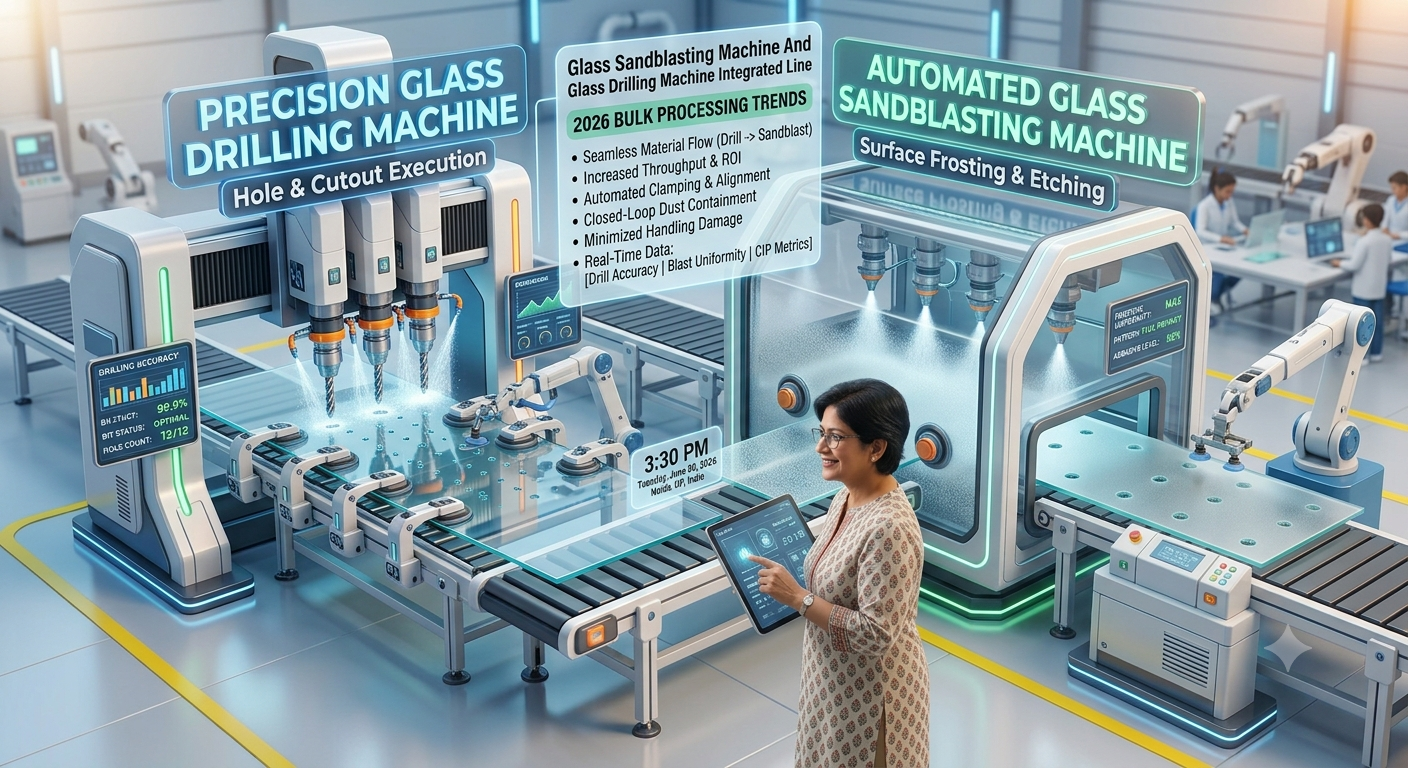
Unlike manual abrasive blasting, an automated glass sandblasting system can provide more consistent results, improve production efficiency and make repetitive designs easier to reproduce. The right machine can also be integrated into a wider glass-processing line alongside equipment such as a Glass Drilling Machine, glass cutting systems, edge polishing machines and washing units.
Whether you are upgrading an existing workshop or setting up a new glass-processing facility, selecting the machine based on your actual production requirements is more important than simply choosing the largest or most heavily featured model.
What Is a Glass Sandblasting Machine?
A Glass Sandblasting Machine is specialised equipment designed to blast abrasive media against a glass surface at controlled pressure and velocity.
The abrasive action removes or roughens the surface layer of the glass, producing a matte, frosted or textured appearance. Depending on the machine and process, it can be used to create everything from an overall translucent finish to detailed decorative designs.
Modern machines may include automatic glass loading, programmable blasting, adjustable pressure, dust collection, conveyor systems and CNC or digital control.
What does a glass sandblasting machine do?
In simple terms, it:
- Positions the glass securely.
- Controls the abrasive blasting process.
- Creates the required surface finish or pattern.
- Collects dust and spent abrasive where applicable.
- Produces a repeatable finish across multiple pieces.
The exact configuration depends on whether the application involves full-sheet frosting, decorative glass, patterned surfaces, signage, furniture glass or architectural applications.
Why Is Glass Sandblasting Used?
Sandblasting remains useful because it can change the visual and functional characteristics of glass without changing its basic transparency completely.
Common applications include:
- Frosted glass
- Decorative glass panels
- Shower screens
- Office partitions
- Interior doors
- Glass signage
- Furniture and table tops
- Architectural glazing
- Privacy glass designs
- Mirrors and decorative surfaces
- Custom logos and lettering
- Patterned glass
- Interior design features
For example, an office partition may require a partially frosted pattern to provide privacy while allowing natural light to pass through. A decorative glass manufacturer may instead need precise designs, borders or logos.
The required machine configuration can be very different for these two applications.
Types of Glass Sandblasting Machines
There is no single machine configuration that suits every glass-processing business. Choosing between manual, semi-automatic and fully automatic equipment depends largely on production volume, glass dimensions and the complexity of the work.
1. Manual Glass Sandblasting Machine
Manual systems are generally suitable for smaller workshops or businesses producing customised pieces in relatively low volumes.
The operator controls much of the blasting process, making this type of equipment useful when flexibility is more important than high production throughput.
Suitable for:
- Small glass workshops
- Custom decorative work
- Low-volume production
- Occasional frosting requirements
- Businesses starting glass surface treatment
2. Automatic Glass Sandblasting Machine
Automatic systems reduce manual intervention and provide greater consistency between pieces.
They can be particularly useful when the same type of finish needs to be produced repeatedly.
Depending on the design, automated machines may include:
- Automatic glass feeding
- Conveyor movement
- Programmable blasting parameters
- Multiple blasting nozzles
- Adjustable processing speed
- Automatic dust extraction
- Digital control systems
For businesses processing a high number of glass sheets, automation can make production planning and quality control considerably easier.
3. CNC or Computer-Controlled Sandblasting Systems
Where detailed designs and repeatable patterns are required, digitally controlled systems can offer greater process control.
These machines can be configured for applications involving:
- Logos
- Geometric patterns
- Decorative motifs
- Lettering
- Repeated designs
- Custom architectural features
Before purchasing such a system, confirm the supported software, file formats, programming method and operator training requirements.
How Does a Glass Sandblasting Machine Work?
The basic principle is straightforward, although the equipment itself can be highly engineered.
The glass is positioned inside or on the working area of the machine. Abrasive material is then propelled towards the surface through controlled airflow or blasting equipment.
The impact creates a controlled change in the glass surface.
The final result depends on several variables, including:
- Abrasive type
- Abrasive particle size
- Air pressure
- Nozzle design
- Distance from the glass
- Blasting speed
- Exposure time
- Glass thickness
- Masking or pattern preparation
A small change in one of these parameters can affect the appearance of the finished glass. This is why production trials and parameter control are important before starting large-scale production.
What Abrasive Media Is Used for Glass Sandblasting?
Despite the common term “sandblasting”, modern glass-processing applications do not necessarily use ordinary sand.
Different abrasive materials may be selected depending on the required finish, equipment design, environmental considerations and workplace requirements.
Potential media can include specially selected mineral or synthetic abrasives.
The important point is to follow the machine manufacturer’s specifications and relevant workplace safety requirements rather than selecting abrasive media solely on price.
For commercial production, operators should also consider dust control, ventilation, personal protective equipment and the handling and disposal requirements associated with the selected abrasive.
Glass Sandblasting Machine vs Other Glass Decoration Methods
Sandblasting is only one method of modifying the appearance of glass.
Sandblasting vs Acid Etching
Sandblasting mechanically modifies the surface using abrasive action, while acid etching uses chemical processes.
Sandblasting can be advantageous where a business wants greater control over patterns, surface effects or localised decorative work.
Sandblasting vs Ceramic Printing
Digital or ceramic printing can apply colours, images and graphics to glass. Sandblasting, by comparison, primarily creates a surface texture or translucent/frosted effect.
The best method depends on whether the requirement is for texture, opacity, colour, graphics or a combination of these effects.
Sandblasting vs Film Application
Frosted films can reproduce privacy effects without permanently modifying the glass. However, they are a different product and installation process from mechanically frosted glass.
For permanent architectural or decorative applications, glass surface treatment may offer advantages depending on the project specification.
Glass Sandblasting Machine and Glass Drilling Machine: What Is the Difference?
A Glass Drilling Machine and a Glass Sandblasting Machine perform completely different processes.
A glass drilling machine creates holes in glass for applications such as fittings, handles, shower hardware, brackets and architectural assemblies.
A glass sandblasting machine modifies the surface appearance or texture.
| Machine | Primary Function | Typical Applications |
| Glass Sandblasting Machine | Surface treatment | Frosting, decoration, privacy designs |
| Glass Drilling Machine | Hole creation | Fittings, handles, brackets |
| Glass Edge Polishing Machine | Edge finishing | Polished glass edges |
| Glass Cutting Machine | Glass sizing | Cutting sheets to required dimensions |
| Glass Washing Machine | Cleaning | Removing processing residue |
A glass-processing facility may use several of these machines as part of one production workflow.
For example, a manufacturer producing shower enclosures may cut the glass first, drill holes for hardware, polish the edges, apply a decorative sandblasted pattern and then wash and inspect the finished panel.
Suggested internal link: Glass Drilling Machine
Key Features to Look for When Buying a Glass Sandblasting Machine
The cheapest machine is not necessarily the most economical choice over its operating life. Buyers should evaluate the complete production process.
1. Maximum Glass Size
Check the maximum sheet dimensions the machine can accommodate.
If your business commonly processes large architectural glass panels, purchasing equipment designed for smaller sheets may create unnecessary manual handling and production limitations.
2. Glass Thickness Range
Confirm the manufacturer’s recommended thickness range.
The machine should be suitable for the types of glass your business actually processes rather than only the sample thickness used during a demonstration.
3. Production Capacity
Think in terms of your actual workflow.
Ask:
- How many sheets are processed per shift?
- How frequently does the machine need to change settings?
- How much operator intervention is required?
- What is the expected production mix?
- Are most jobs standard or customised?
This helps determine whether a manual, semi-automatic or fully automatic machine makes commercial sense.
4. Blasting Control
Consistent pressure, movement speed and abrasive delivery are important for producing repeatable finishes.
Look for controls that allow operators to adjust parameters according to the required finish.
5. Dust Collection
Dust management should be a major consideration.
A suitable extraction and filtration arrangement can help maintain a cleaner working environment and support compliance with applicable workplace safety requirements.
Always assess the complete dust-control system rather than looking at the blasting cabinet alone.
6. Ease of Operation
A sophisticated machine is only useful if operators can use it effectively.
Consider:
- Control interface
- Operator training
- Programming requirements
- Maintenance access
- Cleaning procedures
- Availability of technical support
- Documentation and manuals
7. Spare Parts and After-Sales Support
A machine is a long-term production asset. Ask the supplier about:
- Spare parts availability
- Service support
- Maintenance schedules
- Replacement nozzles and wear components
- Technical assistance
- Installation and commissioning
- Operator training
Local support can be particularly valuable when downtime directly affects production schedules.
How Much Does a Glass Sandblasting Machine Cost?
The price of a Glass Sandblasting Machine varies significantly according to its configuration.
Factors influencing the purchase price include:
- Manual or automatic operation
- Maximum glass dimensions
- Processing speed
- Number of blasting heads
- CNC or programmable controls
- Loading and unloading automation
- Dust extraction system
- Customisation
- Installation requirements
- Supplier support
Rather than comparing machines solely by their initial price, calculate the total cost of ownership.
This may include:
Purchase price + installation + training + abrasive/media costs + electricity + maintenance + replacement components + downtime.
A machine with a higher initial price may make better commercial sense if it delivers the production capacity and consistency your business requires.
How to Choose the Right Glass Sandblasting Machine
Before requesting quotations, prepare a basic technical requirement sheet.
Include:
Glass dimensions:
What are the minimum and maximum sheet sizes?
Glass thickness:
What thicknesses will you process regularly?
Production volume:
How many pieces or sheets do you expect to process per day or month?
Finish:
Do you need full frosting, partial frosting, deep texture or decorative patterns?
Design complexity:
Will you process simple masks or detailed digital designs?
Automation:
How much manual handling can your production team accommodate?
Available space:
What floor area is available for the machine, extraction and material handling?
Utilities:
Check electrical requirements, compressed air requirements and extraction needs.
Service:
Ask how quickly technical support and critical spare parts can be supplied.
A reputable supplier should be able to discuss these requirements rather than simply sending a generic machine catalogue.
Common Mistakes When Buying Glass Sandblasting Equipment
Choosing Based Only on Price
A low purchase price can become expensive if the equipment has limited capacity, difficult maintenance or poor after-sales support.
Ignoring the Complete Production Line
Consider how the machine fits into your existing workflow.
If operators must repeatedly move heavy glass between machines, the bottleneck may simply shift from one stage to another.
Not Testing Your Own Glass
Whenever possible, conduct a sample test using the glass types, thicknesses and designs you actually intend to process.
A machine that performs well with one sample may not automatically deliver the same result with every glass specification.
Overlooking Extraction Requirements
Blasting generates airborne particles and process residue. Extraction and filtration should be considered during the equipment-selection stage, not added as an afterthought.
Buying More Automation Than You Need
Automation can improve productivity, but unnecessary features increase the investment and may complicate operation.
Choose automation according to measurable production requirements.
Maintenance Tips for a Glass Sandblasting Machine
Regular maintenance helps protect production consistency and equipment reliability.
A practical maintenance routine should include:
- Inspecting blasting nozzles for wear
- Checking abrasive delivery components
- Cleaning the working chamber
- Inspecting seals and hoses
- Checking dust filters
- Monitoring extraction performance
- Inspecting electrical and pneumatic connections
- Following the manufacturer’s lubrication schedule
- Keeping control systems and sensors clean
Operators should also record recurring faults and maintenance activities. This can help identify wear patterns before they become major production problems.
Safety Considerations
Glass processing combines sharp materials, abrasive equipment, compressed air and potentially hazardous airborne particles.
Operators should follow the machine manufacturer’s safety instructions and applicable workplace regulations.
Depending on the equipment and process, appropriate controls may include:
- Enclosed blasting areas
- Effective dust extraction
- Suitable respiratory protection where required
- Eye and face protection
- Protective clothing
- Safe glass handling procedures
- Machine guarding
- Emergency stop systems
- Operator training
Safety requirements should be assessed by competent personnel for the specific workplace and equipment configuration.
Applications of Glass Sandblasting Machines
The technology can be used across several industries.
Architectural Glass
Sandblasted glass is commonly used for privacy partitions, doors, feature panels and interior architectural elements.
Interior Design
Designers can use frosted and patterned surfaces to introduce visual separation while maintaining a degree of light transmission.
Shower and Bathroom Glass
Decorative frosting can be used for privacy zones and customised designs.
Furniture Glass
Table tops, cabinets and display furniture can incorporate frosted logos, borders or decorative patterns.
Commercial Signage
Businesses can use sandblasted glass for branded partitions, reception areas and decorative signage.
Custom Glass Fabrication
Glass processors handling bespoke projects can use programmable equipment to reproduce designs across multiple pieces.
Frequently Asked Questions
What is a Glass Sandblasting Machine used for?
A Glass Sandblasting Machine is used to create frosted, matte, textured or decorative finishes on glass. It can process entire surfaces or selected areas depending on the machine and masking or programming method.
Can a glass sandblasting machine create patterns?
Yes. Depending on the machine configuration and process, patterns, logos, lettering, borders and decorative designs can be produced.
Is a Glass Sandblasting Machine suitable for large glass sheets?
Some industrial machines are specifically designed for large-format glass. Buyers should check the machine’s maximum working dimensions and handling system before purchasing.
What is the difference between sandblasting and frosting glass?
Frosting describes the resulting translucent or matte appearance, while sandblasting is one process that can be used to create that finish.
Can sandblasting be used on different glass thicknesses?
Many machines can process a range of glass thicknesses, but the acceptable range depends on the machine design and handling system. Always verify the manufacturer’s specifications.
Do I need a Glass Drilling Machine as well?
That depends on your production requirements. If your business needs holes for handles, fittings, brackets or other hardware, a Glass Drilling Machine may be required alongside surface-finishing equipment.
How do I select the best glass sandblasting machine?
Start with glass dimensions, thickness, production volume, required finish, design complexity, automation requirements, available space and after-sales support. Then compare machines against those criteria.
Why Supplier Selection Matters
Purchasing industrial glass-processing equipment is not simply a transaction. The supplier can influence installation, commissioning, operator training, maintenance and long-term machine performance.
When evaluating a supplier, look beyond the product brochure.
Ask for:
- Technical specifications
- Machine demonstrations
- Sample processing
- Installation details
- Warranty terms
- Spare-parts information
- Maintenance requirements
- Training options
- Delivery timelines
- Service and support arrangements
A supplier that takes time to understand your production requirements is generally better positioned to recommend a suitable configuration than one that simply recommends a standard model.