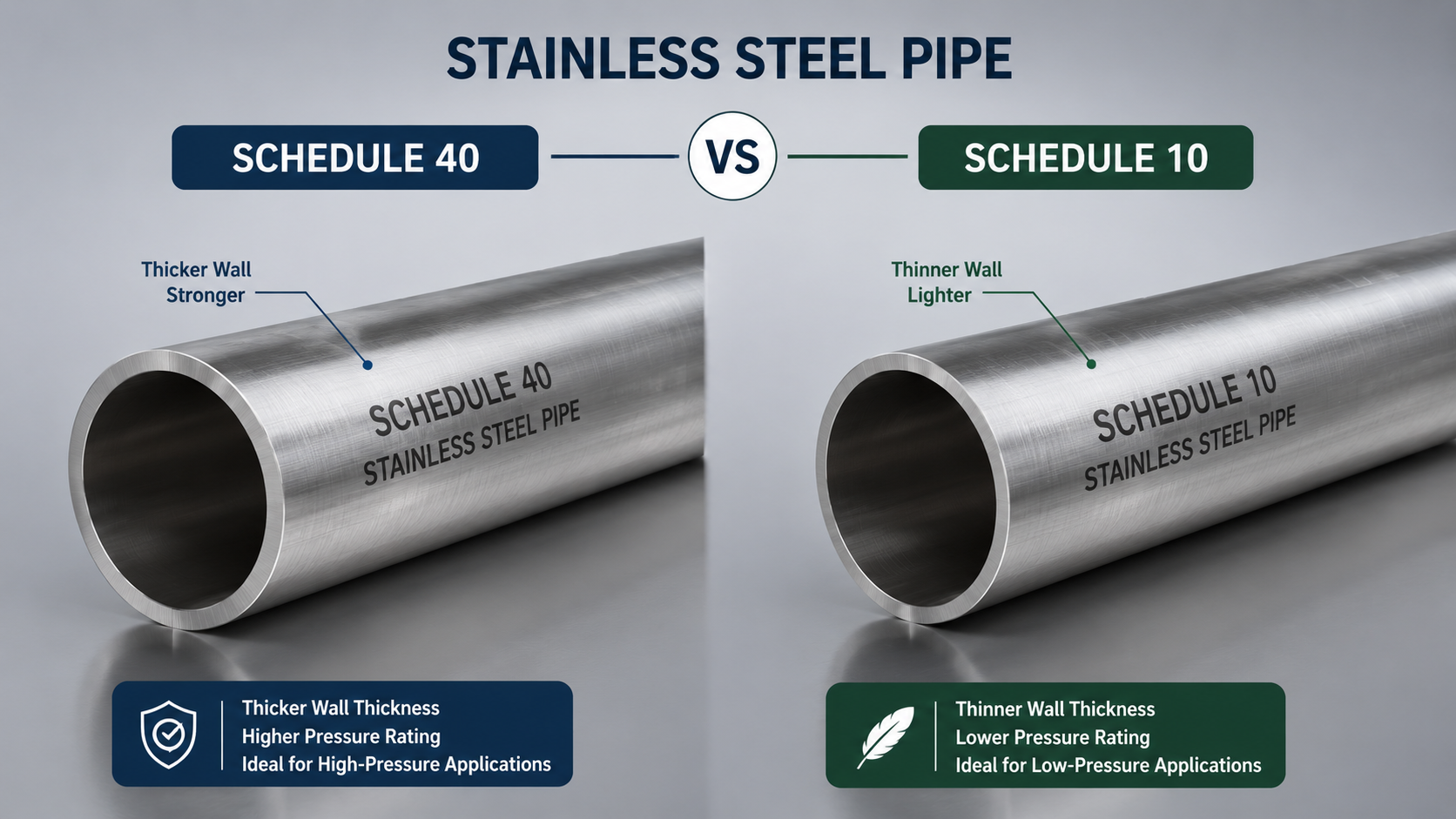
Selecting the correct stainless steel piping is essential for building a safe, durable, and cost-effective piping system. Two commonly specified options are Stainless Steel Pipe Schedule 40 and Schedule 10 Stainless Steel Pipe. Although both may be manufactured from similar stainless steel grades, their wall thickness, weight, pressure capability, installation requirements, and typical applications can be significantly different.
A pipe schedule is primarily a standardized way of identifying wall thickness. It should not be confused with the outside diameter of the pipe. For a given nominal pipe size, different schedules can have the same outside diameter but different wall thicknesses and internal diameters.
Understanding these differences helps engineers, fabricators, contractors, and procurement professionals select piping that matches operating pressure, temperature, corrosion conditions, flow requirements, and project economics.
Understanding Stainless Steel Pipe Schedule 40
Stainless Steel Pipe Schedule 40 is widely used where a relatively substantial wall thickness and dependable mechanical strength are required. Compared with lower schedules of the same nominal size, Schedule 40 generally has a thicker wall.
This additional material can make the pipe suitable for demanding industrial piping installations, depending on its grade, dimensions, manufacturing specification, temperature, joining method, and design pressure.
Common stainless steel grades include 304/304L and 316/316L. Grade selection is important because wall thickness alone does not determine corrosion resistance.
Typical advantages include:
- Strong and durable construction
- Good resistance to mechanical damage
- Suitability for many industrial piping systems
- Availability in multiple nominal pipe sizes
- Compatibility with welded and seamless manufacturing
- Excellent corrosion resistance when the appropriate grade is selected
Schedule 40 is frequently considered when system durability and pressure capability are higher priorities than minimizing material weight.
What Is Schedule 10 Stainless Steel Pipe?
Schedule 10 Stainless Steel Pipe has a thinner wall than Schedule 40 for the same nominal pipe size. The reduced wall thickness decreases the amount of stainless steel required and makes individual pipe sections lighter.
Its lighter construction can simplify handling, fabrication, supporting, and installation. Schedule 10 is commonly considered for lower-pressure applications and systems where corrosion resistance is important but a heavy pipe wall is unnecessary.
Potential applications include water distribution, process lines, certain food and beverage systems, architectural installations, and other services where the selected pipe specification satisfies engineering requirements.
However, Schedule 10 Stainless Steel Pipe should never be selected simply because it costs less. Pressure, temperature, corrosion allowance, joining procedures, applicable standards, and operating conditions must all be evaluated.
Schedule 40 vs Schedule 10 Stainless Steel Pipe
The most obvious distinction between the two schedules is wall thickness. That difference affects several other characteristics.
| Feature | Schedule 40 | Schedule 10 |
| Wall thickness | Thicker | Thinner |
| Pipe weight | Higher | Lower |
| Internal diameter | Smaller for same OD | Larger for same OD |
| Material requirement | Higher | Lower |
| Handling | Relatively heavier | Easier |
| Typical use | More demanding service | Lighter-duty service |
| Initial material cost | Generally higher | Generally lower |
These are general comparisons. Actual dimensions and pressure capabilities depend on nominal pipe size, material specification, grade, temperature, and governing design standard.
Why Wall Thickness Matters
Wall thickness influences more than the physical weight of stainless steel piping. It can affect pressure capability, mechanical durability, internal flow area, welding requirements, overall project cost, and service life.
A thicker Stainless Steel Pipe Schedule 40 provides more metal between the process fluid and external environment. This may provide additional mechanical allowance in demanding installations.
Conversely, the thinner wall of Schedule 10 Stainless Steel Pipe creates a larger internal diameter when compared with a thicker schedule having the same outside diameter. This difference can influence flow characteristics.
The correct schedule therefore depends on engineering calculations rather than assuming that thicker pipe is always the superior option.
Common Applications of Schedule 40
Schedule 40 stainless steel piping can be found across numerous industrial sectors where strength and corrosion resistance are required.
Applications may include:
- Chemical processing systems
- Industrial water pipelines
- Oil and gas facilities
- Manufacturing plants
- Utility piping
- Process equipment connections
- Marine installations
- High-demand commercial piping
The actual suitability of Stainless Steel Pipe Schedule 40 must still be established according to operating pressure, temperature, fluid characteristics, corrosion conditions, and relevant engineering codes.
Where Schedule 10 Pipe Is Commonly Used
Schedule 10 piping can provide an effective balance between corrosion resistance, weight, and material economy.
Schedule 10 Stainless Steel Pipe may be considered for:
- Low-pressure process piping
- Water distribution
- Food-processing installations
- Beverage production facilities
- Selected pharmaceutical applications
- Drainage and utility systems
- Architectural stainless steel projects
- Certain compressed-air or gas services when appropriately designed
Its reduced weight can be particularly valuable in large installations containing extensive pipe runs.
Stainless Steel Grades and Corrosion Resistance
Pipe schedule and stainless steel grade address different engineering requirements. Schedule primarily relates to wall thickness, while grade determines important material properties, including corrosion behavior.
304 stainless steel offers good general corrosion resistance and is widely used across commercial and industrial applications. 304L contains lower carbon and is often preferred for welded fabrication.
316 stainless steel contains molybdenum, providing improved resistance in many chloride-containing environments. 316L combines this characteristic with a lower carbon composition suited to many welded applications.
Consequently, selecting Schedule 40 instead of Schedule 10 does not automatically provide better corrosion resistance. Material grade, environment, fabrication quality, and surface condition remain important factors.
How to Choose the Correct Pipe Schedule
Choosing between Stainless Steel Pipe Schedule 40 and Schedule 10 Stainless Steel Pipe should begin with the actual engineering conditions.
Consider:
- Design and operating pressure
- Operating temperature
- Nominal pipe size
- Stainless steel grade
- Process fluid
- Internal and external corrosion
- Mechanical loading
- Welding and fabrication requirements
- Applicable piping codes
- Expected service life
- Installation and maintenance costs
For critical applications, pipe schedule selection should be verified by a qualified piping or mechanical engineer according to the applicable code and project specification.
Cost and Installation Considerations
Schedule 10 generally requires less stainless steel than Schedule 40 of the corresponding nominal size, which can reduce material weight and potentially lower purchasing, transportation, and installation costs.
Schedule 40 requires more material but provides a thicker wall that may be necessary for specific operating conditions.
The cheapest initial pipe is not necessarily the most economical long-term choice. Purchasing teams should consider fabrication, supports, welding, maintenance, downtime, corrosion conditions, and expected service life when comparing alternatives.
An optimized system uses sufficient wall thickness to satisfy safety and performance requirements without unnecessarily increasing material consumption.
Frequently Asked Questions
1. What does Schedule 40 mean in stainless steel pipe?
Schedule 40 identifies a standardized pipe wall-thickness series. The exact wall thickness varies according to nominal pipe size.
2. Is Schedule 40 thicker than Schedule 10?
Generally, yes. For the same nominal pipe size, Schedule 40 normally has a thicker wall than Schedule 10.
3. Is Schedule 10 stainless steel pipe lightweight?
Yes. Its thinner wall generally makes it lighter than Schedule 40 of the corresponding nominal size.
4. Which pipe is better for higher pressure?
A thicker-wall Schedule 40 pipe may provide greater pressure capability, but suitability must be determined using material, size, temperature, specification, and design-code requirements.
5. Can Schedule 10 be welded?
Yes. Schedule 10 stainless steel piping can be welded using suitable procedures, equipment, filler materials, and qualified fabrication practices.
6. Is Schedule 40 more expensive?
It generally contains more stainless steel, so its material cost and weight are usually higher than comparable Schedule 10 piping.
7. Can Schedule 10 be used for water pipelines?
Yes, in appropriately designed systems where its pressure, temperature, corrosion, and mechanical capabilities meet project requirements.
8. Which stainless steel grade is commonly used?
304/304L and 316/316L are among the most commonly specified grades, although the correct grade depends on the service environment.
9. Does pipe schedule determine corrosion resistance?
No. Corrosion resistance depends primarily on stainless steel grade, environment, fabrication, surface condition, and exposure conditions.
10. How should I select between Schedule 10 and Schedule 40?
Evaluate pressure, temperature, fluid, pipe size, grade, mechanical loading, applicable standards, fabrication, corrosion allowance, and lifecycle cost.