The polymer processing sector is entering a period of significant technological change as manufacturers seek equipment capable of handling more diverse raw materials and increasingly specialized product requirements. Extrusion machinery is becoming an important part of this transition, with Twin Extruder and Single Extruder systems supporting different areas of modern plastics production.
Rather than concentrating exclusively on production speed, processors are paying greater attention to repeatability, material flexibility, energy use, automation, and the ability to accommodate new formulations.
This development is particularly relevant as manufacturers introduce recycled feedstock, mineral-filled materials, engineering polymers, masterbatch, and customized compounds into their production portfolios.
The result is a changing extrusion landscape in which machine selection is becoming closely connected with long-term production strategy.
Material Innovation Is Reshaping Extrusion Requirements
The materials entering modern plastics factories can be considerably more complicated than traditional polymer pellets.
Manufacturers may now work with formulations containing several ingredients designed to modify appearance, strength, processability, durability, or other characteristics.
These ingredients can include pigments, stabilizers, mineral fillers, reinforcing fibers, processing aids, and performance modifiers.
Each addition creates new processing considerations.
A formulation containing a large quantity of mineral filler, for example, may behave differently from an unfilled polymer. A compound containing reinforcing fibers can introduce different feeding and processing requirements.
Extrusion machinery must therefore be selected around material behavior rather than product category alone.
Single Extruder Technology Maintains a Strong Industrial Role
As polymer technology advances, established extrusion methods remain highly relevant.
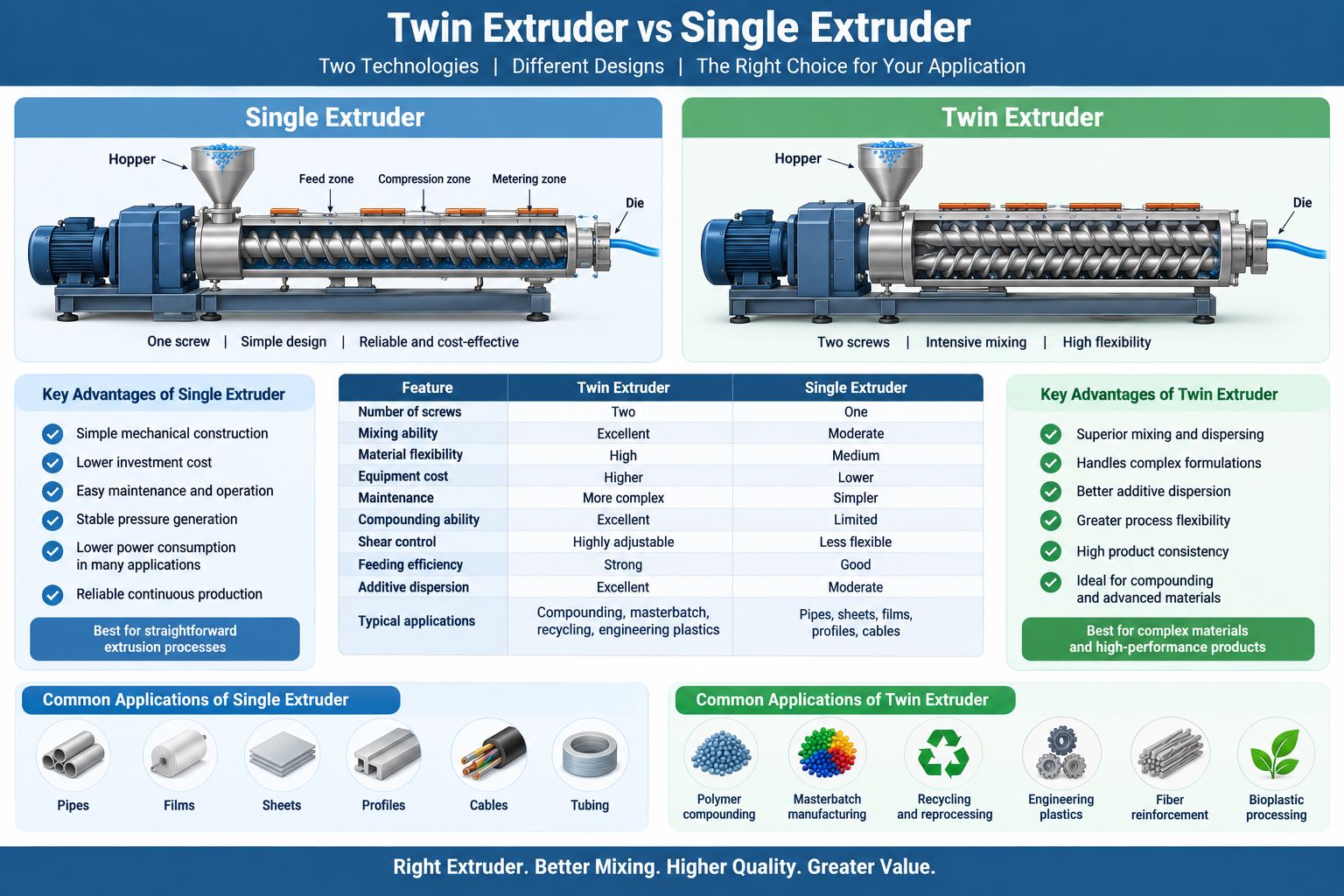
A Single Extruder uses one rotating screw to transport material continuously through a barrel. During this process, the material experiences controlled heating, mechanical energy, and pressure before moving toward the die.
The design is widely recognized for its role in continuous thermoplastic processing.
Manufacturing applications can include:
- Pipes and tubing
- Plastic profiles
- Sheets
- Films
- Wire insulation
- Cable coating
- Other continuous plastic products
For these applications, manufacturers often need predictable material flow rather than intensive ingredient mixing.
This distinction allows single-screw extrusion to remain an important production technology even as more sophisticated processing systems enter the market.
Twin Extruder Systems Address Formulation Complexity
While some factories primarily convert prepared polymers into finished products, others manufacture the polymer compounds themselves.
These operations face a different challenge.
A compound producer may need to introduce resin, pigment, filler, reinforcement, and several additives into a single production process.
A Twin Extruder provides two screws that can be configured to create different material-processing conditions along the barrel.
Depending on the equipment, various screw elements can contribute to conveying, kneading, distribution, dispersion, and homogenization.
This flexibility has made twin-screw technology important in areas including masterbatch, engineering plastics, polymer blends, filled compounds, reinforced materials, and other customized formulations.
Customized Plastics Create Demand for Flexible Production
Standardized mass production remains important, but manufacturers are increasingly expected to supply materials designed for particular applications.
One customer might require a specific color compound, while another needs mineral reinforcement or modified processing characteristics.
Frequent formulation changes can create production challenges.
Manufacturers need equipment that can maintain repeatability while accommodating different material recipes.
For compound producers, the configurable nature of a Twin Extruder can support this type of manufacturing flexibility.
For companies producing established products from consistent raw materials, a Single Extruder can continue to provide an efficient production route without unnecessary processing complexity.
Digital Monitoring Is Changing Extruder Operations
Another development influencing extrusion manufacturing is the growing availability of production data.
Operators traditionally relied heavily on direct observation and experience to identify processing changes. These skills remain valuable, but modern control systems can provide additional information about machine behavior.
Important production parameters can include:
- Screw speed
- Feed rate
- Barrel temperature
- Melt temperature
- Melt pressure
- Motor load
- Production output
- Cooling conditions
Monitoring these variables over time can help manufacturers understand whether a process is operating within an established production window.
Unexpected changes may indicate raw-material variation, feeding problems, component wear, or other processing issues.
Recycled Feedstock Brings New Processing Considerations
The increasing use of recycled polymers is also affecting extrusion planning.
Recycled plastic can differ significantly from uniform virgin resin. Material collected from different sources may contain variations in particle size, moisture, contamination, color, or previous processing history.
Before extrusion, suitable feedstock may need to pass through sorting, washing, grinding, and drying operations.
The prepared material can then enter an extrusion system for further processing.
A Single Extruder may be suitable for certain relatively consistent recycling streams. More complex formulations that require substantial mixing or modification may benefit from twin-screw processing.
There is no universal extrusion configuration for recycled plastics because feedstock quality and final material requirements can vary widely.
Manufacturers Examine Quality Per Kilogram
A notable change in production thinking is the increasing importance of usable output.
Maximum capacity figures remain relevant, but they do not reveal how much acceptable material reaches the end of the production line.
Consider a high-output extrusion line generating significant scrap. Its theoretical production capacity may appear impressive, while its commercially usable output tells a different story.
Manufacturers can gain a clearer picture by monitoring:
| Manufacturing Measure | Production Significance |
| Good output | Quantity meeting specifications |
| Scrap percentage | Material lost during processing |
| Energy per kilogram | Energy required for usable production |
| Downtime | Lost manufacturing availability |
| Changeover time | Time required between products |
| Quality variation | Consistency between production batches |
| Maintenance hours | Time required to maintain equipment |
This broader measurement approach can help factories identify opportunities for meaningful process improvement.
Extruder Wear Receives Greater Attention
Processing machinery naturally experiences wear over time.
Screws and barrels are particularly important because changes to their working surfaces can influence material transportation and processing behavior.
Abrasive ingredients can make this consideration even more important.
Instead of waiting for major quality problems to appear, manufacturers can incorporate inspection into preventive maintenance programs.
Monitoring equipment condition may help identify gradual changes before they develop into expensive downtime.
Maintenance planning should also include gearboxes, bearings, heating systems, cooling circuits, feeders, sensors, and downstream equipment.
Energy Efficiency Becomes Part of Equipment Selection
Industrial energy costs make efficiency an important consideration for many processors.
However, comparing extrusion machines solely by installed motor power provides limited information.
Actual energy performance depends on material characteristics, throughput, temperature requirements, screw configuration, machine utilization, and downstream equipment.
A more meaningful measure is energy consumption relative to acceptable production.
If improved process stability reduces scrap and repeated processing, overall manufacturing efficiency can improve even without major changes to machine capacity.
This places greater emphasis on optimization throughout the complete extrusion line.
Production Flexibility Influences Investment Decisions
Extrusion equipment is typically expected to remain productive for many years.
Manufacturers therefore need to think beyond their immediate product portfolio.
A company currently processing conventional polymers may eventually introduce recycled content or different product grades. A compound producer may need to accommodate new additives or filler concentrations.
Before selecting a Twin Extruder or Single Extruder, businesses can evaluate:
- Current raw materials
- Planned formulations
- Required production capacity
- Mixing requirements
- Product specifications
- Expected material changes
- Maintenance capabilities
- Automation requirements
- Available utilities
- Future expansion plans
This long-term perspective can help reduce the risk of purchasing equipment that quickly becomes restrictive.
Frequently Asked Questions
1. Why are extrusion requirements changing?
Manufacturers are processing more diverse polymers, additives, fillers, recycled materials, and customized formulations.
2. What role does a Single Extruder play?
A Single Extruder provides continuous material processing and is widely used for suitable pipes, films, sheets, profiles, tubing, and coating applications.
3. Where is a Twin Extruder commonly used?
Twin-screw technology is widely associated with compounding, masterbatch, polymer modification, and other formulation-intensive applications.
4. Why is extrusion monitoring useful?
Monitoring can help operators identify changes in temperature, pressure, feed rate, motor load, and other production conditions.
5. Can recycled material be extruded?
Yes. Appropriate extrusion systems can process many prepared recycled polymer streams.
6. Why does raw-material consistency matter?
Material variation can influence feeding, melting, pressure, mixing, output, and finished-product quality.
7. Does higher capacity guarantee greater efficiency?
No. Scrap, downtime, energy consumption, and usable output must also be considered.
8. Why are screws and barrels inspected?
Wear can gradually influence material conveying and overall processing performance.
9. Can extrusion equipment support customized compounds?
Yes. Suitable extrusion systems can process formulations containing pigments, fillers, reinforcing materials, and functional additives.
10. What should manufacturers consider before investing?
They should evaluate current and future materials, production targets, quality requirements, processing complexity, operating costs, maintenance, and automation.