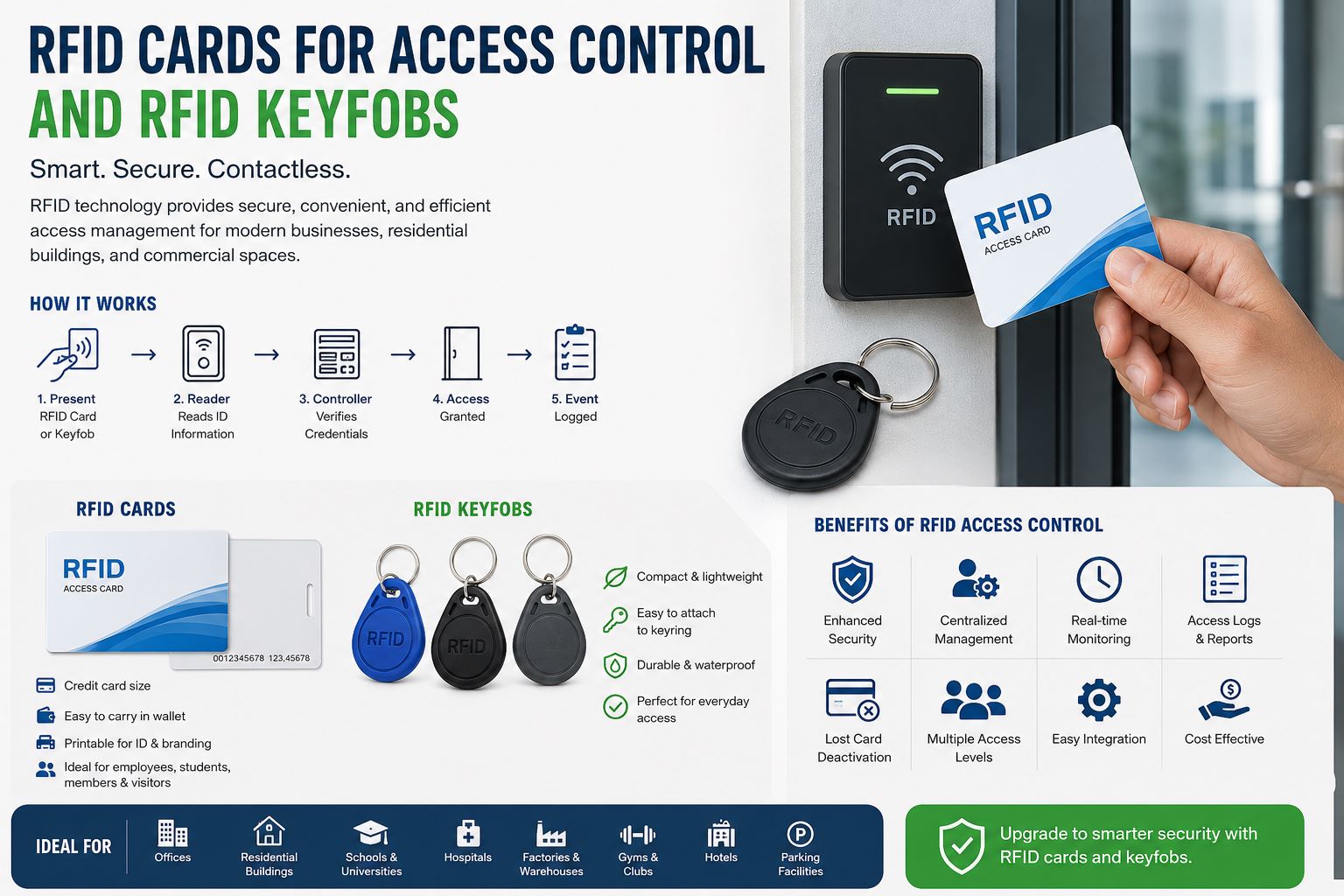
Physical security has changed significantly as organizations move from mechanical keys toward digital, contactless identification. Today, offices, factories, residential buildings, educational institutions, healthcare facilities, warehouses, hotels, and commercial properties need access systems that are convenient for users while giving administrators greater control.
RFID cards for access control and RFID keyfobs have become practical solutions for this purpose. Instead of inserting a key into a lock, an authorized person simply presents an RFID credential near a compatible reader. The access control system verifies the credential and determines whether the person has permission to enter.
Beyond convenience, RFID technology helps organizations control individual permissions, deactivate lost credentials, maintain access records, and manage multiple doors from a centralized platform.
RFID Access Control Is More Than Electronic Door Opening
RFID stands for Radio Frequency Identification. In an access control environment, RFID technology creates wireless communication between a credential and a reader.
A typical system includes an RFID credential, reader, access controller, electronic lock, database, and management software.
When someone presents a card or keyfob, several actions happen almost instantly:
- The reader detects the RFID credential.
- Credential information is transmitted to the system.
- The controller identifies the registered user.
- Access permissions are checked.
- The door unlocks when authorization is valid.
- The access event can be recorded for future reference.
This approach turns an ordinary doorway into a controlled security point with identifiable and manageable access.
Why RFID Cards Remain Important for Business Security
RFID cards for access control combine physical identification and electronic authorization in one convenient credential.
An organization can print an employee’s photograph, name, department, identification number, company logo, or other information directly on compatible cards. The same card can then provide access to approved areas.
Better Control Over Individual Access
One major advantage is the ability to create different permission levels.
For example, an employee might receive access to:
- Main entrance
- Assigned office floor
- Meeting rooms
- Employee facilities
Meanwhile, server rooms, laboratories, inventory areas, executive sections, or other sensitive locations can remain restricted.
This means organizations do not have to provide identical building access to every credential holder.
Easier Management of Lost Credentials
Traditional keys create an operational problem when they disappear. Depending on the security risk, locks may need to be changed and replacement keys distributed.
With RFID cards for access control, administrators can usually disable the missing credential through the access management system and issue another one.
The physical door hardware does not necessarily need to be replaced simply because one credential is lost.
RFID Keyfobs Bring Access Control Into a Compact Format
While cards are excellent for employee identification, RFID keyfobs focus heavily on portability.
A keyfob contains RFID technology inside a small enclosure that can be attached to a normal keyring. Users can therefore keep their access credential alongside vehicle, home, locker, or office keys.
This format is particularly practical in environments where displaying a photo ID is unnecessary.
Applications Where Keyfobs Make Sense
RFID keyfobs are frequently suitable for:
- Apartment and residential entrances
- Parking access
- Fitness centers
- Shared offices
- Storage facilities
- Small businesses
- Clubs and membership facilities
- Staff-only entrances
Their compact construction also makes them convenient for users who do not want to carry another full-size card.
RFID Cards and RFID Keyfobs Compared
Although their physical formats differ, both credentials can perform similar authentication functions when used with compatible systems.
| Consideration | RFID Cards | RFID Keyfobs |
| Physical format | Wallet-sized card | Small keyring credential |
| Portability | Easy to carry | Extremely compact |
| Photo identification | Highly suitable | Usually unsuitable |
| Branding space | Large | Limited |
| Keyring attachment | Requires holder | Usually built in |
| Employee badge use | Excellent | Limited |
| Residential use | Suitable | Excellent |
| Access permissions | Configurable | Configurable |
| Replacement management | Simple | Simple |
The decision should therefore be based on how people will use the credential rather than appearance alone.
Understanding RFID Frequency and System Compatibility
A common mistake is assuming that every RFID credential will work with every access reader.
RFID technologies operate using different frequencies, protocols, chip types, and security architectures.
125 kHz Low-Frequency Credentials
125 kHz technology has traditionally been used in proximity access systems. These credentials are generally presented within a short distance of the reader and are widely associated with straightforward identification applications.
13.56 MHz High-Frequency Credentials
13.56 MHz RFID technologies are common in smart cards and more advanced credential systems. Depending on the technology selected, they can support additional security and data capabilities.
Why Buyers Should Verify Technical Specifications
Before ordering RFID cards for access control or RFID keyfobs, confirm:
- Reader frequency
- Supported credential technology
- Chip specification
- Communication protocol
- Security requirements
- Encoding requirements
- Existing system compatibility
Matching frequency alone may not guarantee interoperability. Two credentials operating at the same frequency can still use different technologies.
Security Advantages Beyond Convenience
The real value of RFID access control comes from making physical access manageable.
Administrators can establish rules defining who can enter, which locations they can access, and when their credentials remain valid.
For example, a temporary contractor could receive access between 9:00 AM and 6:00 PM for five working days. A permanent employee could receive different permissions based on role and department.
Depending on the system, organizations may also use event logs to review attempted or successful access.
This creates significantly more administrative visibility than an ordinary mechanical key.
How Organizations Should Select RFID Credentials
Choosing between cards and keyfobs should begin with the existing security infrastructure.
Organizations should first identify their reader technology and supported credentials. Next, they should consider how the credential will be carried, environmental conditions, required durability, identification needs, and expected security level.
For employee-facing corporate environments, printable RFID cards can offer both identification and access functionality. For apartments, parking areas, gyms, or environments where compact credentials are preferred, RFID keyfobs may be more practical.
Security should remain the priority. Organizations handling sensitive facilities should evaluate technologies with appropriate authentication and security capabilities instead of selecting credentials purely according to price.
Frequently Asked Questions About RFID Access Credentials
What are RFID cards for access control?
They are electronic credentials that communicate wirelessly with compatible readers to identify users and manage entry permissions.
How do RFID keyfobs work?
They contain an RFID chip and antenna that communicate with a compatible access reader when presented within operating range.
Do RFID credentials require batteries?
Many access control credentials are passive and receive the energy needed for communication from the reader’s electromagnetic field.
Can RFID cards replace traditional keys?
Yes, RFID credentials can replace mechanical keys for many electronically controlled doors and restricted-access environments.
What happens when an RFID credential is lost?
The credential can typically be deactivated in the access system so it can no longer provide authorized entry.
Can RFID cards contain printed information?
Yes. Suitable cards can display employee names, photographs, company branding, identification numbers, and other printed information.
Can one RFID credential access several doors?
Yes. Administrators can assign one credential permission to multiple doors when supported by the access control configuration.
Are all RFID keyfobs compatible with all readers?
No. Frequency, protocol, credential technology, chip type, and reader configuration must be compatible.
Can RFID access be limited by time?
Many access control platforms support schedules that restrict credentials to specific days, hours, or validity periods.
Should businesses choose cards or keyfobs?
Cards are ideal when visual identification matters, while keyfobs are useful when compactness and everyday portability are priorities.
https://newsgrow.blogspot.com/2026/08/from-pocket-sized-tools-to-digital.html
https://freeseobacklinks.online/why-nfc-tags-and-smart-wristbands-are-changing-the-future-of-events/
https://blogstream.net/event-technology-enters-a-new-phase-as-nfc-wristbands-gain-wider-attention/
https://newsgrow.blogspot.com/2026/08/nfc-tag-china-market-advances-as-nfc.html