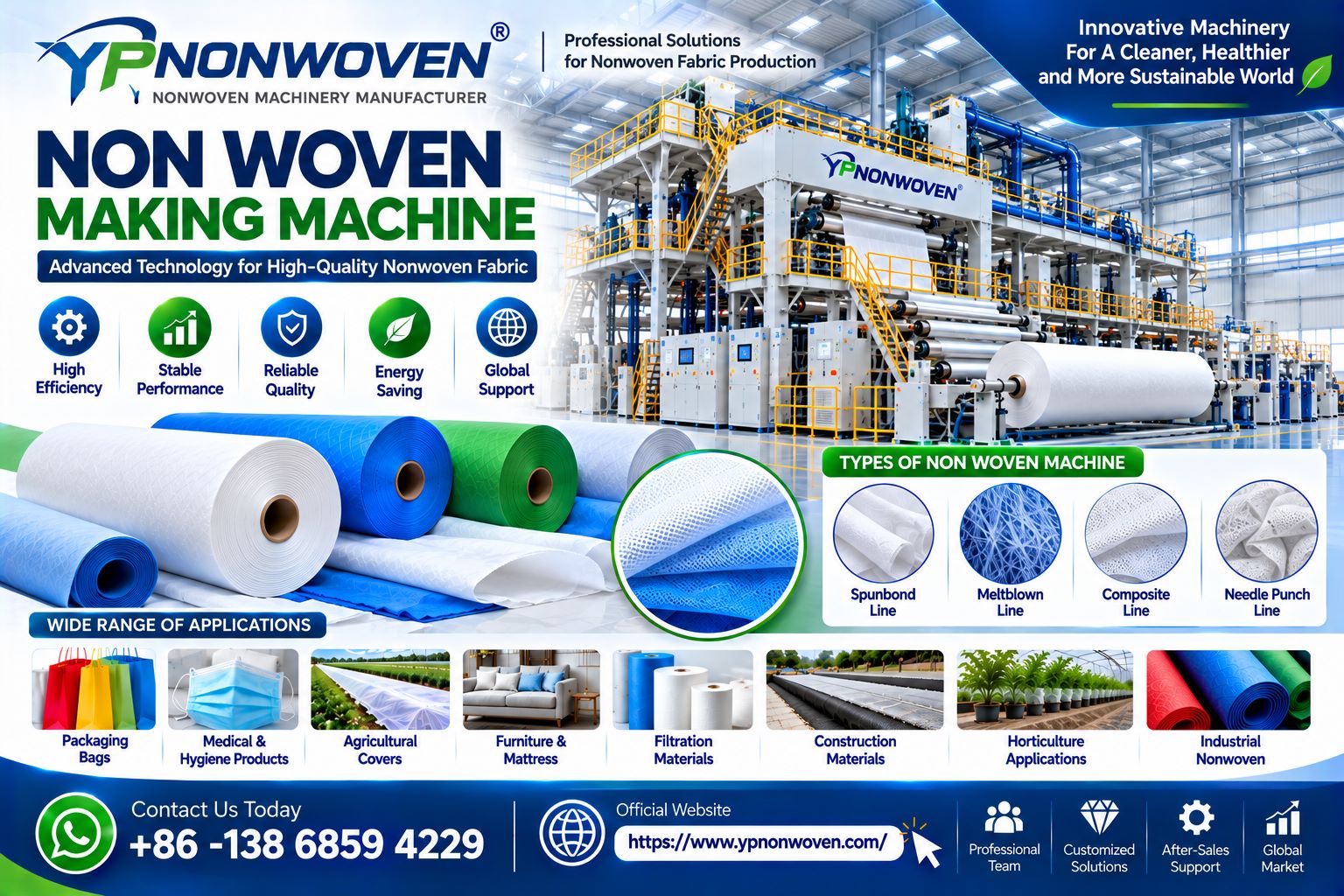
Global textile manufacturing landscape is expanding beyond traditional woven materials as businesses explore alternative fabric technologies for industrial and commercial applications.
From agricultural coverings and filtration materials to packaging, furniture, and hygiene products, nonwoven fabrics serve a wide range of functional requirements.
A Non Woven Making Machine enables manufacturers to produce engineered fabric materials through specialised fibre-forming and bonding processes. Depending on the technology, these systems can manufacture products with different structures, strengths, textures, and performance characteristics.
Meanwhile, the Non Woven Machine market includes equipment designed for various manufacturing methods, allowing businesses to select machinery according to their production goals.
For entrepreneurs, textile manufacturers, and industrial investors, understanding the relationship between machinery technology and market requirements is essential for developing a competitive manufacturing operation.
How Nonwoven Technology Is Changing Fabric Manufacturing
Traditional woven fabrics require yarn interlacing, while knitted materials are produced through interlocking loops.
Nonwoven fabrics follow a different manufacturing approach.
Fibres or filaments are formed into a web and bonded through mechanical, thermal, or chemical methods.
This flexibility allows manufacturers to create materials for applications where conventional textile structures may not be necessary.
As a result, machinery selection should begin with the intended product rather than the machine’s advertised features.
What Is a Non Woven Making Machine?
A Non Woven Making Machine is industrial equipment used to manufacture nonwoven fabric by forming and consolidating fibres or continuous filaments.
The manufacturing process varies according to the selected technology.
Some machines process polymer materials into continuous filaments, while others use staple fibres or specialised web-forming methods.
Common Nonwoven Manufacturing Technologies
- Spunbond Technology: Produces nonwoven webs from continuous polymer filaments.
- Meltblown Technology: Forms fine fibres commonly used in selected filtration applications.
- Needle-Punch Technology: Mechanically entangles fibres to create consolidated nonwoven structures.
- Spunlace Technology: Uses high-pressure water jets to entangle fibres.
- Thermal Bonding: Uses controlled heat to bond suitable fibres or filaments.
Each technology has distinct equipment requirements and product capabilities.
Choosing Machinery According to the Target Market
One of the most important decisions for textile manufacturers is identifying the market they intend to serve.
A business producing agricultural fabrics may have different material requirements from a manufacturer supplying cleaning wipes or filtration media.
Machine specifications should therefore reflect the intended product category.
| Application | Important Fabric Requirements | Relevant Technology Considerations |
| Agricultural Coverings | Weight, strength, permeability | Suitable spunbond configurations |
| Filtration Materials | Fibre structure, airflow, filtration performance | Meltblown or other engineered nonwoven systems |
| Cleaning Wipes | Softness, absorbency, strength | Spunlace technology |
| Geotextiles | Mechanical strength, durability | Suitable needle-punch systems |
| Packaging Materials | Consistent weight, strength, appearance | Spunbond or other suitable technologies |
These are general associations. Final equipment selection should depend on tested product specifications.
Production Flexibility as a Competitive Advantage
Manufacturers frequently encounter customer requirements involving different fabric weights, widths, colours, or finishing characteristics.
A production system capable of handling suitable product variations may help businesses address multiple customer segments.
However, manufacturing flexibility has technical limitations.
Not every machine can produce every nonwoven product, and changes in material specifications may require adjustments or additional equipment.
Businesses should evaluate the machine’s actual operating range before investing in additional product categories.
Why Fabric Sampling Matters Before Full Production
Product sampling is an important stage in nonwoven manufacturing projects.
Before approving large-volume production, manufacturers should establish whether sample materials meet customer expectations.
Testing may involve fabric weight, tensile properties, thickness, permeability, and visual appearance.
The relevant measurements depend on the application.
For example, a filtration product may require performance tests that would not be appropriate for ordinary packaging fabric.
A structured sampling process allows manufacturers to identify technical limitations and confirm whether a proposed product can be manufactured consistently.
Understanding Non Woven Machine Configurations
The term Non Woven Machine describes a broad category rather than one standard equipment design.
Different configurations may include specialised fibre preparation, web formation, bonding, finishing, and winding equipment.
Some manufacturing systems integrate several functions into one continuous line.
Others combine separate processing units according to the intended material.
Manufacturers should review equipment compatibility, available factory space, utility requirements, and the handling needs of finished products.
A well-planned configuration helps connect the manufacturing process with the requirements of the final market.
Factory Planning Beyond Equipment Installation
Establishing a nonwoven manufacturing facility involves decisions beyond purchasing machinery.
Factory layout can influence material movement, workplace safety, equipment accessibility, and production organisation.
Raw materials should be stored according to their handling requirements.
Finished fabric rolls may also need appropriate storage conditions to protect product quality.
Manufacturers should consider electrical capacity, ventilation, environmental controls, and applicable safety requirements.
Effective factory planning supports smoother production operations and reduces avoidable handling difficulties.
Material Selection and Fabric Performance
Raw material selection directly influences the properties of nonwoven products.
Depending on the manufacturing technology, materials may include polypropylene, polyester, viscose, or other suitable fibres and polymers.
Each material offers different performance characteristics.
For instance, polypropylene is frequently used in suitable thermally bonded nonwoven applications, while viscose can contribute absorbency in certain fabric structures.
However, product performance depends on both material properties and manufacturing conditions.
Selecting an appropriate fibre or polymer is therefore only one part of the engineering process.
Sustainability and Responsible Manufacturing
Environmental performance is becoming an important consideration in textile manufacturing decisions.
Manufacturers may investigate material efficiency, production waste, energy consumption, and suitable recycling opportunities.
However, nonwoven products should not automatically be described as environmentally friendly simply because they use fewer conventional textile processing stages.
Their environmental impact depends on raw materials, manufacturing practices, product lifespan, and disposal or recovery options.
Responsible manufacturing requires evaluating the complete product application rather than relying on unsupported sustainability claims.
How Manufacturers Can Make Better Investment Decisions
A successful machinery investment should balance technical capability with commercial demand.
Before selecting equipment, manufacturers should:
- Identify their target nonwoven fabric applications.
- Define expected material and product specifications.
- Compare suitable manufacturing technologies.
- Evaluate production capacity against realistic customer demand.
- Review installation, maintenance, and workforce requirements.
- Establish sampling and product acceptance procedures.
This approach can help businesses avoid investing in equipment that does not match their intended products.
Frequently Asked Questions (FAQs)
1. What is a Non Woven Making Machine?
It is industrial equipment used to manufacture nonwoven fabrics through fibre or filament formation and suitable bonding processes.
2. What is the difference between a Non Woven Machine and a weaving machine?
Nonwoven equipment forms and bonds fibres or filaments without conventional yarn weaving, while weaving machines interlace yarns to manufacture woven textiles.
3. Which materials are used in nonwoven fabric production?
Common materials include polypropylene, polyester, viscose, and other suitable fibres or polymers, depending on the manufacturing technology.
4. Can one nonwoven machine produce different fabric products?
Some systems support variations in fabric specifications, but their capabilities depend on the selected technology and equipment configuration.
5. What should buyers consider before purchasing nonwoven machinery?
Buyers should assess target applications, material compatibility, fabric specifications, production requirements, factory infrastructure, and technical support.
Media Contact
Department: Nonwoven Manufacturing Equipment and Business Enquiries
Contact: +86-138 6859 4229
Email: info@ypnonwoven.com
Official Website: https://www.ypnonwoven.com/
Read more :-
https://tandtlawassociates.com/nonwoven-production-line-and-pp-spunbond-nonwoven-machine-a-guide-to-efficient-manufacturing/