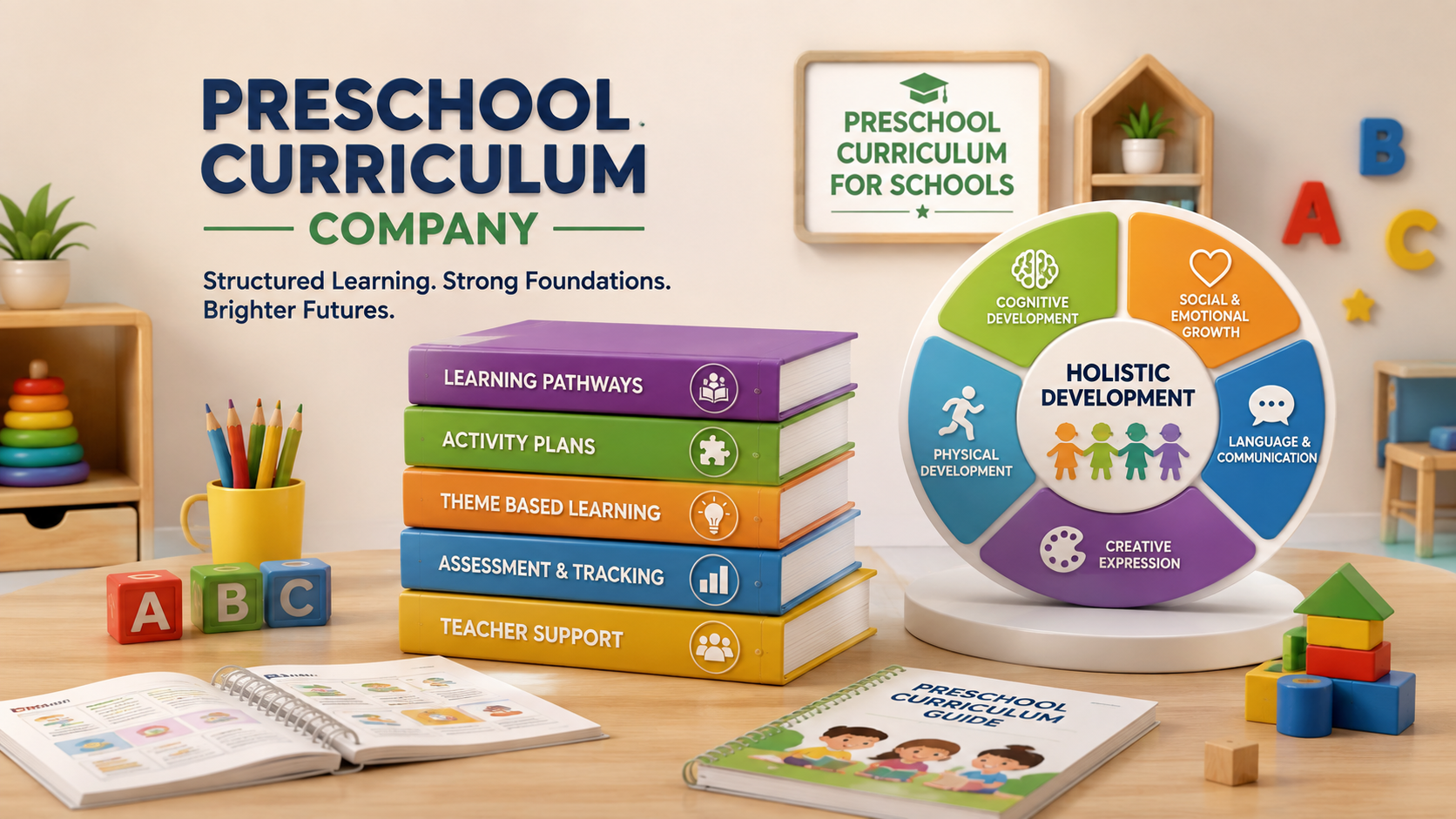
Early childhood education creates the foundation for how children communicate, think, explore, solve problems, and interact with the world. For schools, therefore, selecting the right preschool curriculum company is much more than purchasing books or classroom worksheets. It involves choosing a structured learning system that supports children’s development while giving teachers practical tools to create meaningful classroom experiences.
A thoughtfully developed preschool curriculum for schools combines play, communication, creativity, movement, early literacy, numeracy, environmental awareness, and social-emotional development. Rather than pushing children toward formal academics too early, an effective curriculum introduces concepts through age-appropriate experiences that encourage curiosity and confidence.
What Is a Preschool Curriculum Company?
A preschool curriculum company develops structured educational programs specifically for early childhood learning environments. Depending on the provider, the program may include student books, teacher manuals, lesson plans, classroom activities, assessments, flashcards, worksheets, digital resources, storytelling materials, and teacher-training support.
The strongest curriculum providers understand that preschool children learn differently from older students. Young learners need opportunities to touch, observe, speak, move, experiment, imagine, repeat, and discover.
Therefore, curriculum development should consider multiple developmental areas, including:
- Language and communication
- Early literacy and phonological awareness
- Pre-mathematical concepts
- Cognitive and problem-solving skills
- Fine and gross motor development
- Social-emotional learning
- Creativity and imagination
- Environmental awareness
- Personal habits and independence
A curriculum company should connect these areas instead of treating every subject as an isolated classroom activity.
Why Schools Need a Structured Preschool Curriculum
Preschool classrooms can become inconsistent when teaching depends entirely on individual teachers or disconnected activity books. One classroom may focus heavily on writing while another emphasizes crafts without clearly defined learning outcomes.
A structured preschool curriculum for schools creates continuity.
Teachers know what concepts should be introduced, school leaders can monitor learning progression, and parents gain a clearer understanding of what their children are experiencing.
A well-planned curriculum also helps prevent unnecessary academic pressure. Preschool education should prepare children for future learning without turning early childhood classrooms into miniature primary schools.
The objective is school readiness through development, not memorization alone.
What an Effective Preschool Curriculum Should Include
A comprehensive preschool program should balance academic readiness with whole-child development.
Early language activities may include storytelling, conversations, rhymes, picture reading, vocabulary games, listening exercises, and sound recognition.
Early mathematics can introduce:
- Number awareness
- Shapes and patterns
- Sorting and classification
- Size and measurement concepts
- Spatial understanding
- Simple comparisons
Creative activities such as drawing, music, role-play, clay work, craft, and imaginative games encourage expression while strengthening important developmental abilities.
Physical activities are equally valuable because movement supports coordination, balance, body awareness, and confidence.
Play-Based Learning and Classroom Exploration
Play is not separate from learning during the preschool years. Properly designed play experiences can become powerful opportunities for children to understand concepts naturally.
For example, a pretend grocery shop can introduce numbers, vocabulary, communication, sorting, and social interaction within one activity. Building blocks can strengthen spatial awareness, creativity, coordination, and problem-solving.
An experienced preschool curriculum company therefore designs activities around learning objectives while maintaining the enjoyment and exploration children naturally seek.
Teachers become facilitators who encourage children to observe, ask questions, experiment, communicate, and discover solutions.
Age-Appropriate Progression Matters
Children between approximately two and six years experience rapid developmental changes. The same classroom expectations cannot reasonably apply across every preschool level.
A quality preschool curriculum for schools should therefore provide progressive learning experiences.
| Curriculum Stage | Primary Learning Focus |
| Early Years | Sensory exploration, vocabulary, movement and routines |
| Nursery | Communication, concept recognition and social interaction |
| Lower Kindergarten | Early literacy, numeracy and structured exploration |
| Upper Kindergarten | School readiness, reasoning and independent learning |
Progression should remain flexible because children develop at different speeds. Teachers should be able to support individual needs without creating unnecessary competition.
How Curriculum Supports Preschool Teachers
Even experienced teachers benefit from a clear instructional framework.
Teacher resources can provide learning objectives, classroom preparation guidance, suggested activities, discussion prompts, observation techniques, storytelling ideas, material requirements, and extension activities.
Instead of spending excessive time deciding what to teach every day, educators can concentrate on how effectively children are learning.
However, lesson plans should not become rigid scripts. A strong curriculum gives teachers direction while allowing them to adapt activities according to classroom size, children’s abilities, available resources, and local context.
Assessment Should Focus on Development
Traditional examinations are generally unsuitable as the primary assessment method for preschool children. Young learners demonstrate development through participation, communication, behavior, activities, and everyday classroom experiences.
Assessment can therefore involve:
- Teacher observations
- Activity-based evaluation
- Children’s portfolios
- Developmental milestones
- Classroom participation
- Conversation and storytelling
- Practical demonstrations
The purpose should be understanding progress and identifying areas where additional support may be useful.
A responsible preschool curriculum company incorporates assessment without creating fear or performance pressure.
Choosing the Right Preschool Curriculum Company
Schools should evaluate curriculum providers carefully rather than selecting a program based only on attractive books.
Consider whether the curriculum has clear developmental objectives, logical progression between levels, practical teacher resources, activity-based learning, assessment guidance, and opportunities for creativity.
Schools should also examine how easily the program can be implemented.
A curriculum may look impressive on paper but become difficult to use if activities require expensive materials, excessive preparation, or unrealistic classroom conditions.
The best preschool curriculum for schools should be educationally sound and practically manageable.
Benefits for Schools, Teachers, Children and Parents
A comprehensive curriculum creates value across the entire preschool ecosystem.
For schools, it establishes consistency and measurable learning objectives.
For teachers, it provides structure, resources, and classroom direction.
For children, it creates engaging experiences that support academic, physical, emotional, creative, and social growth.
For parents, a defined learning framework makes children’s educational journey easier to understand.
Most importantly, curriculum quality should be judged by children’s development rather than the number of worksheets completed.
Frequently Asked Questions
1. What does a preschool curriculum company provide?
It typically provides structured learning programs, lesson plans, student resources, activities, assessments, teacher guides, and sometimes digital learning or training resources.
2. What makes a good preschool curriculum?
It should be age-appropriate, play-based, progressive, engaging, inclusive, and focused on whole-child development.
3. Should preschool children receive homework?
Any home activity should generally be short, enjoyable, and developmentally appropriate rather than repetitive academic work.
4. Is play-based learning educational?
Yes. Purposeful play can develop communication, reasoning, creativity, coordination, collaboration, and early academic concepts.
5. How should preschool children be assessed?
Observation, portfolios, activities, conversations, participation, and developmental indicators are useful approaches.
6. Can one curriculum work for every preschool level?
The overall framework can remain consistent, but activities and learning expectations should progress according to age and development.
7. Does preschool curriculum include mathematics?
Yes. Early mathematics includes numbers, patterns, sorting, shapes, comparison, measurement, and spatial concepts.
8. Why are teacher guides important?
They help educators understand objectives, preparation requirements, teaching strategies, activities, and assessment methods.
9. Should a preschool curriculum include social-emotional learning?
Yes. Sharing, communication, emotional awareness, independence, cooperation, and relationship-building are essential early childhood skills.
10. How can schools select a curriculum provider?
Schools should review educational philosophy, age-wise progression, classroom resources, teacher support, assessment methods, implementation requirements, and adaptability.