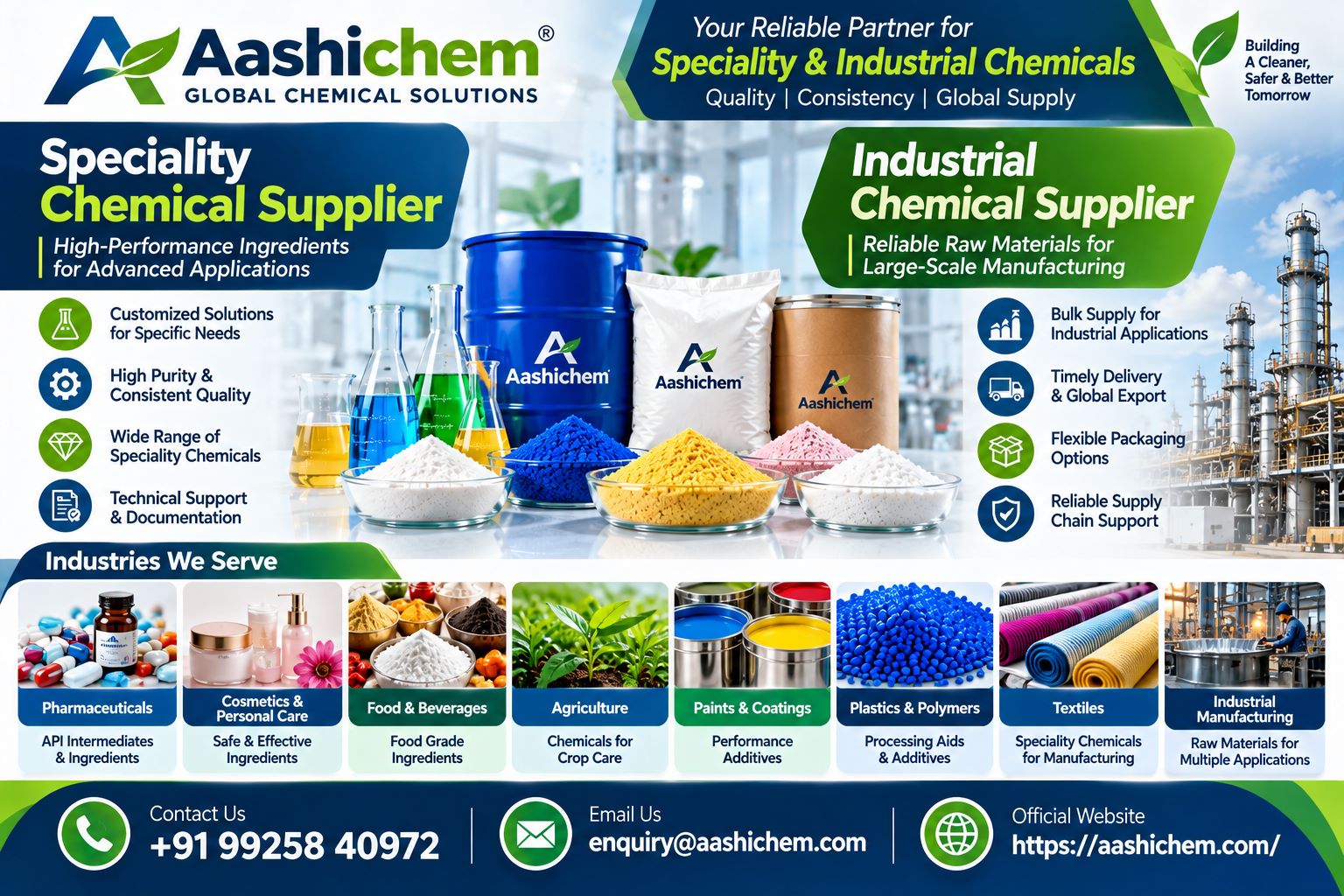
As manufacturing companies focus on product innovation, consistent quality, and efficient production processes, the demand for dependable chemical sourcing continues to influence industrial procurement strategies.
A professional Speciality Chemical Supplier provides application-specific chemicals designed to perform particular functions in manufacturing processes. Meanwhile, a reliable Industrial Chemical Supplier supports businesses with chemical raw materials used across industrial production, processing, and maintenance operations.
Both supplier categories contribute to manufacturing performance, product development, and supply chain efficiency. Understanding their differences, applications, quality requirements, and sourcing considerations helps businesses make informed procurement decisions.
What Is a Speciality Chemical Supplier?
A Speciality Chemical Supplier is a company that manufactures, sources, or distributes chemicals selected for specific performance characteristics and technical applications.
Unlike many commodity chemicals, speciality chemicals are frequently chosen because of their functional properties rather than chemical composition alone.
They may support product formulation, surface treatment, manufacturing efficiency, and specialized processing requirements.
Major Categories of Speciality Chemicals
- Performance Additives: Improve selected properties of manufactured products.
- Coating Chemicals: Support protective and decorative coating formulations.
- Water Treatment Chemicals: Serve specific industrial water-processing functions.
- Polymer Additives: Modify selected characteristics of plastic materials.
- Textile Chemicals: Support processing, finishing, and fabric treatment.
- Personal Care Ingredients: Provide functional properties in suitable cosmetic formulations.
Understanding Industrial Chemical Suppliers
An Industrial Chemical Supplier provides chemical products used in manufacturing, processing, cleaning, treatment, and other commercial operations.
Industrial chemical portfolios may include acids, alkalis, solvents, salts, and chemical intermediates.
These substances support numerous industries, but their suitability depends on the required grade, concentration, and intended application.
Important Industrial Chemical Categories
Acids and Alkalis: Used in appropriate chemical processing and pH-adjustment applications.
Industrial Solvents: Support selected cleaning, extraction, and formulation processes.
Chemical Intermediates: Serve as starting materials in chemical production.
Inorganic Salts: Used in different manufacturing and treatment applications.
Process Chemicals: Support specific operational functions in industrial facilities.
Suppliers should provide accurate chemical identification and appropriate handling information.
Speciality Chemical Supplier vs. Industrial Chemical Supplier
Although both businesses supply chemicals, their commercial focus can differ.
| Feature | Speciality Chemical Supplier | Industrial Chemical Supplier |
| Main focus | Application-specific chemical performance | Broad industrial chemical requirements |
| Product selection | Functional characteristics | Chemical identity, grade, and specification |
| Typical customers | Formulators and specialized manufacturers | Industrial processors and manufacturers |
| Technical requirements | Application and performance evaluation | Purity, concentration, and process compatibility |
| Procurement priority | Functional suitability and consistency | Reliable specifications and supply |
| Documentation | Technical data, COA, SDS | Product specifications, COA, SDS |
A supplier may offer both speciality and industrial chemical products, depending on its capabilities.
Industries That Depend on Chemical Suppliers
Chemical sourcing supports a wide range of manufacturing sectors.
Paints and Coatings
Specialized additives and industrial raw materials influence coating performance, application characteristics, and formulation stability.
Plastic and Polymer Manufacturing
Chemical ingredients support polymer processing and the development of materials with specific performance properties.
Textile Processing
Selected chemicals are used in preparation, dyeing, and finishing operations.
Water Treatment
Suitable chemical products support industrial water treatment and maintenance processes.
Pharmaceutical Manufacturing
Qualified chemical materials support pharmaceutical production, subject to appropriate regulatory and quality requirements.
Cosmetics and Personal Care
Specialized ingredients contribute to suitable skincare, hair care, and personal hygiene formulations.
Each industry requires chemical products with specifications appropriate to its intended use.
Importance of Chemical Quality and Documentation
A dependable Speciality Chemical Supplier should provide technical information supporting the evaluation of product suitability.
Likewise, an Industrial Chemical Supplier should help customers identify chemicals that meet defined manufacturing requirements.
Essential Quality Documents
- Certificate of Analysis (COA): Provides relevant batch-specific test results.
- Safety Data Sheet (SDS): Describes hazards, handling precautions, and safety information.
- Technical Data Sheet: Explains product characteristics and relevant application information.
- Product Specifications: Defines important chemical and physical requirements.
- Batch Identification: Supports material traceability.
- Storage Guidelines: Provides appropriate product-handling recommendations.
Documentation must be supported by appropriate quality controls rather than treated as a substitute for testing.
How Chemical Suppliers Support Manufacturing Efficiency
Reliable chemical sourcing can contribute to efficient production planning.
Suitable raw materials help manufacturers maintain consistent formulations and reduce unexpected processing problems.
Technical communication is particularly valuable when businesses introduce new formulations or evaluate alternative materials.
Suppliers may also assist with packaging specifications, sample availability, and procurement coordination.
However, any substitution must undergo technical evaluation before being approved for production.
Chemical Packaging, Storage, and Transportation
Chemical products require packaging suitable for their physical properties and hazard classifications.
Depending on the substance, suppliers may use drums, bags, containers, or intermediate bulk containers.
Important considerations include:
- Appropriate chemical labeling
- Suitable packaging compatibility
- Protection against contamination
- Proper storage conditions
- Separation of incompatible materials
- Compliance with applicable transport requirements
Hazardous substances may require additional controls based on their classification and destination.
How to Choose a Reliable Chemical Supplier
Businesses should evaluate suppliers through a structured qualification process.
Important Supplier Selection Factors
Product Portfolio: Availability of suitable chemical categories.
Technical Expertise: Understanding of chemical applications and specifications.
Quality Assurance: Appropriate inspection and testing practices.
Supply Reliability: Ability to meet agreed delivery requirements.
Regulatory Awareness: Familiarity with applicable handling and market requirements.
Packaging Options: Suitable container formats for commercial orders.
Transparent Pricing: Clear quotations and commercial conditions.
Customer Support: Timely communication regarding specifications and orders.
A technically capable supplier can help improve procurement confidence and reduce material-selection errors.
Frequently Asked Questions (FAQs)
1. What is a Speciality Chemical Supplier?
It is a company supplying chemicals selected for specific functional or technical applications.
2. What is an Industrial Chemical Supplier?
It supplies chemical raw materials used in manufacturing, processing, and industrial operations.
3. What is the difference between speciality and industrial chemicals?
Speciality chemicals are often selected for specific performance characteristics, while industrial chemicals cover broader manufacturing requirements.
4. Which industries use speciality chemicals?
Coatings, plastics, textiles, cosmetics, water treatment, and other manufacturing sectors use speciality chemicals.
5. Can industrial chemicals be purchased in bulk?
Yes. Many suppliers offer commercial quantities subject to product availability and packaging requirements.
6. Why are chemical specifications important?
They help confirm whether a material meets the quality and performance requirements of its intended application.
7. What documents should a chemical supplier provide?
Common documents include Certificates of Analysis, Safety Data Sheets, and technical specifications.
8. Are speciality chemicals always more expensive?
Not necessarily. Pricing depends on composition, performance requirements, production complexity, and supply conditions.
9. Can one supplier provide both chemical categories?
Yes, provided the supplier has an appropriate product portfolio and the necessary quality controls.
10. How should manufacturers select a chemical supplier?
Evaluate product suitability, quality documentation, technical support, packaging, regulatory compliance, and delivery reliability.
Media Contact
Department: Speciality and Industrial Chemical Business Communications
Email: enquiry@aashichem.com
Contact: +91 99258 40972
Official Website: https://aashichem.com/