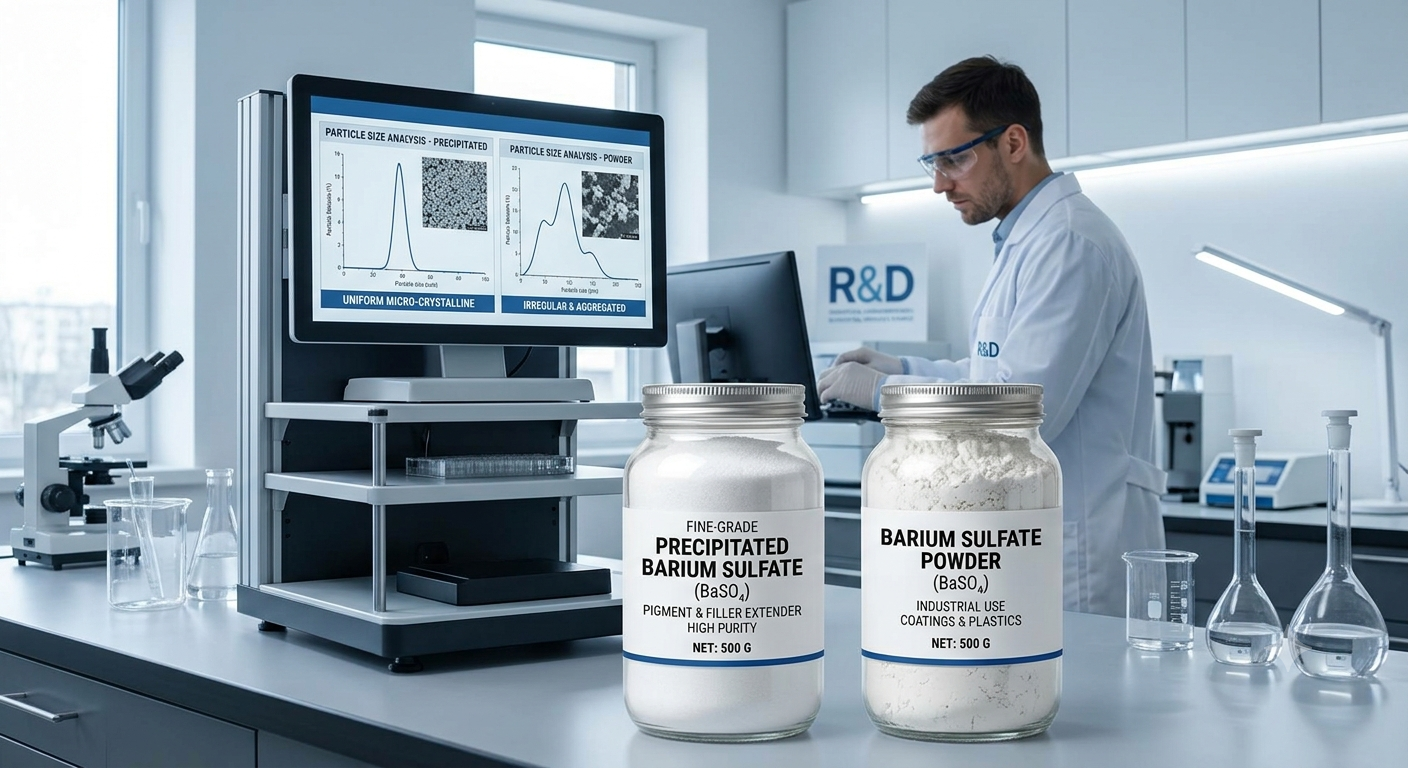
Industrial manufacturers constantly look for raw materials that can improve product consistency, durability, appearance, and processing efficiency. Among the mineral-based materials widely used across coatings, plastics, rubber, inks, and related industries, Precipitated Barium Sulfate and Barium Sulfate Powder hold an important position.
Although both materials are based on barium sulfate, differences in manufacturing method, particle characteristics, purity, and application requirements can influence their performance. Understanding these differences helps manufacturers select the right grade for their formulation rather than simply choosing a filler based on price.
Understanding Precipitated Barium Sulfate
Precipitated Barium Sulfate is a synthetically produced form of barium sulfate created through a controlled chemical precipitation process. The manufacturing method makes it possible to achieve relatively consistent particle size, high whiteness, controlled purity, and predictable performance.
Its chemical stability and low solubility make it suitable for industrial formulations where reliability is particularly important.
Manufacturers commonly consider precipitated grades when they require:
- High whiteness and brightness
- Fine and uniform particle distribution
- Good chemical resistance
- Improved surface finish
- Low oil absorption
- Excellent dispersibility
- Dimensional stability
- Consistent batch-to-batch quality
These characteristics allow the material to function as more than a simple extender. Depending on the formulation, it can help manufacturers adjust optical, mechanical, rheological, and processing properties.
What Is Barium Sulfate Powder?
Barium Sulfate Powder generally refers to powdered barium sulfate supplied in different grades and particle sizes for industrial applications. Natural grades are frequently obtained from barite, which is processed through crushing, purification, grinding, and classification.
The powder is valued for its relatively high density, chemical inertness, whiteness, and compatibility with numerous industrial systems.
Typical application areas include:
- Paints and protective coatings
- Engineering plastics
- Rubber compounds
- Printing inks
- Powder coatings
- Adhesives and sealants
- Industrial masterbatches
- Friction and specialty materials
The correct grade depends on factors such as particle size, brightness, density, moisture level, purity, and compatibility with the surrounding resin or binder.
Precipitated Barium Sulfate vs Barium Sulfate Powder
The two materials can sometimes serve similar purposes, but they should not automatically be considered interchangeable.
| Property | Precipitated Barium Sulfate | Barium Sulfate Powder |
| Production | Controlled chemical precipitation | Commonly mineral processing and grinding |
| Particle consistency | Highly controlled | Depends on selected grade |
| Whiteness | Generally high | Varies by mineral quality |
| Purity | Typically high | Grade dependent |
| Surface finish | Suitable for demanding finishes | Suitable for general industrial applications |
| Cost | Usually relatively higher | Often more economical |
| Typical use | Premium and technically demanding formulations | General filling and functional applications |
Manufacturers should therefore evaluate the complete formulation instead of making a decision based only on chemical composition.
Why Particle Size Matters
Particle size has a major influence on how Barium Sulfate Powder behaves inside coatings, polymers, inks, and other formulations.
Fine Particle Grades
Finer particles can contribute to smoother surfaces, improved dispersion, and more uniform visual characteristics. They may be particularly valuable in coatings and plastic products where appearance is important.
Controlled Particle Distribution
A well-controlled distribution helps manufacturers maintain predictable processing behaviour and reduces variations between production batches.
Dispersion Is Equally Important
Even high-quality powder can perform poorly when it is inadequately dispersed. Processing equipment, mixing speed, formulation chemistry, and addition sequence should therefore be considered alongside particle specifications.
Applications in Paints and Coatings
The coatings industry represents an important application area for Precipitated Barium Sulfate.
Because of its stability and optical characteristics, the material may be incorporated into architectural, industrial, automotive, powder, and protective coating formulations.
Potential formulation benefits include improved:
- Surface smoothness
- Film appearance
- Filler distribution
- Chemical resistance
- Mechanical performance
- Pigment utilisation
- Dimensional consistency
High-quality grades can also help formulators balance performance with raw-material costs when used correctly alongside pigments, binders, additives, and other extenders.
Role in Plastic Manufacturing
Plastic manufacturers use Barium Sulfate Powder in various polymer systems where density, surface quality, dimensional stability, or controlled filler loading is required.
Possible applications include polypropylene, polyethylene, engineering compounds, masterbatches, and specialty plastic products.
Depending on particle treatment and formulation design, barium sulfate can provide good compatibility while helping maintain desirable processing characteristics.
Manufacturers should always perform application trials because filler concentration may influence melt flow, mechanical strength, appearance, and final component weight.
Use in Rubber Products
Barium sulfate is also used as a functional mineral filler in rubber formulations.
Its chemical stability can make it suitable for applications where resistance to environmental or chemical exposure is required. The material may be found in industrial rubber components, flooring, seals, mats, and molded products.
Selection should be based on particle size, moisture, purity, processing behaviour, and interaction with other compound ingredients.
Barium Sulfate in Printing Inks
Consistent particle characteristics are particularly important in printing systems.
Fine Precipitated Barium Sulfate can support ink formulations where smoothness, controlled viscosity, brightness, and good dispersion are desirable.
However, the effectiveness of any grade depends heavily on the complete ink formulation, including resin chemistry, solvents, pigments, and processing conditions.
How to Select the Right Barium Sulfate Grade
Choosing an industrial mineral should involve more than comparing prices.
Manufacturers should evaluate:
- Chemical purity
- Average particle size
- Particle-size distribution
- Whiteness and brightness
- Moisture content
- Oil absorption
- Density
- Dispersion characteristics
- Surface treatment, where applicable
- Batch consistency
Technical data sheets and representative samples should be reviewed before committing to large-volume purchases.
Importance of Supplier Consistency
Reliable sourcing is critical when Barium Sulfate Powder becomes an important component of a production formula.
Changes in particle size, moisture, purity, or brightness may affect processing and finished-product performance. Manufacturers should therefore work with suppliers capable of providing appropriate technical documentation, consistent specifications, and dependable quality control.
A good supplier should also understand the intended application rather than recommending one universal grade for every industry.
Frequently Asked Questions
1. What is Precipitated Barium Sulfate?
It is a synthetically produced form of barium sulfate manufactured through controlled chemical precipitation to achieve consistent purity and particle characteristics.
2. Is barium sulfate soluble in water?
Barium sulfate has extremely low water solubility, contributing to its usefulness in many industrial applications.
3. Where is Barium Sulfate Powder commonly used?
It is commonly used in paints, plastics, rubber, coatings, inks, masterbatches, adhesives, and other industrial formulations.
4. Why is precipitated barium sulfate preferred for premium coatings?
Its controlled particle characteristics, high whiteness, purity, and consistency can make it suitable for demanding surface-finish applications.
5. Can barium sulfate be used in plastics?
Yes. Suitable grades can be incorporated into several plastic and polymer formulations.
6. Does particle size affect performance?
Yes. Particle size influences dispersion, surface finish, processing behaviour, and other formulation properties.
7. Is natural barium sulfate the same as precipitated barium sulfate?
No. Natural material is generally mineral-derived, while precipitated material is produced through a controlled chemical process.
8. How should manufacturers select a grade?
They should compare purity, particle size, whiteness, moisture, oil absorption, density, dispersion, and application requirements.
9. Can barium sulfate reduce formulation costs?
In appropriate formulations, it can serve as a functional extender or filler, but cost optimisation should never compromise required product performance.
10. Why is supplier quality important?
Consistent raw-material specifications help maintain stable manufacturing processes and predictable finished-product quality.