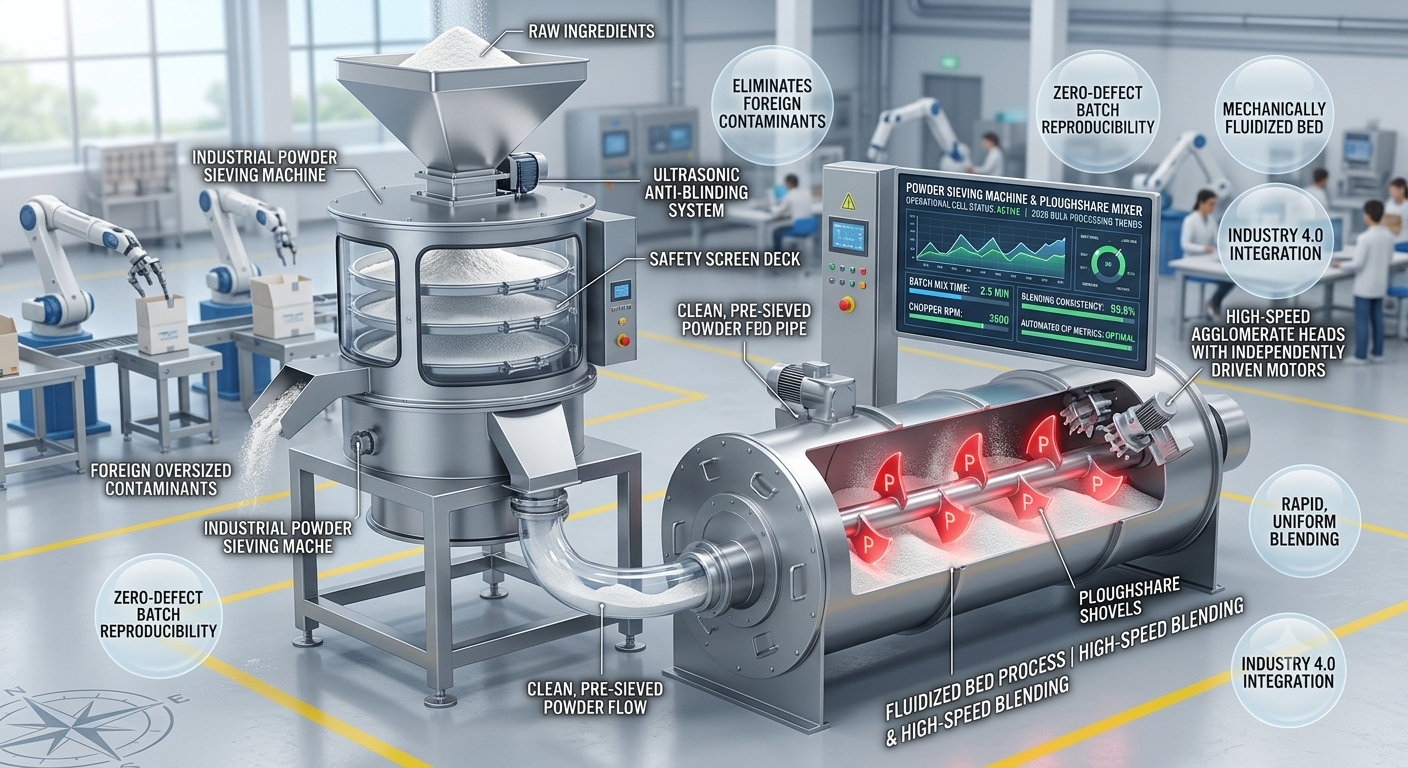
Industrial powder processing is rarely as simple as moving material from one machine to another. Manufacturers must control particle size, remove unwanted contamination, achieve uniform blending, reduce production losses, and maintain consistent product quality from batch to batch.
Two machines play particularly important roles in achieving these objectives: the powder sieving machine and the ploughshare mixer.
Although they perform very different operations, they often complement each other within food processing, chemicals, pharmaceuticals, minerals, detergents, construction materials, pigments, and other powder-handling industries. A properly selected sieving and mixing system can improve product consistency while making the entire manufacturing process more efficient.
Why Powder Preparation Matters in Modern Manufacturing
Raw powders may contain oversized particles, lumps, foreign material, or inconsistent particle distributions. If these materials enter downstream equipment without proper screening, they may affect blending performance and final product quality.
This is where a powder sieving machine becomes valuable.
After screening, powders frequently need to be combined with other dry ingredients, additives, granules, or small quantities of liquids. A ploughshare mixer provides intensive mixing action that helps distribute those components evenly throughout the batch.
Together, these technologies support a controlled process where materials are first prepared and then blended under predictable conditions.
What Is a Powder Sieving Machine?
A powder sieving machine is industrial equipment designed to separate powder according to particle size. Material passes through a screen or mesh while oversized particles and unwanted contaminants are retained.
Depending on the application, sieving equipment may be used for:
- Removing lumps from stored powders
- Separating coarse and fine particles
- Screening raw materials before mixing
- Recovering usable material from production processes
- Protecting downstream machinery
- Improving particle-size consistency
- Removing foreign contaminants
Modern sieving systems may include vibratory screening, centrifugal screening, rotary screening, or other separation mechanisms.
How the Sieving Process Works
Material enters the screening chamber and comes into contact with a selected mesh. Mechanical movement encourages smaller particles to pass through the openings while larger material remains above the screen.
The required mesh size depends on the powder properties and desired product specification.
Important Selection Factors
Manufacturers should evaluate powder flowability, particle size, moisture level, production capacity, mesh opening, cleaning requirements, and whether the material is abrasive or sensitive.
Selecting equipment only according to throughput can result in poor screening performance.
What Is a Ploughshare Mixer?
A ploughshare mixer is an industrial batch mixer designed for fast and intensive blending of powders, granules, and certain liquid additions.
Inside the horizontal mixing chamber, specially shaped plough elements rotate around a central shaft. Their movement lifts and throws material through the chamber, creating continuous interaction between particles.
This three-dimensional mixing pattern can produce highly uniform blends within relatively short processing times.
Where Ploughshare Mixing Is Used
Typical applications include:
- Food premixes
- Chemical powders
- Fertiliser formulations
- Detergents
- Animal feed additives
- Cement-based products
- Pigments
- Pharmaceutical intermediates
- Mineral compounds
The equipment is especially useful where small ingredients must be dispersed consistently throughout a larger powder volume.
Optional High-Speed Tools
Some systems incorporate high-speed choppers. These tools can help break soft agglomerates or assist with dispersing liquids into powders during processing.
Powder Sieving Machine vs Ploughshare Mixer
| Feature | Powder Sieving Machine | Ploughshare Mixer |
| Main purpose | Particle separation | Homogeneous blending |
| Process type | Screening | Mixing |
| Handles powders | Yes | Yes |
| Removes oversized particles | Yes | No |
| Combines multiple ingredients | No | Yes |
| Improves particle consistency | Yes | Indirectly |
| Liquid addition capability | Usually no | Available in suitable designs |
| Typical position | Before or after processing | Main blending stage |
These machines should therefore not be viewed as alternatives. They solve different production challenges.
Why Sieving Before Mixing Can Improve Results
Using a powder sieving machine before a ploughshare mixer provides several operational advantages.
Oversized particles and lumps can interfere with uniform mixing. Screening helps create a more consistent feed material before ingredients enter the mixing chamber.
A typical production sequence may involve:
- Raw material feeding
- Powder screening
- Controlled weighing
- Ingredient dosing
- Intensive mixing
- Final screening when required
- Packaging
Such an arrangement can reduce unwanted variation between production batches.
Important Features to Consider Before Purchasing
Industrial processing equipment should always be selected according to actual material characteristics rather than machine size alone.
For Powder Sieving Equipment
Evaluate:
- Required screening capacity
- Mesh size
- Number of separation grades
- Contact material
- Dust containment
- Cleaning accessibility
- Screen replacement system
- Motor specification
For Ploughshare Mixing Equipment
Consider:
- Batch volume
- Bulk density
- Mixing time
- Motor power
- Shaft design
- Discharge arrangement
- Liquid spraying requirements
- Chopper requirements
- Cleaning and maintenance access
Material Testing Is Valuable
Whenever possible, conduct trials using the actual powder. Laboratory or pilot testing can reveal flow behaviour, screening efficiency, mixing time, agglomeration tendencies, and discharge characteristics before full-scale equipment is ordered.
Benefits of an Integrated Powder Processing System
Combining screening and intensive mixing can contribute to better process reliability.
Potential advantages include:
- More consistent particle distribution
- Improved blend uniformity
- Reduced contamination risk
- Better downstream processing
- Lower manual handling requirements
- Easier production standardisation
- Improved batch repeatability
- Reduced processing bottlenecks
Automation can further improve control by connecting feeding, weighing, sieving, mixing, discharge, and packaging operations.
Frequently Asked Questions
1. What does a powder sieving machine do?
It separates powder according to particle size and removes oversized particles, lumps, or unwanted contaminants.
2. Why should powder be sieved before mixing?
Screening creates a more consistent feed and prevents large particles from affecting blending quality.
3. What is a ploughshare mixer mainly used for?
It is used for rapid and homogeneous mixing of powders, granules, additives, and suitable liquid additions.
4. Can a ploughshare mixer break lumps?
It can provide strong mixing action, while optional high-speed choppers may help break soft agglomerates.
5. Which industries use powder sieving systems?
Food, pharmaceuticals, chemicals, minerals, plastics, pigments, construction materials, and many other industries use them.
6. Can liquids be added during ploughshare mixing?
Yes. Properly designed systems can incorporate spray nozzles for controlled liquid addition.
7. How is the correct sieve mesh selected?
Mesh selection depends on desired particle size, powder characteristics, final specifications, and process requirements.
8. Can sieving be performed after mixing?
Yes. Final screening is sometimes used before packaging to remove agglomerates or ensure consistent finished-product size.
9. How important is mixer capacity?
Mixer capacity must match batch size, bulk density, required fill level, production targets, and material behaviour.
10. Should manufacturers test materials before buying equipment?
Yes. Material trials help confirm whether the proposed equipment can meet screening, mixing, capacity, and product-quality requirements.