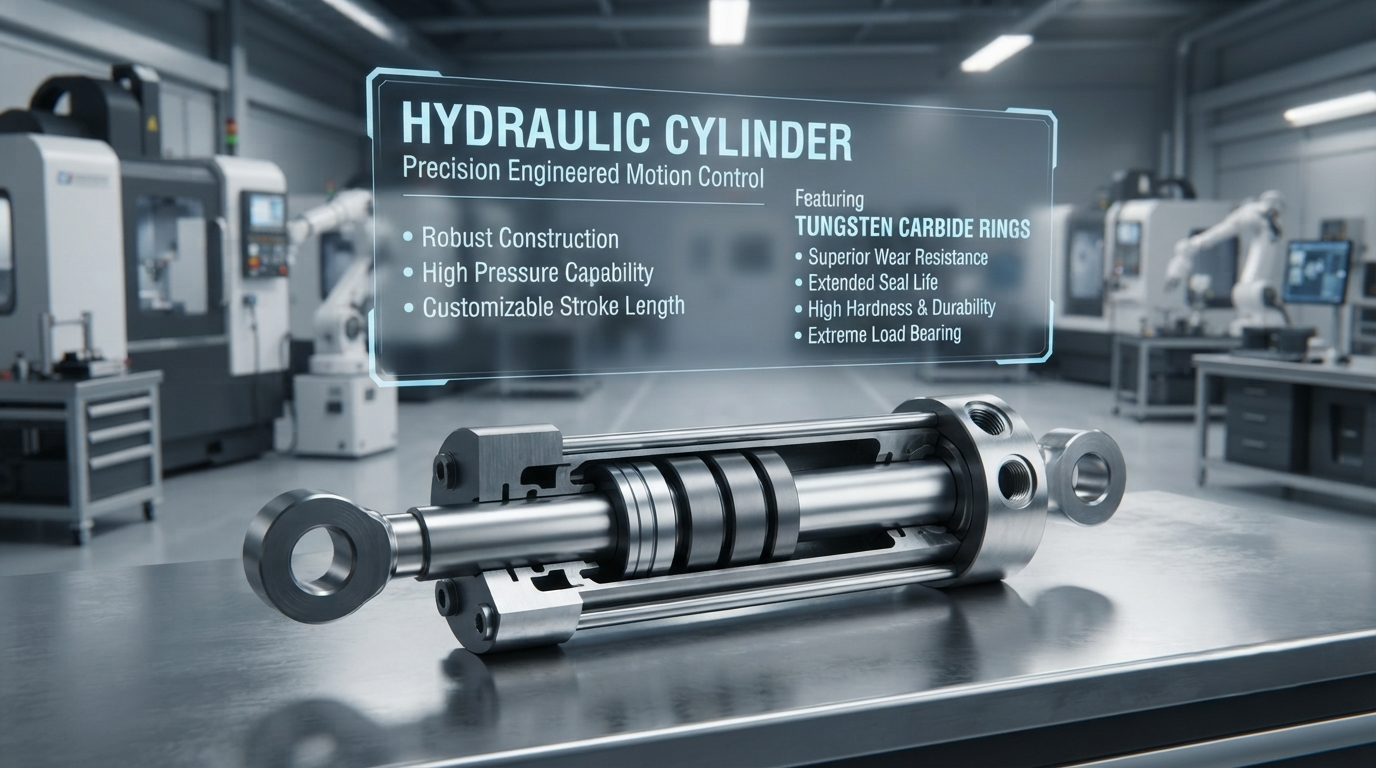
Two important components used across manufacturing, construction, mining, steel processing, oil and gas, and heavy engineering are the Hydraulic Cylinder and Tungsten Carbide Rings.
Although these products perform completely different functions, both contribute to equipment reliability and productivity. A Hydraulic Cylinder converts hydraulic pressure into controlled linear force, while Tungsten Carbide Rings provide exceptional wear resistance in applications involving friction, pressure, heat, and abrasive materials.
Understanding their construction, advantages, applications, and selection criteria helps industries reduce maintenance costs and achieve dependable machine performance.
What Is a Hydraulic Cylinder?
A Hydraulic Cylinder is a mechanical actuator that uses pressurized hydraulic fluid to generate linear movement and force. It normally consists of a cylinder barrel, piston, piston rod, seals, end caps, and fluid ports.
When hydraulic oil enters one side of the cylinder, pressure pushes the piston along the barrel. This movement transfers force through the piston rod to operate machinery.
Hydraulic cylinders are widely preferred where substantial force is required within relatively compact equipment.
Common advantages include:
- High force output
- Smooth and controlled movement
- Compact construction
- Reliable load handling
- Adjustable speed and pressure
- Suitability for heavy-duty operations
Their effectiveness makes hydraulic actuation essential in many modern industrial systems.
How Hydraulic Cylinders Work
Hydraulic systems operate according to pressure transmission through an enclosed fluid. A hydraulic pump supplies pressurized oil to the cylinder through hoses, valves, and control equipment.
The operating sequence generally includes:
- Hydraulic oil enters the cylinder.
- Fluid pressure acts against the piston surface.
- The piston moves through the barrel.
- The piston rod transfers mechanical force.
- Oil from the opposite chamber returns to the reservoir.
Single-acting cylinders normally generate force primarily in one direction, while double-acting cylinders use hydraulic pressure for both extension and retraction.
Choosing the correct design depends on stroke length, working pressure, mounting configuration, required force, operating speed, and environmental conditions.
Important Types of Hydraulic Cylinders
Industries use several cylinder configurations depending on machinery requirements.
Single-acting cylinders use hydraulic pressure in one direction and usually depend on gravity, springs, or external loads for return movement.
Double-acting cylinders provide powered movement in both directions and are widely used in industrial machines requiring accurate control.
Telescopic cylinders contain multiple extending stages, allowing long strokes from compact installations. They are common in dump trucks and lifting equipment.
Heavy-duty cylinders are designed for demanding environments involving high loads, continuous operation, vibration, contamination, or elevated pressures.
Custom hydraulic cylinders can also be engineered when standard dimensions cannot satisfy particular machine specifications.
What Are Tungsten Carbide Rings?
Tungsten Carbide Rings are precision industrial components manufactured from tungsten carbide materials combined with suitable metallic binders. Tungsten carbide is known for extremely high hardness, excellent wear resistance, compressive strength, and durability.
These properties allow the rings to operate successfully where conventional steel components may experience rapid surface wear.
Industrial Tungsten Carbide Rings are commonly used in rolling mills, wire production, sealing systems, mechanical equipment, dies, guides, and other wear-intensive applications.
Their ability to retain dimensional accuracy under demanding operating conditions can significantly improve productivity and component life.
Major Benefits of Tungsten Carbide Rings
One major reason industries select Tungsten Carbide Rings is their outstanding resistance to abrasion.
Additional advantages include:
- Excellent surface hardness
- High compressive strength
- Superior wear resistance
- Good dimensional stability
- Long operational life
- Resistance to deformation
- Reduced replacement frequency
- Consistent performance under severe conditions
Correct carbide grade selection is particularly important. Different combinations of carbide grain structure and binder content can influence toughness, hardness, impact resistance, and overall wear performance.
Hydraulic Cylinder vs Tungsten Carbide Rings
| Feature | Hydraulic Cylinder | Tungsten Carbide Rings |
| Primary Function | Creates linear mechanical force | Resists wear and abrasion |
| Main Principle | Hydraulic pressure | Material hardness |
| Common Material | Steel and alloy components | Tungsten carbide composite |
| Typical Application | Lifting and machine movement | Rolling, sealing and wear control |
| Key Advantage | Powerful controlled motion | Exceptional wear resistance |
| Maintenance Need | Seals, oil and surface inspection | Surface and dimensional inspection |
These components are not direct alternatives. Instead, they solve different industrial engineering challenges.
Industrial Applications
A Hydraulic Cylinder can be found in numerous machines and systems, including:
- Construction equipment
- Excavators and loaders
- Hydraulic presses
- Material handling systems
- Agricultural machinery
- Mining equipment
- Steel plants
- Industrial automation
- Waste handling equipment
Tungsten Carbide Rings are frequently used in:
- Wire and rod rolling
- Steel processing
- Mechanical seals
- Guide systems
- Precision forming equipment
- Wear-resistant assemblies
- Tube manufacturing
- High-friction machinery
Both products help industrial facilities maintain consistent production where equipment reliability is critical.
How to Select the Right Hydraulic Cylinder
Selecting a cylinder requires more than matching its external dimensions.
Buyers should evaluate:
- Required pushing or pulling force
- Operating pressure
- Bore diameter
- Rod diameter
- Stroke length
- Mounting arrangement
- Operating temperature
- Hydraulic fluid compatibility
- Working environment
- Required operating cycle
Seal quality also matters because worn or unsuitable seals can cause leakage, pressure loss, contamination, and reduced efficiency.
Correct specification improves safety while preventing unnecessary equipment downtime.
How to Choose Tungsten Carbide Rings
When purchasing Tungsten Carbide Rings, consider the actual operating conditions instead of selecting solely according to hardness.
Important factors include carbide grade, dimensions, tolerances, surface finish, operating load, rotational speed, temperature, impact conditions, and contact material.
Extremely hard carbide may provide excellent wear resistance but may not always be appropriate where severe impact occurs. Manufacturers should therefore balance toughness and hardness according to the application.
Precision manufacturing is equally important because dimensional inaccuracies can affect alignment, product quality, vibration, and equipment performance.
Maintenance and Service Life
Regular maintenance improves the service life of hydraulic systems. Inspect cylinders for oil leakage, rod damage, corrosion, seal deterioration, contamination, and unusual movement. Hydraulic oil should remain clean and suitable for the specified operating temperature.
For carbide rings, inspect surfaces for cracks, abnormal wear, chipping, dimensional changes, and incorrect alignment.
Preventive inspection is generally more economical than operating components until complete failure occurs.
Frequently Asked Questions
1. What is a Hydraulic Cylinder used for?
A Hydraulic Cylinder converts hydraulic pressure into linear force for lifting, pushing, pulling, pressing, positioning, and moving equipment.
2. What are Tungsten Carbide Rings used for?
Tungsten Carbide Rings are used where high wear resistance, dimensional stability, and surface durability are required.
3. Why are hydraulic cylinders powerful?
Pressurized hydraulic fluid can generate substantial force across the surface area of the cylinder piston.
4. Are tungsten carbide rings harder than steel?
Generally, tungsten carbide offers considerably greater hardness and wear resistance than commonly used industrial steels.
5. What causes hydraulic cylinder leakage?
Common causes include damaged seals, contaminated oil, scratched rods, excessive pressure, incorrect installation, and component wear.
6. Can hydraulic cylinders be customized?
Yes. Bore size, stroke, rod diameter, mounting type, seals, ports, and materials can be customized for specific equipment.
7. Can carbide rings handle high temperatures?
They can perform in demanding temperature environments, although suitability depends on carbide grade, binder material, and operating conditions.
8. How long does a hydraulic cylinder last?
Service life depends on workload, pressure, maintenance, fluid cleanliness, installation quality, and operating environment.
9. Why is carbide grade important?
Carbide grade influences hardness, toughness, wear resistance, impact performance, and expected component life.
10. How can industrial component life be increased?
Correct specification, quality materials, proper installation, lubrication, alignment, inspection, and preventive maintenance significantly improve component durability.