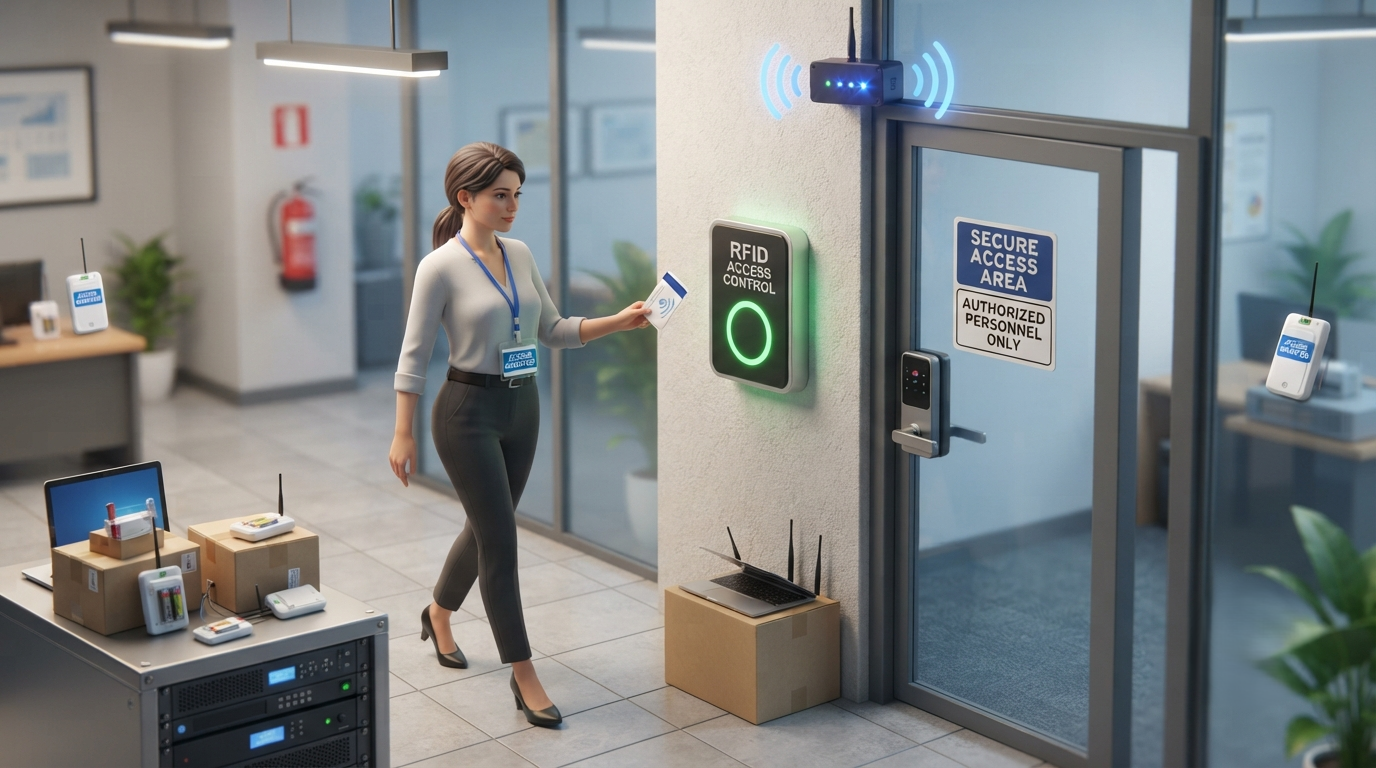
Businesses, factories, hospitals, warehouses, educational institutions, and logistics facilities increasingly require real-time identification, automated monitoring, and accurate access management. This is where Active RFID Tags and RFID Access Control technologies offer significant advantages.
Radio Frequency Identification, commonly known as RFID, uses radio waves to identify tagged people, vehicles, equipment, or assets. When active tags are integrated with access control infrastructure, organizations can create a secure, contactless, and highly automated environment while reducing dependence on manual security procedures.
What Are Active RFID Tags?
Active RFID Tags are electronic identification devices equipped with their own internal power source, usually a battery. Unlike passive RFID tags, which receive power from an RFID reader’s signal, active tags can independently transmit information at regular intervals.
Because they have an onboard battery, these tags generally provide a longer communication range and can support advanced functions such as sensors, real-time location monitoring, movement detection, and automated alerts.
Typical applications include:
- Vehicle identification
- Employee tracking
- Equipment monitoring
- Warehouse asset management
- Healthcare equipment tracking
- Construction site security
- Logistics and supply chain visibility
Businesses often choose Active RFID Tags when objects need to be detected automatically from greater distances without requiring users to place a card directly near a reader.
How Do Active RFID Tags Work?
An active RFID system generally includes tags, RFID readers, antennas, middleware, and management software.
The process is straightforward:
- The RFID tag stores its unique identification information.
- Its internal battery powers periodic radio transmissions.
- A compatible reader receives the transmitted signal.
- Middleware processes the identification information.
- The software connects that information with an employee, asset, vehicle, or predefined security rule.
- Appropriate actions or alerts are generated automatically.
Some advanced Active RFID Tags can also transmit environmental information such as temperature, movement, vibration, or equipment status.
This makes RFID useful not only for identification but also for broader IoT and real-time monitoring applications.
What Is RFID Access Control?
RFID Access Control is a security system that uses RFID credentials to determine whether a person or vehicle can enter a controlled location.
Instead of relying entirely on physical keys, authorized users receive RFID cards, badges, key fobs, tags, or other credentials. When the credential is detected by an RFID reader, the system verifies its identification number against stored access permissions.
If authorization is confirmed, the system can automatically unlock the door, gate, barrier, or other secured entry point.
Modern systems may also record information such as:
- User identity
- Entry location
- Entry time
- Exit time
- Failed access attempts
- Door status
- Credential activity
These records help security administrators improve accountability and investigate unusual activities.
Key Benefits of RFID Access Control
One major advantage of RFID Access Control is centralized permission management. Traditional physical keys become difficult to manage when an organization has hundreds of employees or multiple buildings.
With RFID, administrators can quickly activate, modify, or disable credentials.
Important benefits include:
- Contactless authentication
- Faster entry and exit
- Centralized access management
- Detailed access records
- Reduced dependency on traditional keys
- Flexible employee permissions
- Integration with attendance systems
- Multiple-zone security
- Easier credential replacement
- Improved operational efficiency
If an RFID credential is lost, administrators can usually deactivate that specific credential rather than replacing physical locks.
Active RFID Tags vs Passive RFID Tags
Choosing between active and passive RFID depends on communication distance, application requirements, infrastructure, and budget.
| Feature | Active RFID | Passive RFID |
| Power Source | Internal battery | Powered by reader |
| Read Range | Generally longer | Generally shorter |
| Data Transmission | Automatic transmission possible | Responds when energized |
| Tag Cost | Higher | Lower |
| Maintenance | Battery may require replacement | Minimal |
| Common Use | Tracking and automation | ID cards and inventory |
| Sensors | Often supported | More limited |
| Real-Time Monitoring | Well suited | Application dependent |
For standard door credentials, passive RFID may be sufficient. For automated vehicle detection, asset tracking, or longer-distance identification, Active RFID Tags may provide greater flexibility.
Combining Active RFID With Access Control
Integrating Active RFID Tags with RFID Access Control can create a more intelligent security system.
Consider a large industrial facility. An authorized vehicle approaching the entrance can carry an active RFID tag. The entrance reader detects the vehicle before it reaches the gate and sends its identification data to the access control platform.
The platform verifies:
- Vehicle registration
- Driver authorization
- Permitted entry zone
- Access schedule
- Credential status
If all conditions match predefined rules, the gate can open automatically.
The same concept can be used for staff, contractors, expensive machinery, restricted equipment, and movable assets.
Industries Using RFID Security Solutions
RFID technology can support many environments where identification and controlled access are important.
Manufacturing facilities use RFID to monitor employees, equipment, and restricted production areas. Warehouses can combine asset tracking with controlled entry points. Hospitals may use RFID for staff authorization and medical equipment tracking.
Other applications include:
- Airports and transportation hubs
- Corporate offices
- Data centers
- Universities
- Hotels
- Parking facilities
- Construction sites
- Government facilities
- Logistics centers
- Research laboratories
The correct solution depends on security requirements, facility layout, reading distance, environmental conditions, and system integration needs.
Important Features to Consider
Before implementing an RFID solution, organizations should evaluate both immediate requirements and future expansion.
Look for features such as:
- Suitable operating frequency
- Required reading distance
- Secure credential authentication
- Tag battery life
- Reader compatibility
- Access logging
- User permission management
- Alarm integration
- API or software integration
- Scalable system architecture
Security should remain a priority. Organizations should choose modern RFID technologies with appropriate authentication, encryption, credential management, and network security protections for their risk environment.
Improving Security Through Real-Time Visibility
Traditional access control answers an important question: who entered?
RFID-based tracking can potentially answer additional questions, including where tagged assets are located and whether protected equipment has moved into or out of predefined areas.
When Active RFID Tags are integrated with security software, organizations may configure alerts for unauthorized movement, restricted-zone entry, missing equipment, or unexpected activity.
This combination of physical access management and real-time visibility can improve both security and operational decision-making.
Frequently Asked Questions About Active RFID and Access Control
1. What are Active RFID Tags?
Active RFID Tags are battery-powered identification devices capable of transmitting RFID signals to compatible readers.
2. How are active tags different from passive tags?
Active tags contain their own power source, while passive tags generally depend on energy supplied by an RFID reader.
3. What is RFID Access Control?
RFID Access Control uses RFID credentials and readers to authenticate users before allowing access to secured locations.
4. Can RFID be used for vehicle access?
Yes. RFID can identify authorized vehicles and integrate with automated gates or parking barriers.
5. Are Active RFID Tags suitable for asset tracking?
Yes. Their longer communication capability makes them useful for many real-time asset monitoring applications.
6. Can RFID access systems record entry history?
Yes. Many systems maintain logs containing credential, location, date, time, and access-event information.
7. Can lost RFID cards be disabled?
Yes. Administrators can typically deactivate compromised or lost credentials from the access management system.
8. Can RFID integrate with attendance software?
Yes. Many platforms can integrate RFID events with attendance, workforce, visitor, or identity management systems.
9. Do active RFID tags require maintenance?
Yes. Since they contain batteries, battery condition and replacement cycles should be considered.
10. Is RFID suitable for large facilities?
Yes. Properly designed RFID infrastructure can support warehouses, campuses, factories, hospitals, and multi-building environments.