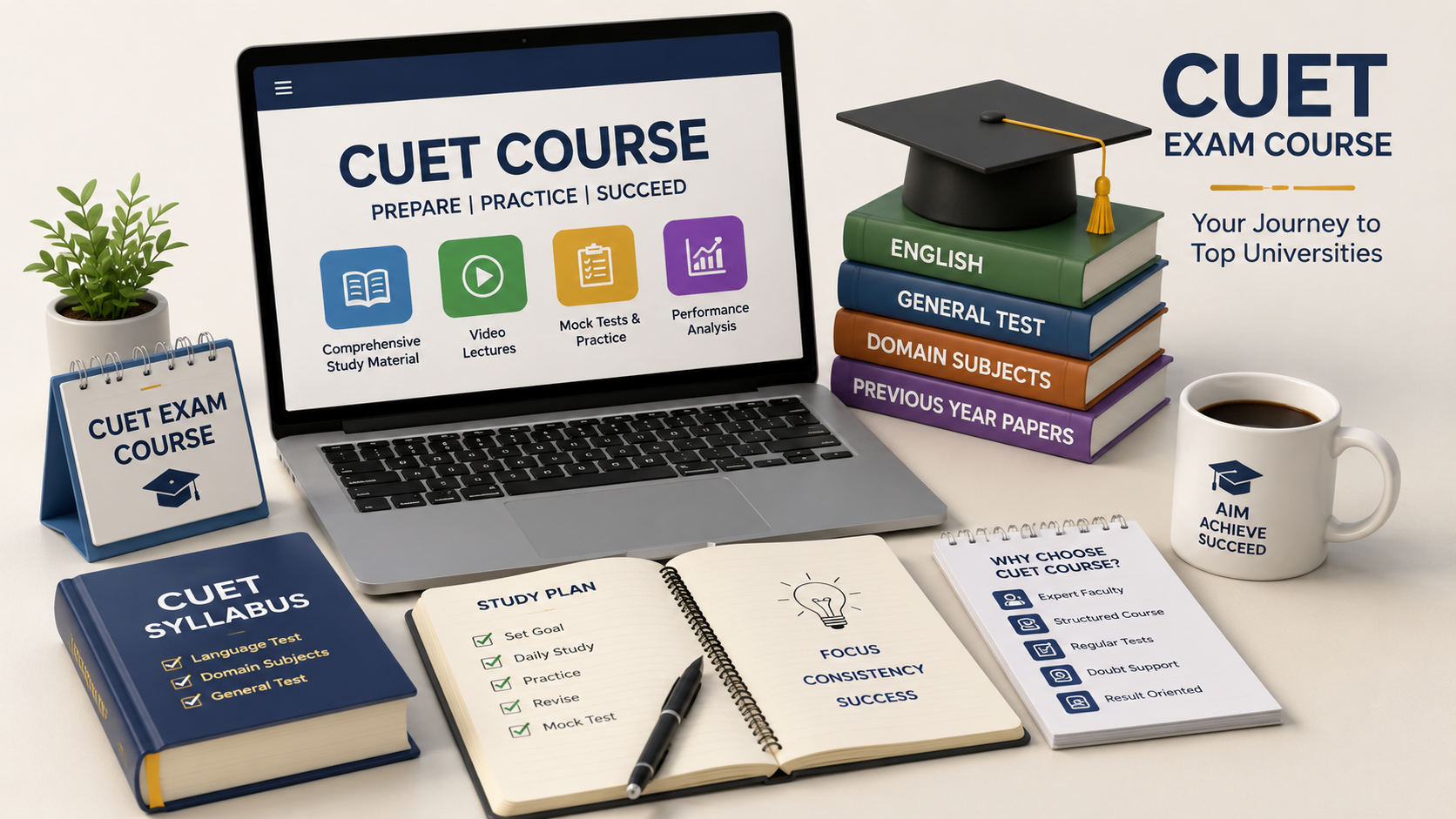
The Common University Entrance Test (CUET) has become an important pathway for students seeking admission to undergraduate programmes at participating universities in India. Because competition can be intense, choosing the right CUET course for preparation can make studying more organised, focused, and effective.
A well-designed CUET exam course does more than provide study material. It helps students understand the syllabus, strengthen concepts, practise examination-level questions, improve speed, and develop a realistic strategy for the actual entrance test.
Whether you are preparing independently or joining coaching, understanding what a CUET preparation programme should include can help you make better decisions.
What Is a CUET Course?
A CUET course is a structured preparation programme designed to help candidates study for the Common University Entrance Test. These courses may be available through classroom coaching institutes, online learning platforms, recorded video programmes, or self-study packages.
A comprehensive course usually includes:
- Subject-wise concept lessons
- Language preparation
- Domain subject preparation
- General Aptitude Test preparation where applicable
- Topic-wise practice questions
- Previous-year-style questions
- Sectional tests
- Full-length mock examinations
- Doubt-solving sessions
- Performance analysis and revision plans
Instead of preparing randomly from multiple sources, students can follow a systematic learning sequence.
What Is Included in a CUET Exam Course?
The structure of a CUET exam course depends on the subjects and programmes selected by the student. Universities may have different subject requirements for different undergraduate programmes, so candidates should always check the eligibility criteria of their preferred universities.
A preparation programme may cover three broad areas.
Language preparation: Students practise reading comprehension, vocabulary, grammar, verbal ability, and language usage.
Domain subjects: These are based on subjects selected according to the admission requirements of the intended programme. Examples can include Physics, Chemistry, Mathematics, Biology, Economics, Accountancy, Business Studies, History, Geography, and Political Science.
General Aptitude Test: Where required, preparation may include general knowledge, current affairs, numerical ability, logical reasoning, quantitative reasoning, and analytical skills.
The best course should therefore match your selected CUET subjects rather than offering unnecessary material.
Why Should Students Consider a Structured CUET Course?
CUET preparation requires more than memorising textbook chapters. Students must understand concepts while also learning how to answer questions accurately within a limited examination period.
A structured preparation programme can provide several advantages.
- Clear preparation roadmap: Students know what to study and in what sequence.
- Regular practice: Topic-wise questions reinforce concepts immediately after learning.
- Better time management: Scheduled lessons prevent students from spending excessive time on one chapter.
- Mock-test experience: Practice examinations help students become familiar with exam pressure.
- Performance tracking: Test analysis identifies strong and weak areas.
- Systematic revision: Important chapters can be revised repeatedly before the examination.
However, enrolling in a course alone does not guarantee results. Consistent self-study and practice remain essential.
Online CUET Course vs Classroom CUET Coaching
| Factor | Online CUET Course | Classroom Course |
| Learning location | Study from anywhere | Attend coaching centre |
| Schedule | Often flexible | Mostly fixed |
| Recorded lessons | Usually available | May not always be available |
| Interaction | Live chat or online sessions | Face-to-face |
| Revision | Videos can often be replayed | Depends on notes/classes |
| Travel | Not required | Usually required |
| Best suited for | Self-disciplined learners | Students needing structured supervision |
Neither format is automatically better. Students should choose according to their learning habits, available time, location, and preparation requirements.
How to Choose the Best CUET Exam Course
Before enrolling in any CUET exam course, carefully evaluate what the programme actually provides.
Look for a course with updated subject coverage, experienced teachers, quality practice questions, regular mock examinations, doubt support, and clear performance analysis.
Students should also check:
- Whether their required domain subjects are included
- Number and quality of mock tests
- Availability of recorded lectures
- Study material quality
- Faculty experience
- Doubt-resolution system
- Test analytics
- Revision classes
- Course validity
- Student support
Avoid selecting a course only because of advertisements or exaggerated success claims. A programme should provide useful academic support rather than unrealistic guarantees.
CUET Course Preparation Strategy
Even the best preparation material requires the right study strategy.
Begin by understanding the examination requirements for the universities and programmes you want to apply for. Once your required subjects are clear, divide the syllabus into manageable sections.
A practical daily routine could include:
- 2–3 hours for domain subjects
- 45–60 minutes for language preparation
- 45–60 minutes for aptitude or reasoning where required
- 30 minutes for revision
- Regular practice questions or sectional tests
Students should adjust these timings according to their strengths and available preparation period.
Importance of Mock Tests in a CUET Course
Mock examinations are one of the most valuable components of CUET preparation.
Students sometimes understand the syllabus well but struggle during competitive examinations because they have not practised answering questions under timed conditions.
Mock tests help develop:
- Question-selection strategy
- Time management
- Accuracy
- Speed
- Concentration
- Examination confidence
After every mock test, analyse incorrect answers. Determine whether mistakes occurred because of weak concepts, careless calculation, misunderstanding of questions, or poor time management.
This analysis can be more valuable than simply attempting many tests.
Common Mistakes During CUET Preparation
Students should avoid several common preparation mistakes.
Do not study every subject equally without identifying your weaker areas. Avoid collecting too many books and online resources because excessive material can create confusion.
Other mistakes include:
- Ignoring university-specific eligibility requirements
- Delaying mock tests until the final weeks
- Studying without revision
- Memorising without understanding concepts
- Ignoring weaker chapters
- Practising questions without analysing mistakes
- Following an unrealistic daily timetable
A smaller number of reliable resources used consistently is usually more effective than constantly switching between materials.
Can You Prepare for CUET Without Coaching?
Yes. Many students can prepare independently if they have strong discipline, suitable textbooks, quality practice material, and a clear study schedule.
Self-study may work especially well for students who already have a strong understanding of their school subjects.
However, a structured CUET course may be useful for students who require:
- Additional conceptual explanation
- Regular deadlines
- Teacher support
- Mock examinations
- Doubt clarification
- Personalised performance analysis
The right choice depends on the individual learner rather than a universal preparation method.
Frequently Asked Questions About CUET Course
1. What is a CUET course?
It is a structured preparation programme designed to help students study the subjects, practise questions, and prepare for CUET.
2. Is a CUET exam course compulsory?
No. Students can prepare through self-study, online resources, or coaching depending on their learning requirements.
3. When should I start CUET preparation?
Starting several months in advance provides sufficient time for syllabus completion, practice, revision, and mock examinations.
4. Does a CUET course include all subjects?
Not necessarily. Course coverage varies, so students should confirm that their required domain subjects are available.
5. Are NCERT books useful for CUET preparation?
For relevant domain subjects, NCERT textbooks can be an important foundation for building conceptual understanding.
6. Are mock tests necessary for CUET?
Yes. Mock tests help improve speed, accuracy, time management, and familiarity with examination-style questions.
7. Is an online CUET course effective?
It can be highly useful for disciplined students who prefer flexible learning and recorded lessons.
8. How many hours should I study daily?
The ideal duration depends on preparation level. Consistent focused study is more important than simply studying for long hours.
9. Should I prepare for CUET alongside board examinations?
Yes. Since domain preparation may overlap with school subjects, students can create an integrated study schedule.
10. How do I select the right CUET exam course?
Compare syllabus coverage, faculty, mock tests, study materials, doubt support, course validity, and performance analysis before enrolling.