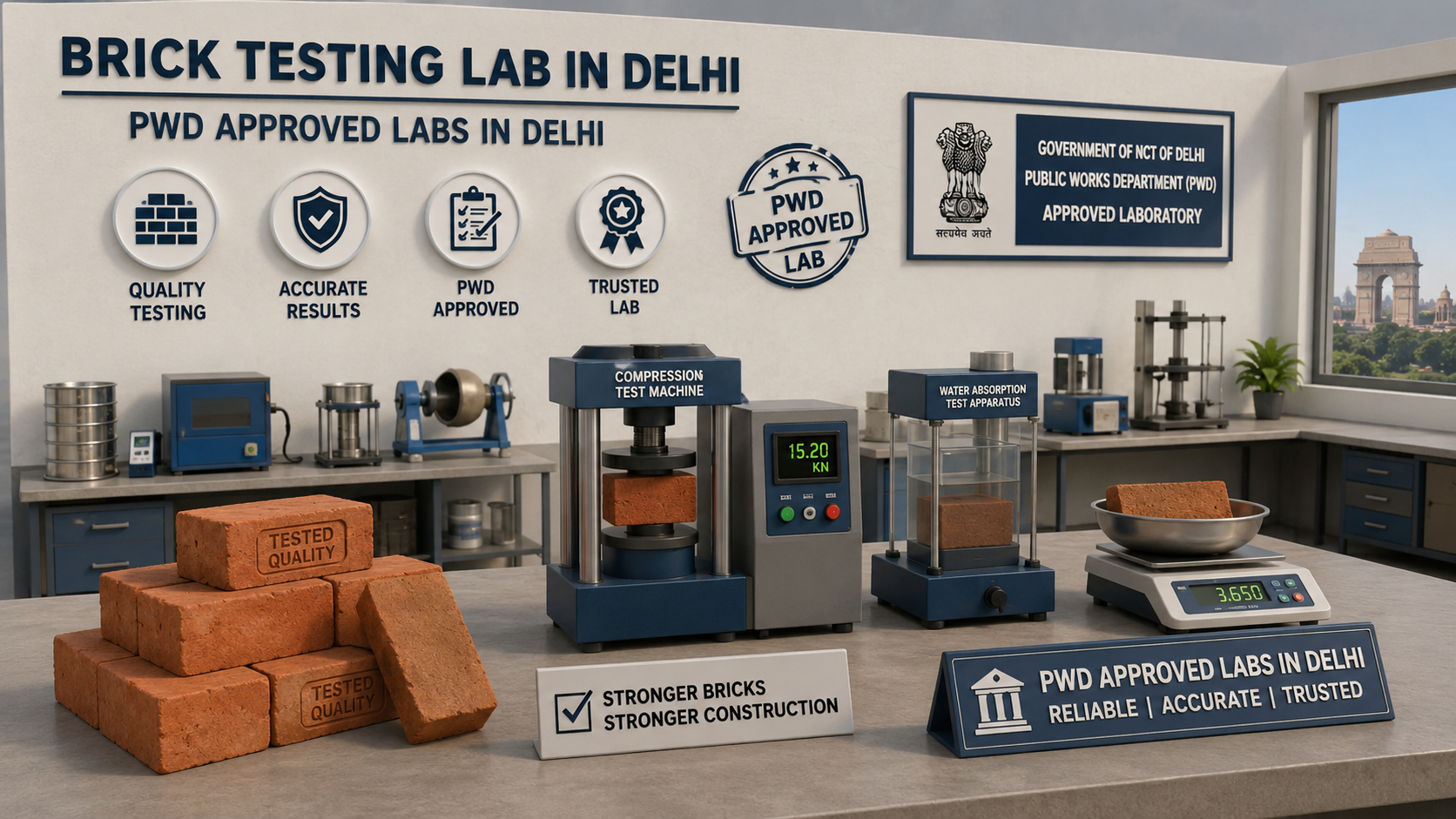
Construction quality depends heavily on the materials used at every stage of a project. Bricks, cement, concrete, aggregates, steel, soil, and water all influence the strength, durability, and safety of a structure. This makes professional material testing an important part of residential, commercial, industrial, and infrastructure development.
Choosing a reliable brick testing lab in Delhi helps builders, contractors, architects, consultants, manufacturers, and project owners understand whether bricks meet the required quality parameters. Similarly, working with appropriate PWD approved labs in Delhi may be necessary for projects where testing must follow department-specific specifications, tender conditions, or applicable standards.
Professional laboratory testing replaces assumptions with measurable results and provides documented evidence about material performance before it becomes part of a structure.
Why Brick Testing Is Important for Construction Projects
Bricks may appear simple, but their properties can significantly affect masonry performance. Poor-quality bricks can absorb excessive water, develop cracks, lose strength, or contribute to premature deterioration.
A professional brick testing lab in Delhi evaluates samples under controlled conditions using defined testing procedures. Depending on the brick type, project requirement, and applicable standard, testing may examine characteristics such as:
- Compressive strength
- Water absorption
- Dimensions and dimensional tolerance
- Efflorescence
- Density or related physical properties
- Visual characteristics
- Structure and workmanship
- Other project-specific parameters
Testing allows engineers and procurement teams to compare supplied materials against specified requirements rather than relying only on appearance or supplier claims.
Understanding Compressive Strength Testing of Bricks
Compressive strength is one of the most important properties considered when evaluating masonry units. It indicates the ability of a brick to resist compressive loads before failure.
In laboratory testing, representative brick samples are prepared according to the applicable procedure and subjected to progressively increasing load using suitable testing equipment.
The resulting data helps engineers determine whether the submitted sample meets the specified strength criteria. A competent brick testing lab in Delhi should follow the relevant test method, maintain suitable equipment, and clearly identify the testing conditions in its report.
Strength requirements should always be interpreted according to the applicable standard, project specification, brick classification, and contractual requirements rather than using one universal value for every project.
Water Absorption and Its Role in Brick Quality
Water absorption provides useful information about how much moisture a brick can absorb under specified test conditions. Excessive absorption can be associated with durability concerns, dampness, or changes in masonry performance.
During testing, specimens are generally conditioned and weighed before and after the prescribed water exposure process. The difference is used to determine water absorption according to the relevant testing method.
Testing is particularly valuable when bricks are being procured in large quantities because variations between batches may not always be visible during a basic site inspection.
Why Efflorescence Testing Matters
White or greyish salt deposits sometimes visible on masonry surfaces are commonly associated with efflorescence. Soluble salts present in bricks, mortar, water, or surrounding materials can migrate with moisture and become visible after evaporation.
Efflorescence testing helps assess the tendency of brick samples to show salt deposits under prescribed conditions.
Although the appearance of salts does not automatically establish the complete structural quality of a brick, the test provides valuable information for material selection and quality-control decisions.
What Are PWD Approved Labs in Delhi?
The term PWD approved labs in Delhi is commonly used when contractors or project teams are looking for laboratories acceptable for testing connected with Public Works Department projects.
However, laboratory eligibility should not be assumed simply from advertising language. Approval, empanelment, recognition, accreditation scope, and validity can vary by department, test, material, and project.
Before submitting samples, clients should verify the laboratory against the current tender or department requirements and ask for documentary evidence of applicable approval or recognition.
This verification is particularly important when the test report will form part of billing documentation, quality records, project approvals, inspections, or contractual compliance.
Brick Testing Lab vs PWD Approved Laboratory
| Factor | Brick Testing Laboratory | PWD Approved Laboratory |
| Primary purpose | Testing brick properties | Testing according to applicable project or departmental requirements |
| Typical users | Manufacturers, builders, architects and contractors | Government contractors and infrastructure project teams |
| Testing scope | Primarily brick or building-material parameters | May cover multiple construction materials |
| Documentation | Laboratory test report | Reports suitable for applicable project requirements |
| Verification needed | Test capability and applicable accreditation | Current departmental acceptance plus required test capability |
A laboratory can offer brick testing without necessarily satisfying a particular PWD project’s acceptance requirements. Therefore, project teams should verify both technical competence and administrative eligibility.
Materials Commonly Tested by Construction Laboratories
Many PWD approved labs in Delhi and construction-material laboratories offer testing beyond bricks. Depending on their facilities and recognized scope, they may test:
- Bricks and masonry products
- Cement and concrete
- Fine and coarse aggregates
- Reinforcement steel
- Soil and earthwork materials
- Paver blocks
- AAC blocks
- Natural stone
- Construction water
- Other building materials
Using one competent laboratory for several required tests can simplify sample tracking, reporting, documentation, and communication during a construction project.
How to Select a Reliable Brick Testing Lab in Delhi
Price should not be the only factor when selecting a laboratory. Technical capability and report acceptability are more important when results influence engineering or contractual decisions.
Before choosing a brick testing lab in Delhi, check the laboratory’s scope for the specific test you require. Ask which standard or project specification will be followed and whether the equipment used for testing is appropriately maintained and calibrated.
Also consider sample identification procedures, reporting format, expected turnaround time, traceability, and whether the laboratory’s accreditation or approval is valid for your particular requirement.
For government projects, confirm that the selected laboratory satisfies the latest tender or department conditions before sending samples.
Benefits of Using Professional Testing Services
Professional testing supports better construction quality by producing objective information about materials.
Important benefits include:
- Early identification of unsuitable materials
- Better supplier and batch evaluation
- Improved construction quality control
- Documented evidence for project records
- Reduced risk of using non-conforming materials
- Better support for engineering decisions
- Improved traceability during inspections
- Greater confidence in procurement decisions
Laboratory testing should complement proper site supervision, sampling, workmanship control, and engineering judgment rather than replace them.
Importance of Accurate Sampling and Documentation
Even a technically correct laboratory test may provide limited value if the submitted sample does not represent the actual material being used on site.
Samples should therefore be selected, identified, sealed, transported, and documented according to applicable project procedures.
Details such as supplier name, batch information, project location, sample identification, material type, collection date, and required test parameters can improve traceability.
For government or contract-based projects, sampling requirements may be specifically defined. Those instructions should be followed carefully to help ensure that reports remain acceptable for their intended purpose.
Frequently Asked Questions
1. What does a brick testing lab in Delhi test?
A laboratory may test compressive strength, water absorption, dimensions, efflorescence, and other parameters depending on the brick type and required standard.
2. Why should bricks be laboratory tested?
Testing provides measurable evidence about important properties and helps identify materials that may not meet project specifications.
3. What does PWD approved laboratory mean?
It generally refers to a laboratory recognized or accepted for relevant Public Works Department work, subject to current departmental and project requirements.
4. How can I verify whether a laboratory is PWD approved?
Ask for current documentary evidence and verify it against the requirements stated by the concerned department or project tender.
5. Is accreditation the same as PWD approval?
Not necessarily. Accreditation and departmental approval or empanelment can be separate requirements.
6. How much brick sample is required for testing?
The required quantity depends on the test method, applicable standard, project specification, and laboratory procedure.
7. Can the same laboratory test cement and concrete?
Yes, if those tests fall within the laboratory’s available facilities and applicable recognized scope.
8. How long does brick testing take?
Turnaround depends on the requested tests, sample preparation requirements, laboratory workload, and prescribed testing procedures.
9. Can a laboratory test AAC blocks and paver blocks?
Many construction laboratories can, but clients should confirm the exact test capabilities and recognized scope before submission.
10. Are laboratory reports useful for government projects?
Yes, provided the laboratory, sampling procedure, test method, and report satisfy the applicable department or contractual requirements.