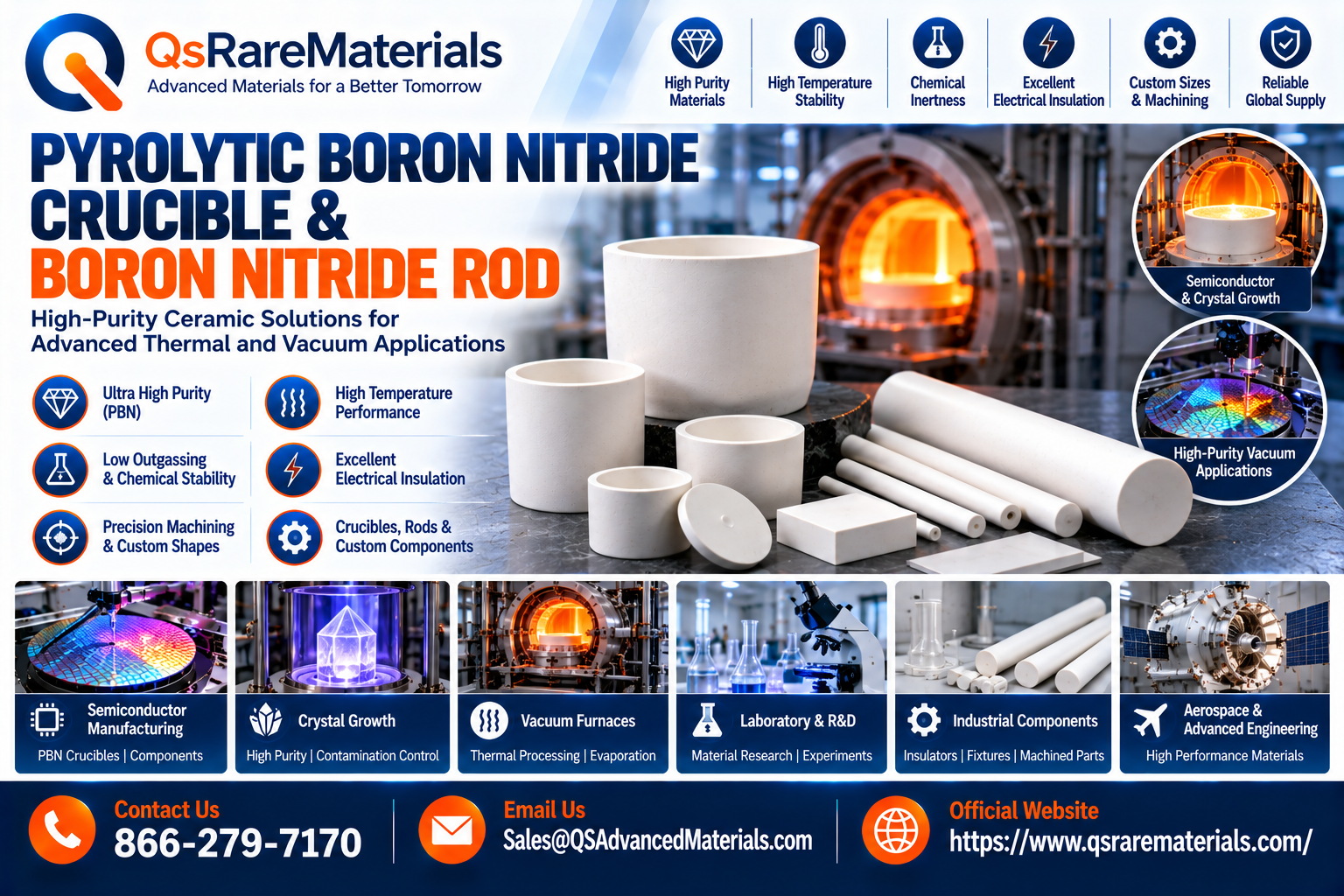
As semiconductor manufacturing, crystal growth, vacuum processing, laboratory research, electronics, and specialty metallurgy continue to demand cleaner and more stable materials, interest in the Pyrolytic Boron Nitride Crucible and Boron Nitride Rod is increasing. Both materials support high-temperature and electrically insulating applications, but they serve different engineering needs.
A pyrolytic boron nitride crucible is particularly valued where high purity, low contamination, chemical stability, and vacuum compatibility are important. A boron nitride rod, meanwhile, provides a machinable ceramic form that can be converted into insulators, supports, fixtures, rings, bushings, and other custom components.
What Is a Pyrolytic Boron Nitride Crucible?
A Pyrolytic Boron Nitride Crucible is a high-purity ceramic container manufactured from pyrolytic boron nitride, commonly known as PBN.
PBN is produced through a chemical vapor deposition process rather than conventional powder pressing and sintering. This manufacturing route can create a dense, high-purity material with low porosity and distinctive directional properties.
Typical applications may include:
- Semiconductor processing
- Crystal growth
- Thermal evaporation
- High-vacuum systems
- Specialty metallurgy
- Laboratory research
- High-temperature material handling
Because contamination control is critical in many of these applications, PBN crucibles are often considered where conventional ceramic or graphite containers may not be suitable.
Why Pyrolytic Boron Nitride Is Valuable
The usefulness of a Pyrolytic Boron Nitride Crucible comes from a combination of technical properties.
High Purity
PBN can be produced with very low impurity levels, making it attractive for semiconductor, crystal-growth, and advanced research processes.
Electrical Insulation
The material provides strong electrical insulation, even in demanding thermal environments.
High-Temperature Stability
PBN can perform at elevated temperatures, especially under vacuum or inert atmosphere conditions.
Low Outgassing
This characteristic is particularly important in vacuum systems and processes requiring a clean working environment.
Chemical Stability
PBN can resist interaction with many molten materials and process environments when properly matched to the application.
Common Uses of Pyrolytic Boron Nitride Crucibles
The Pyrolytic Boron Nitride Crucible is used in several demanding technical sectors.
Semiconductor Manufacturing
It may be used in thermal processing, evaporation, crystal preparation, and equipment requiring high-purity ceramic containment.
Crystal Growth
Sensitive crystal-growth processes can benefit from a crucible material with high purity and low contamination.
Vacuum Processing
PBN’s low outgassing and thermal performance can make it useful in high-vacuum equipment.
Thermal Evaporation
Certain coating and evaporation processes require a stable container capable of handling repeated high-temperature cycles.
Research and Development
Universities, laboratories, and advanced-material companies may use custom PBN crucibles for experimental thermal processes.
What Is a Boron Nitride Rod?
A Boron Nitride Rod is a cylindrical ceramic component manufactured from boron nitride material.
It can be supplied as a finished part or as raw stock for further machining.
Common applications include:
- Electrical insulation
- Furnace fixtures
- High-temperature supports
- Bushings
- Spacers
- Custom-machined components
- Semiconductor equipment
- Vacuum-system parts
Compared with many other advanced ceramics, hot-pressed boron nitride is relatively machinable, which makes rod stock useful for custom engineering work.
Why Boron Nitride Rods Are Popular
A Boron Nitride Rod offers a practical combination of thermal performance and machinability.
Easy Custom Machining
Depending on the grade, BN rods can often be turned, milled, drilled, and shaped using suitable techniques.
Electrical Insulation
The material is useful for components positioned near electrically active systems.
Thermal Resistance
BN rod components can be used in selected high-temperature environments.
Low Density
Compared with many metals and ceramics, boron nitride can provide a relatively lightweight solution.
Chemical Compatibility
Certain grades can resist interaction with molten metals and process chemicals.
Pyrolytic Boron Nitride vs Hot-Pressed Boron Nitride
Although both materials belong to the boron nitride family, their manufacturing methods are different.
Pyrolytic Boron Nitride is generally produced by chemical vapor deposition and is known for:
- Very high purity
- Low porosity
- Layered structure
- Strong vacuum compatibility
Hot-pressed boron nitride is typically manufactured from BN powder under heat and pressure and may be selected for:
- Machinability
- Structural components
- Custom shapes
- Rods, plates, rings, and insulators
A Pyrolytic Boron Nitride Crucible is therefore usually chosen for high-purity containment, while a Boron Nitride Rod is often selected for machining into custom technical parts.
Material Grade Selection Matters
Not all boron nitride products have identical properties.
Some grades may include secondary phases or binders that alter:
- Mechanical strength
- Machinability
- Thermal conductivity
- Electrical performance
- Chemical resistance
- Maximum recommended temperature
The correct material should be selected according to the process environment rather than by product shape alone.
Temperature and Atmosphere Must Be Considered Together
The operating atmosphere has a major effect on ceramic performance.
Applications may involve:
- Vacuum
- Argon
- Nitrogen
- Other inert gases
- Air
A boron nitride component that performs well at a particular temperature in vacuum may have a different service limit in oxidizing conditions.
For this reason, buyers should provide both temperature and atmosphere when discussing a Pyrolytic Boron Nitride Crucible or Boron Nitride Rod application.
Thermal Shock Resistance
Rapid heating and cooling can damage technical ceramics.
Boron nitride generally offers useful thermal-shock resistance, which can benefit:
- Repeated furnace cycles
- Laboratory experiments
- Semiconductor processing
- Thermal evaporation
However, actual performance depends on part geometry, wall thickness, temperature gradient, material grade, and heating rate.
A crucible with unnecessarily thin walls may behave differently from a thicker design.
Machining Boron Nitride Rods
A Boron Nitride Rod can often be machined into a wide range of custom geometries.
Possible operations include:
- Turning
- Drilling
- Milling
- Cutting
- Grinding
- Threading where suitable
This allows manufacturers to create:
- Nozzles
- Insulating sleeves
- Spacers
- Rings
- Bushings
- Custom fixtures
Appropriate dust-control and industrial safety measures should be used during machining.
Custom Dimensions and Engineering Drawings
Advanced-material components are often application-specific.
A PBN crucible may require custom:
- Diameter
- Height
- Wall thickness
- Bottom thickness
- Flange geometry
A BN rod may require specific:
- Diameter
- Length
- Machining tolerance
- Surface finish
Providing a drawing can help the supplier assess manufacturability and reduce unnecessary revisions.
Purity and Contamination Control
Purity is especially important in semiconductor and crystal-growth applications.
Even small levels of contamination can influence:
- Material quality
- Process repeatability
- Coating purity
- Crystal formation
- Experimental results
A Pyrolytic Boron Nitride Crucible is particularly useful where strict contamination control is required.
For rod applications, buyers should also specify whether a standard BN grade is acceptable or whether a higher-purity formulation is needed.
Quality Control for Boron Nitride Products
Inspection may include:
- Dimensional measurement
- Surface inspection
- Material verification
- Purity documentation where required
- Visual crack inspection
- Machining tolerance checks
- Packaging verification
- Batch traceability for critical applications
High-value PBN components should be handled carefully because advanced ceramics can still be brittle.
Packaging and Transportation
Proper packaging protects finished surfaces and thin-wall ceramic structures.
Useful protective methods may include:
- Individual wrapping
- Foam cushioning
- Rigid internal boxes
- Shock-resistant outer cartons
- Moisture-protective packaging where required
Crucibles, rings, and machined rods should be protected from edge impact during international transport.
Frequently Asked Questions
What is a Pyrolytic Boron Nitride Crucible?
A Pyrolytic Boron Nitride Crucible is a high-purity ceramic container produced from PBN for high-temperature, vacuum, semiconductor, crystal-growth, and research applications.
What is a Boron Nitride Rod?
A Boron Nitride Rod is a cylindrical BN ceramic component used as finished hardware or as machinable stock for custom technical parts.
Why is PBN used for high-purity processing?
Its low porosity, low outgassing, and high purity can help reduce contamination in sensitive processes.
Is boron nitride electrically conductive?
Boron nitride is generally an electrical insulator, although exact properties depend on material grade and operating conditions.
Can PBN crucibles withstand high temperatures?
Yes, under suitable atmosphere and operating conditions. The allowable temperature depends on the specific grade and process environment.
Can boron nitride rods be machined?
Yes. Many hot-pressed BN grades can be turned, milled, drilled, and otherwise machined more easily than many technical ceramics.
Can crucibles be customized?
Yes. Diameter, height, wall thickness, bottom geometry, and other dimensions can be customized.
What industries use PBN crucibles?
Semiconductor, vacuum technology, crystal growth, laboratory research, thermal processing, and specialty-material industries commonly use them.
What information is needed for a quotation?
Useful details include dimensions, material grade, purity, quantity, operating temperature, atmosphere, processed material, and technical drawings.
Should samples be tested before bulk orders?
For specialized applications, sample evaluation can help confirm fit, compatibility, and process performance before larger orders are placed.
Media Contact
Boron Nitride & Advanced Materials Enquiries
Contact: 866-279-7170
Email: Sales@QSAdvancedMaterials.com
Official Website: https://www.qsrarematerials.com/