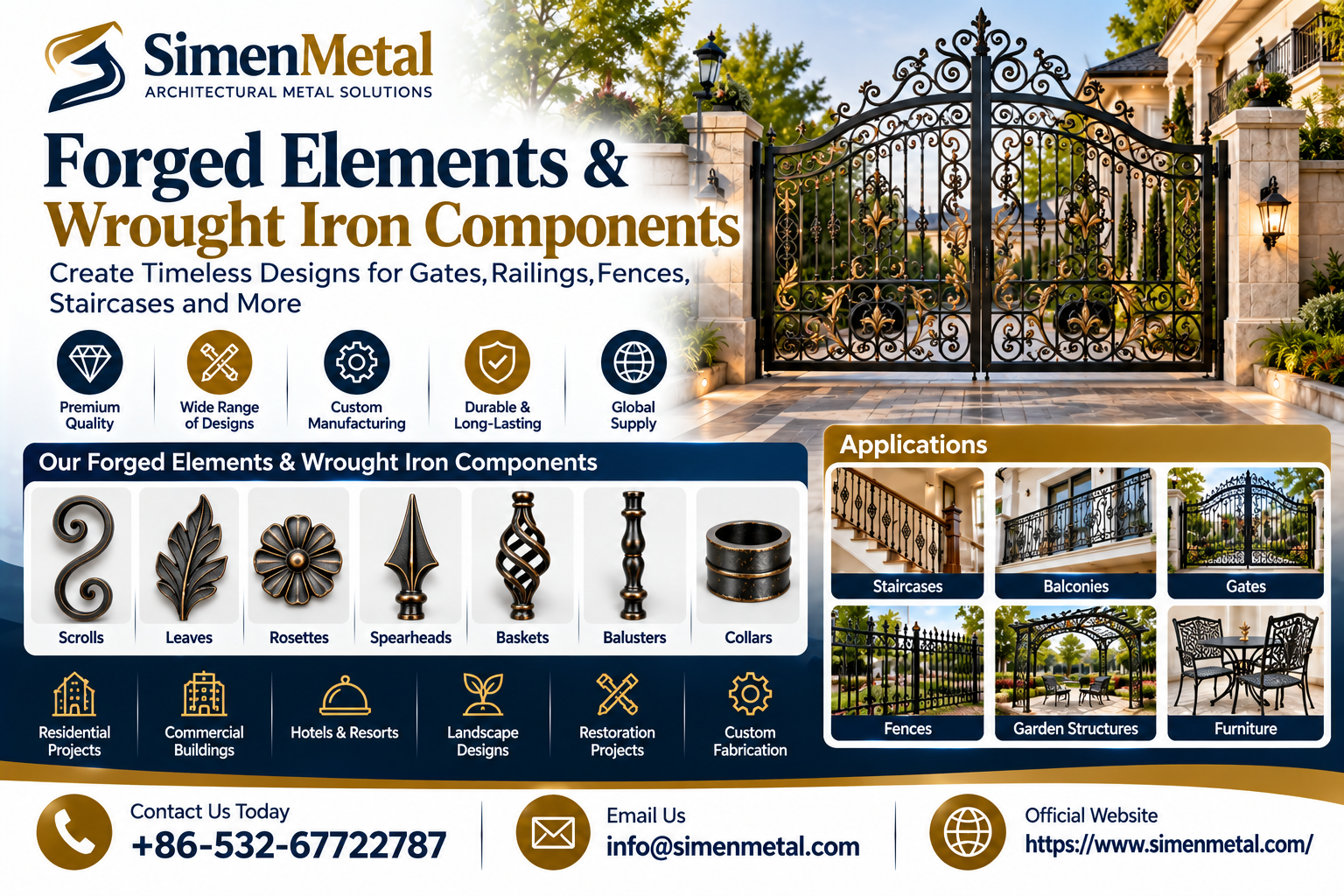
Demand for customized gates, staircases, railings, balconies, fences, furniture, and landscape structures continues to support growth in decorative metal fabrication. At the center of this trend are Forged Elements and Wrought Iron Components, which allow fabricators, architects, contractors, and designers to combine traditional ornamental character with efficient modern production.
From decorative scrolls and leaves to balusters, baskets, collars, rosettes, and spearheads, these components can be incorporated into both classical and contemporary architectural projects. Their modular nature enables workshops to create distinctive designs without manufacturing every ornamental detail from the beginning.
What Are Forged Elements?
Forged Elements are metal pieces shaped through forging, forming, pressing, twisting, or related fabrication methods to create functional or ornamental components.
They may include:
- Scrolls
- Leaves
- Flowers
- Rosettes
- Baskets
- Twisted bars
- Decorative rings
- Spearheads
- Collars
- Forged panels
These pieces are commonly incorporated into larger fabricated structures such as gates, stair railings, balconies, fences, doors, furniture, and garden features.
Because individual elements can be combined in numerous arrangements, fabricators have considerable design flexibility.
Why Forged Elements Remain Popular
Architectural trends continue to change, but forged metal has maintained long-term appeal because it can support both traditional ornamentation and simplified modern styling.
Traditional designs may feature:
Scrollwork
Curved scrolls can create flowing patterns for gates, railings, and balcony sections.
Floral Motifs
Leaves, flowers, vines, and rosettes are commonly used in ornamental projects.
Twisted Profiles
Twisted bars can add texture without requiring highly elaborate ornamentation.
Baskets and Collars
These smaller pieces can break up straight sections and add detail to repetitive railing patterns.
Modern projects may use fewer components with cleaner spacing and simpler geometry.
Understanding Wrought Iron Components
Wrought Iron Components are ready-to-use or customizable metal parts intended for incorporation into decorative architectural assemblies.
They can help fabricators create repeatable designs while maintaining consistency throughout larger projects.
Common applications include:
- Main entrance gates
- Staircases
- Balcony railings
- Boundary fences
- Window grilles
- Garden structures
- Decorative furniture
- Interior partitions
A railing, for example, may combine straight balusters, forged baskets, collars, scrolls, and a custom handrail into one cohesive system.
Forged Components in Gates
Entrance gates are among the most visible applications for Forged Elements.
A gate may feature:
- Decorative centers
- Scroll sections
- Spearhead tops
- Ornamental leaves
- Rosettes
- Forged borders
Designers can use dense ornamentation for a traditional luxury appearance or select only a few decorative accents for a cleaner modern gate.
The final pattern should remain balanced so that decoration supports rather than overwhelms the structure.
Stair Railings and Balusters
Staircases often become major architectural focal points inside homes, villas, hotels, and commercial buildings.
Wrought Iron Components can be combined with:
- Wooden handrails
- Metal handrails
- Stone staircases
- Decorative newel posts
- Custom balusters
Repeated patterns require dimensional consistency because even small variations become visible across a long staircase.
Component accuracy can therefore directly affect fabrication efficiency and installation quality.
Balconies, Terraces, and Fences
Outdoor applications require decorative appeal as well as durability.
Iron components can be used for:
Balcony Railings
Decorative sections can complement classic, Mediterranean, European, or contemporary architecture.
Boundary Fences
Spearheads, scrolls, and forged bars can improve visual character while maintaining an open boundary design.
Terrace Railings
Simpler profiles with occasional decorative elements can create an elegant look without excessive ornamentation.
Because outdoor metalwork is exposed to weather, appropriate surface protection is essential.
Material Consistency Matters
Decorative appearance should not be the only consideration when sourcing Forged Elements.
Fabricators also need predictable:
- Dimensions
- Material thickness
- Shape
- Surface condition
- Weldability
- Finish quality
Consistent components help reduce grinding, adjustment, and alignment work during fabrication.
This becomes especially important in commercial or hospitality projects involving hundreds of repeated pieces.
Custom Manufacturing Supports Unique Projects
Standard catalog components provide convenience, but many architectural projects require custom dimensions or patterns.
Customized Wrought Iron Components may be produced from:
- Technical drawings
- CAD designs
- Reference samples
- Project-specific measurements
Customization can be useful for luxury villas, feature gates, heritage restorations, hotels, and commercial developments where off-the-shelf ornamentation may not match the design concept.
Surface Finishing Protects Decorative Ironwork
Iron-based products typically require protective finishing, especially outdoors.
Common options include:
- Powder coating
- Galvanizing
- Primer and paint systems
- Antique finishes
- Decorative patinas
A black powder-coated finish can create a modern or traditional appearance depending on the component style, while bronze or antique effects may suit classical projects.
Good surface preparation is critical because contamination, corrosion, or mill scale can reduce coating performance.
Forged Elements for Furniture and Landscaping
Architectural metalwork is not limited to buildings.
Forged Elements may also be incorporated into:
- Garden tables
- Chairs
- Benches
- Pergolas
- Arches
- Trellises
- Planters
- Decorative screens
Using similar ornamental motifs across gates, furniture, and landscape features can help create a consistent design language throughout a property.
Restoration and Heritage Metalwork
Restoration projects often require components that resemble historical ironwork.
Existing parts may be damaged, missing, or too deteriorated to reuse.
Customized Wrought Iron Components can help reproduce:
- Balusters
- Rosettes
- Scrolls
- Decorative leaves
- Finials
Accurate restoration requires attention to scale, pattern, dimensions, and surface appearance so that replacement parts integrate naturally with the original structure.
Quality Control for Forged Metal Products
Reliable production should include inspection of:
- Dimensions
- Shape consistency
- Surface condition
- Weld areas
- Decorative details
- Finish quality
Products intended for export should also receive appropriate packaging.
Separators, protective wrapping, cartons, pallets, or wooden cases can help reduce scratches, deformation, and impact damage during transportation.
How to Select the Right Components
The correct component depends on the final architectural style.
For traditional properties, buyers may choose complex scrolls, floral patterns, and baskets.
For modern buildings, simpler Forged Elements with geometric shapes may be more suitable.
Before ordering, buyers should provide clear details including:
- Component dimensions
- Quantity
- Material requirements
- Drawings or reference designs
- Surface finish
- Packaging requirements
Clear specifications reduce misunderstandings and improve production consistency.
Frequently Asked Questions
What are Forged Elements?
Forged Elements are shaped metal components used for decorative or functional purposes in gates, railings, fences, staircases, furniture, and architectural structures.
What are Wrought Iron Components?
Wrought Iron Components are ornamental or structural metal parts such as scrolls, balusters, collars, baskets, leaves, rosettes, and spearheads used in fabricated ironwork.
Where can forged components be used?
They are commonly used in gates, staircases, balconies, fences, doors, furniture, gardens, hotels, villas, and commercial buildings.
Can forged iron components be customized?
Yes. Sizes, designs, motifs, and finishes can be produced according to drawings or project requirements.
Are forged elements suitable for outdoor use?
Yes, provided they receive suitable corrosion protection and surface finishing.
What finishes are available for decorative ironwork?
Common finishes include powder coating, galvanizing, painting, antique effects, and decorative patinas.
Can wrought iron components be welded?
Many components are designed for integration into welded fabricated structures, subject to appropriate material and fabrication methods.
Are standard components useful for custom projects?
Yes. Standard elements can be arranged in different combinations to create highly customized finished designs.
What information is needed for a quotation?
Buyers should provide dimensions, drawings, quantity, material specifications, required finish, and packaging requirements.
Why is packaging important for forged components?
Good packaging helps protect shapes and finishes from scratches, bending, and impact damage during transportation.
Media Contact
Architectural Metalwork & Business Enquiries
Contact: +86-532-67722787
Email: info@simenmetal.com
Official Website: https://www.simenmetal.com/