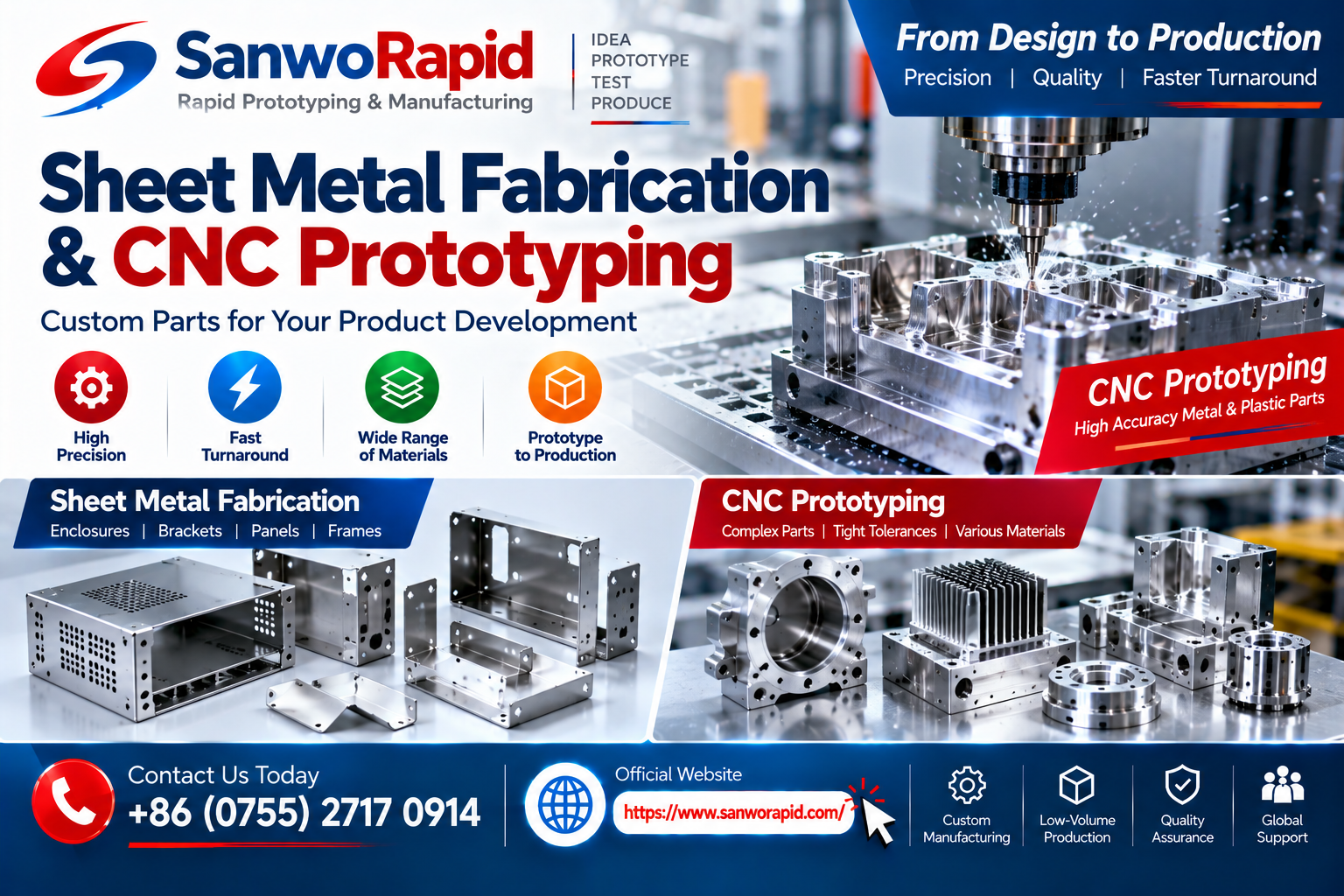
Product developers are increasingly under pressure to shorten development cycles, validate designs earlier, and reduce the risk of costly production changes. As a result, sheet metal fabrication and cnc prototyping have become essential manufacturing methods for companies developing enclosures, brackets, housings, machinery components, electronic products, automotive parts, and industrial assemblies.
Both processes enable engineers to move quickly from CAD models to physical components. Sheet metal methods are particularly effective for structural panels, folded enclosures, and fabricated assemblies, while CNC machining provides precise prototypes directly from engineering-grade metals and plastics.
Why Sheet Metal Fabrication Is Important in Product Development
Sheet metal fabrication converts flat metal sheets into finished components through processes such as cutting, bending, punching, welding, and finishing.
It is commonly used for:
- Electronic enclosures
- Machine covers
- Mounting brackets
- Control cabinets
- Automotive components
- Chassis and frames
- Industrial housings
- Equipment panels
Because many sheet metal components can be produced without expensive dedicated tooling, the process works particularly well for prototypes and low-volume production.
It also allows engineering teams to test real materials and real assembly methods before investing in higher-volume manufacturing.
How Sheet Metal Fabrication Works
A typical project begins with a CAD design or technical drawing.
The manufacturing process may follow:
Design Review → Material Selection → Cutting → Bending → Welding or Assembly → Finishing → Inspection
Different technologies may be used at each stage.
Laser Cutting
Laser cutting provides accurate profiles and holes with relatively clean edges.
CNC Punching
Punching may be suitable for repetitive holes, slots, and formed features.
Bending
Press brakes create controlled folds and angles in the sheet.
Welding
Welding joins multiple fabricated components into a larger assembly.
Finishing
Painting, powder coating, brushing, plating, or other treatments may improve appearance and corrosion protection.
Material Selection in Sheet Metal Projects
Selecting the right material can influence strength, weight, corrosion resistance, and manufacturing cost.
Common materials include:
- Aluminum
- Stainless steel
- Mild steel
- Galvanized steel
- Copper and specialty metals for selected applications
Aluminum is often selected where lower weight is important. Stainless steel may be preferred for corrosion resistance, while mild steel can be practical for strong structural components.
The correct choice depends on how the finished product will be used.
What Is CNC Prototyping?
CNC prototyping uses computer-controlled machining equipment to produce prototype parts from blocks, bars, or other forms of solid material.
CNC milling and turning can create highly accurate components directly from CAD data.
The process is widely used for:
- Metal housings
- Mechanical parts
- Fixtures
- Precision brackets
- Plastic prototypes
- Heat sinks
- Functional assemblies
- Custom engineering components
Because no mold is required, CNC machining is particularly useful during early and intermediate product-development stages.
Why CNC Prototyping Is Valuable
One major advantage of cnc prototyping is the ability to produce parts from materials that are similar—or identical—to those intended for final production.
This can support more realistic evaluation of:
Fit
Machined components can be assembled with other parts to verify interfaces and dimensions.
Function
Engineers can perform mechanical tests using actual engineering materials.
Tolerances
Critical dimensions can be evaluated before production specifications are finalized.
Appearance
Machined prototypes can receive surface finishes that make them suitable for presentations, exhibitions, or customer review.
CNC Milling and CNC Turning
Different geometries require different machining methods.
CNC Milling
Milling is commonly used for blocks, plates, housings, pockets, holes, and three-dimensional surfaces.
CNC Turning
Turning is suitable for cylindrical components such as shafts, bushings, spacers, and threaded parts.
Projects may combine both operations to produce more complex components.
Modern multi-axis machining can also reduce the number of setups required for complicated geometries.
Combining Sheet Metal Fabrication and CNC Prototyping
These technologies often work together within the same product.
Consider an industrial electronic device. It might require:
- A folded sheet metal enclosure
- CNC-machined aluminum heat sinks
- Precision spacers
- Custom brackets
- Machined mounting blocks
- Finished exterior panels
By combining sheet metal fabrication with cnc prototyping, engineers can assemble a nearly complete production-representative prototype before committing to larger quantities.
This helps identify fit, fastening, tolerance, and assembly problems early.
Design for Manufacturing Reduces Risk
Design for Manufacturing, or DFM, is an important part of both processes.
For sheet metal parts, DFM may evaluate:
- Material thickness
- Bend radius
- Hole-to-edge distances
- Bend relief
- Flange length
- Welding access
- Fastener placement
For CNC-machined components, engineers may review:
- Tool accessibility
- Internal corner radii
- Deep pockets
- Hole depth
- Thread design
- Wall thickness
- Tolerances
Addressing these issues before production begins can reduce lead time and unnecessary cost.
Tolerances Should Match Functional Requirements
One common prototyping mistake is applying extremely tight tolerances to every feature.
Tighter tolerances generally require more machining time, additional inspection, and sometimes specialized processes.
Instead, engineers should clearly identify critical features such as:
- Mating surfaces
- Bearing locations
- Mounting holes
- Alignment features
- Precision interfaces
Non-critical dimensions may allow broader manufacturing tolerances.
This approach makes cnc prototyping more efficient without compromising performance.
Surface Finishing Creates Production-Like Prototypes
Both CNC and sheet metal components can receive production-style finishes.
Options may include:
- Anodizing
- Powder coating
- Painting
- Bead blasting
- Brushing
- Polishing
- Plating
- Laser marking
A finished prototype can be useful for marketing photography, trade shows, customer demonstrations, investor presentations, and design approvals.
Finishing also allows teams to evaluate final colors, textures, and appearance before larger production runs.
Prototyping Can Lead Directly to Low-Volume Manufacturing
After a prototype is approved, companies often require limited quantities before full-scale production.
These early production parts may be needed for:
- Pilot assembly
- Market testing
- Certification
- Engineering trials
- Initial customer orders
- Product demonstrations
The same sheet metal fabrication and cnc prototyping processes used during development can often continue into low-volume manufacturing.
This reduces the gap between prototype validation and commercial production.
Quality Inspection Is Essential
Fast manufacturing should still include appropriate quality control.
Depending on the project, inspection methods can include:
- Calipers
- Micrometers
- Height gauges
- Thread gauges
- Optical measurement
- Coordinate measuring machines
Engineering drawings should identify critical dimensions, tolerances, materials, and finishes clearly.
Accurate documentation helps suppliers understand which features require the greatest attention.
Frequently Asked Questions
What is sheet metal fabrication?
Sheet metal fabrication is the process of cutting, bending, joining, and finishing metal sheets to create parts such as enclosures, brackets, panels, and frames.
What is CNC prototyping?
CNC prototyping uses computer-controlled machining equipment to produce accurate prototype components directly from engineering materials.
Which materials can be used for sheet metal parts?
Common options include aluminum, mild steel, stainless steel, galvanized steel, and selected specialty metals.
Is CNC machining suitable for one prototype?
Yes. CNC machining is frequently used for one-off prototypes as well as small production quantities.
Can sheet metal prototypes be welded?
Yes. Welding is commonly used to create frames, enclosures, cabinets, and other multi-part assemblies.
What files are required for manufacturing?
A 3D CAD model is typically useful, while technical drawings help communicate tolerances, threads, materials, and finishing requirements.
Why is DFM important?
DFM identifies manufacturing challenges before production, helping engineers reduce redesign, delays, and unnecessary cost.
Can prototype parts receive surface finishing?
Yes. Finishes can include anodizing, painting, powder coating, polishing, bead blasting, and other treatments depending on the material.
Can CNC and sheet metal parts be used in the same assembly?
Yes. Many industrial products combine precision-machined components with fabricated sheet metal structures.
Can these processes support low-volume production?
Yes. Both methods are widely used for prototypes, pilot builds, and low-volume manufacturing.
Media Contact
Rapid Prototyping & Manufacturing Enquiries
Contact: +86 (0755) 2717 0914
Official Website: https://www.sanworapid.com/