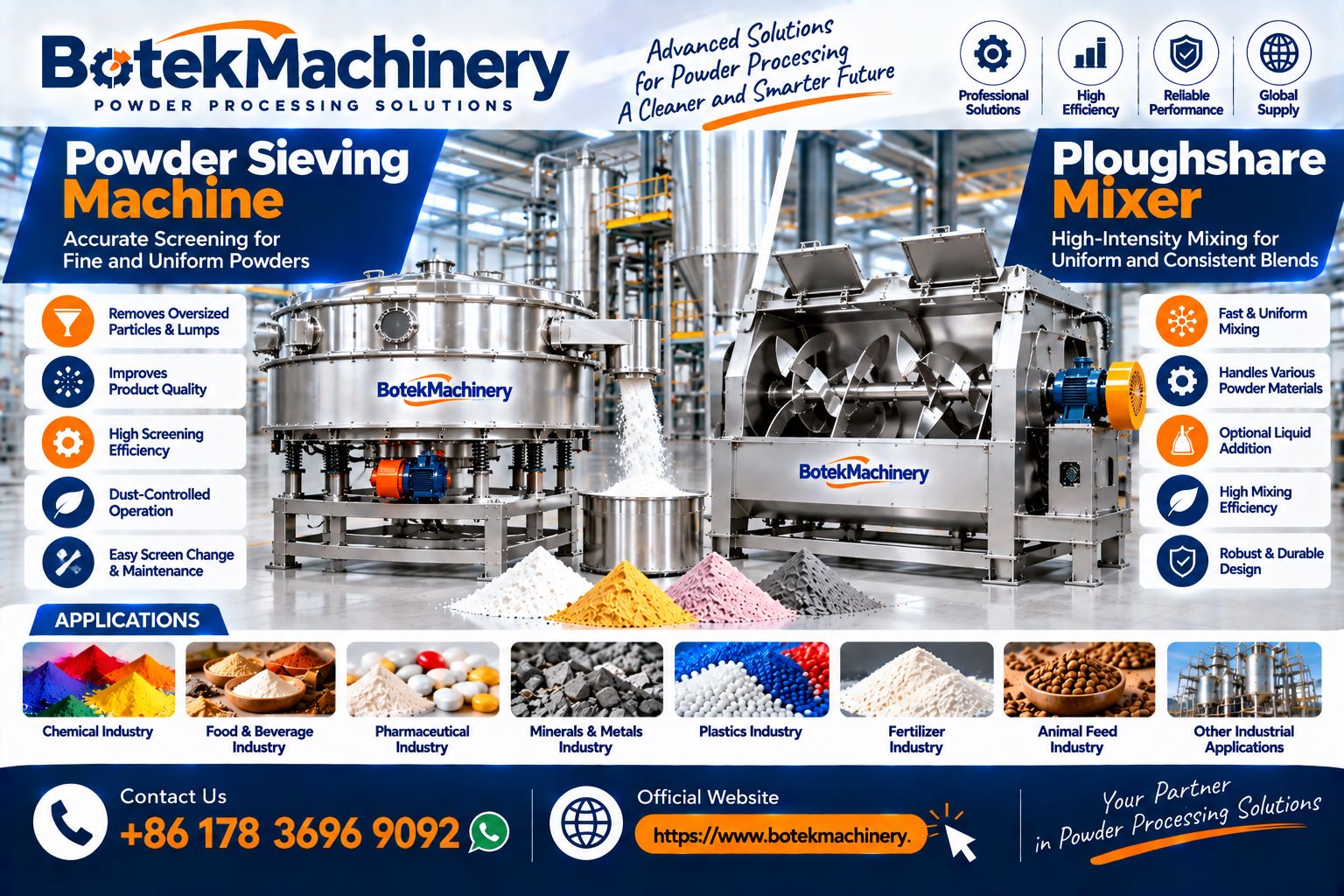
Manufacturers handling powders, granules, food ingredients, chemicals, pharmaceuticals, minerals, fertilizers, plastics, and specialty materials are increasingly focused on cleaner handling, faster processing, and more consistent final products. Two technologies supporting these goals are the powder sieving machine and ploughshare mixer.
A powder sieving machine is used to separate unwanted oversized particles, lumps, or foreign material from a powder stream. A ploughshare mixer performs the next critical task: rapidly distributing different ingredients throughout a batch to achieve a uniform blend. When properly integrated, these systems can help create a more controlled powder-processing line from raw-material preparation through final mixing.
What Is a Powder Sieving Machine?
A powder sieving machine is industrial screening equipment designed to separate particles according to size.
Material is passed across a mesh or screening surface. Particles within the desired range pass through, while oversized particles or unwanted material are retained or discharged separately.
Typical applications can include:
- Food powders
- Pharmaceutical ingredients
- Chemicals
- Pigments
- Minerals
- Fertilizer materials
- Plastic additives
- Nutritional powders
Depending on the material, screening may use vibration, centrifugal force, rotary movement, or another mechanical method.
Why Powder Sieving Is Important
Powders can develop lumps or agglomerates during storage, transportation, and handling.
If these enter subsequent processing stages, manufacturers may experience:
- Inconsistent blending
- Blocked feeders
- Poor product appearance
- Reduced flowability
- Packaging problems
- Variable product quality
A powder sieving machine helps condition raw material before it reaches the mixer.
This can be especially useful when formulations require predictable particle distribution.
Selecting the Right Screen
Screen size has a direct impact on product quality and throughput.
An opening that is too large may fail to remove unwanted material. A screen that is unnecessarily fine may slow production and increase blockage.
Important considerations include:
- Required particle size
- Feed particle distribution
- Moisture level
- Powder flowability
- Throughput requirement
- Agglomerate characteristics
The best screen specification balances product control with practical production capacity.
Dust Control During Sieving
Screening fine powders can generate airborne dust.
Modern equipment may incorporate:
- Enclosed screening sections
- Dust extraction
- Sealed transfer connections
- Filters
- Negative-pressure arrangements
Reducing dust can support better housekeeping, lower product loss, and improved process containment.
Where combustible powders are involved, appropriate dust-hazard assessment and engineering controls are particularly important.
What Is a Ploughshare Mixer?
A ploughshare mixer is an intensive horizontal mixer designed to rapidly blend powders, granules, and selected formulations.
Inside the mixing chamber, a rotating shaft carries plough-shaped mixing elements.
As these elements rotate, they lift, separate, and redistribute material throughout the vessel.
The result is highly active three-dimensional movement that can support rapid and consistent blending.
Materials Suitable for Ploughshare Mixing
Depending on configuration, a ploughshare mixer may be suitable for:
- Chemical powders
- Food premixes
- Pharmaceutical materials
- Minerals
- Fertilizers
- Animal-feed ingredients
- Plastic additives
- Pigments
- Detergent powders
Its intensive mixing action makes it particularly useful when manufacturers need to distribute smaller ingredients through a larger bulk material efficiently.
How a Ploughshare Mixer Works
Material enters the horizontal mixing chamber, where the rotating plough elements create strong movement.
During processing:
- Ingredients are lifted from the powder bed.
- Material is distributed throughout the chamber.
- Different components repeatedly intersect and recombine.
- Continued movement develops a more uniform blend.
- Finished material is discharged for downstream processing.
The required mixing time depends on formulation properties, batch size, speed, and product-quality requirements.
Optional High-Speed Choppers
Certain formulations contain agglomerates that may need additional dispersion.
Some ploughshare systems can incorporate high-speed choppers.
These devices may help:
- Break smaller lumps
- Distribute additives
- Support liquid incorporation
- Improve dispersion
Whether choppers are required depends on the material and intended final product.
Liquid Addition During Mixing
Some dry formulations require oils, binders, flavours, or other liquid ingredients.
A ploughshare mixer may be equipped with spraying systems for controlled liquid addition.
Important factors include:
- Addition rate
- Spray pattern
- Droplet size
- Mixing intensity
- Liquid concentration
- Powder absorption
Poor liquid distribution can produce agglomerates or inconsistent batches, so process trials may be important.
Integrating Sieving and Mixing
A powder sieving machine and ploughshare mixer can work effectively in sequence.
A typical process arrangement may be:
Raw Material → Sieving → Controlled Feeding → Mixing → Product Discharge → Packaging
Screening upstream helps ensure that oversized particles or lumps are removed before ingredients enter the mixer.
This can improve both mixing consistency and downstream material handling.
Why Controlled Feeding Matters
Ingredients should enter the mixer accurately and consistently.
Poor feeding can affect formulation ratios and reduce batch repeatability.
Depending on the plant, feeding systems may include:
- Screw feeders
- Loss-in-weight feeders
- Rotary valves
- Gravity systems
- Pneumatic conveying
Automated dosing can be especially valuable when recipes contain several ingredients at different percentages.
Preventing Segregation After Mixing
Achieving a uniform blend is only part of the process.
A mixture can segregate again if particles have significant differences in size, density, or shape.
Manufacturers can reduce segregation risks by considering:
- Short transfer distances
- Controlled discharge
- Gentle conveying
- Suitable hopper geometry
- Reduced free-fall height
The transfer system after the ploughshare mixer should therefore be designed with the same care as the mixing process itself.
Cleaning and Hygiene
Food, pharmaceutical, and specialty chemical facilities may require regular product changeovers.
Equipment design can support cleaning through:
- Smooth product-contact surfaces
- Accessible interiors
- Removable screens
- Large inspection doors
- Reduced dead zones
- Suitable construction materials
A hygienic process should consider both screening and mixing equipment as part of one production line.
Automation and Process Control
Modern powder plants increasingly integrate machines through centralized control systems.
Automation may help monitor:
- Feed rate
- Sifter operation
- Ingredient weight
- Mixer speed
- Mixing time
- Motor load
- Product level
- Batch status
Recipe-based automation can improve repeatability while reducing manual adjustments.
Frequently Asked Questions
What is a powder sieving machine?
A powder sieving machine is industrial screening equipment designed to separate powders according to particle size and remove lumps or oversized material.
What is a ploughshare mixer?
A ploughshare mixer is a horizontal industrial mixer using rotating plough-shaped elements to rapidly blend powders and granules.
Why should powders be sieved before mixing?
Sieving can remove agglomerates and unwanted oversized material, helping create a more consistent feed for mixing.
What industries use powder sieving machines?
They are commonly used in food, pharmaceutical, chemical, mineral, fertilizer, plastics, and specialty-powder industries.
What materials can a ploughshare mixer process?
Depending on equipment design, it can process powders, granules, additives, food ingredients, chemicals, minerals, pigments, and similar materials.
Can liquids be added to a ploughshare mixer?
Yes, certain configurations can incorporate controlled liquid spraying systems.
What affects mixing quality?
Particle size, density, ingredient concentration, moisture, batch size, mixing speed, and operating time can all affect blending.
Can the sieving machine feed directly into the mixer?
Yes. It can be integrated through gravity discharge, feeders, conveyors, or pneumatic transfer systems.
How should the correct screen mesh be selected?
Mesh size should be based on the required final particle range, material characteristics, and throughput.
Should equipment be tested with the actual product?
Where possible, material trials can help confirm screening efficiency, mixing quality, capacity, and cleaning requirements before final equipment selection.
Media Contact
Sales & Media Enquiries
Contact: +86 178 3696 9092
Official Website: https://www.botekmachinery.