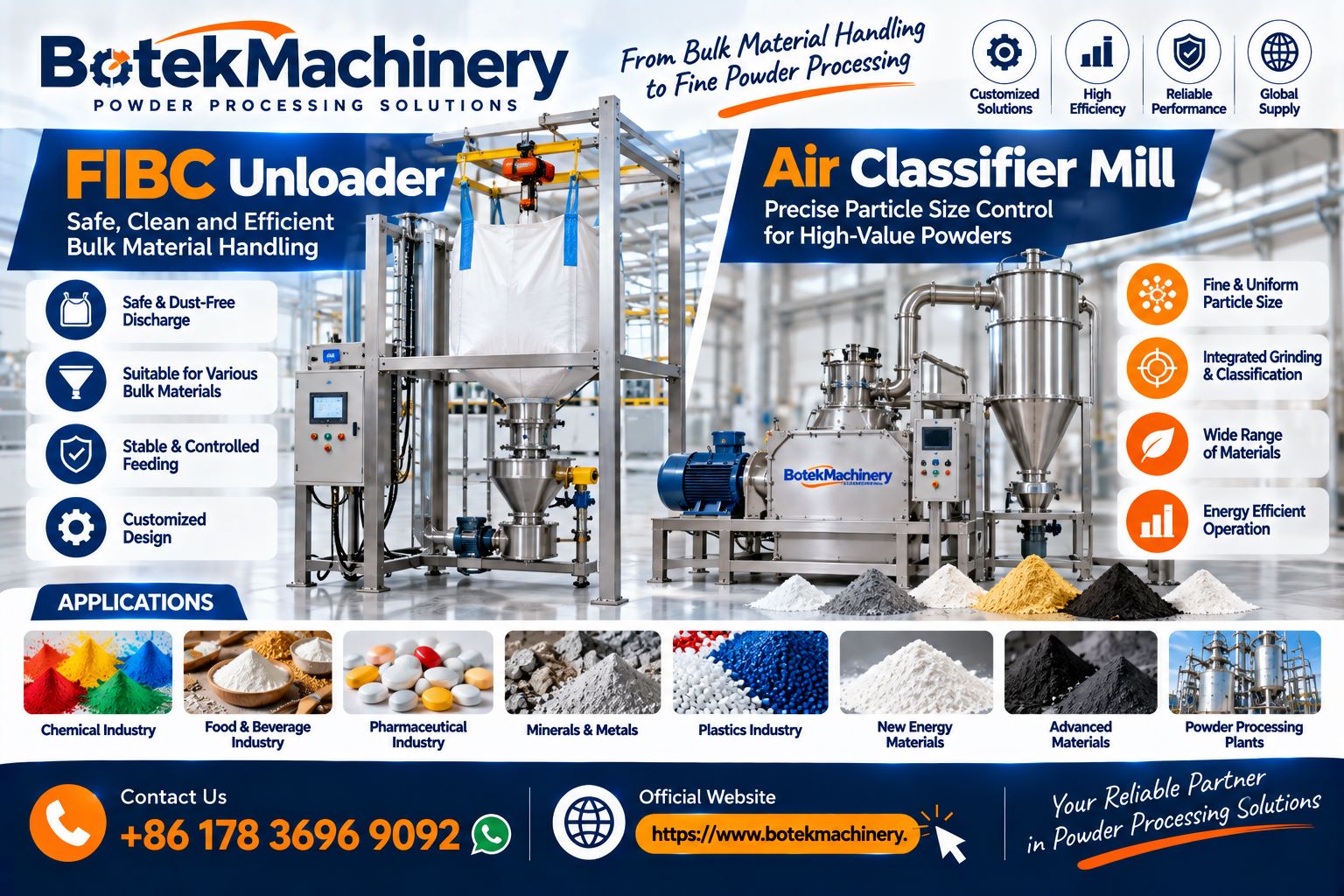
Manufacturers handling powders are under growing pressure to improve particle-size consistency, reduce dust, increase throughput, and create safer material-handling workflows. Two technologies that are becoming increasingly important in these environments are the air classifier mill and FIBC unloader. While one focuses on fine grinding and particle classification, the other is designed to discharge bulk powders from flexible intermediate bulk containers in a controlled and efficient way.
Together, these systems can support a more streamlined powder-processing line across industries such as chemicals, food ingredients, minerals, pharmaceuticals, plastics, pigments, and specialty materials. The key is to match equipment design to product characteristics, target particle size, flow behaviour, hygiene requirements, and production goals.
What Is an Air Classifier Mill?
An air classifier mill is a grinding system that combines impact milling with integrated air classification.
Instead of simply reducing material size and allowing all particles to leave together, the system separates particles according to their size during processing.
The basic process typically involves:
- Feeding material into the grinding chamber
- Applying mechanical impact
- Using airflow to transport particles
- Separating fine and oversized material
- Returning larger particles for additional grinding
- Collecting finished powder
This integrated approach can help manufacturers achieve a narrower particle-size distribution.
Why Air Classification Matters
Particle size can directly influence product performance.
In industries such as chemicals, coatings, food, minerals, and pharmaceuticals, inconsistent particle size may affect:
- Mixing
- Solubility
- Texture
- Flowability
- Reaction behaviour
- Product appearance
- Downstream processing
An air classifier mill gives processors greater control because particles that are not yet fine enough can remain in the system until they reach the desired range.
Key Advantages of an Air Classifier Mill
Depending on product and system design, advantages can include:
- Fine particle production
- Controlled particle-size distribution
- Integrated classification
- Reduced need for separate screening
- Continuous processing
- Adjustable operating parameters
The target fineness can often be influenced by factors such as classifier speed, airflow, feed rate, and grinding conditions.
Materials Commonly Processed
An air classifier mill may be considered for a wide range of dry materials.
Typical examples include:
- Chemical powders
- Food ingredients
- Minerals
- Pigments
- Resins
- Additives
- Pharmaceutical ingredients
- Specialty powders
However, product characteristics matter.
Hardness, moisture, oil content, temperature sensitivity, abrasiveness, and explosibility can all influence equipment selection.
Dust Control in Fine Powder Processing
Fine grinding can generate significant airborne dust if the system is not properly enclosed.
Modern powder-processing lines often integrate:
- Dust collection
- Negative-pressure operation
- Sealed transfer systems
- Filters
- Closed receivers
These measures can improve housekeeping and reduce product loss.
For materials that present combustible-dust risks, appropriate process-safety evaluation and equipment design are essential.
What Is an FIBC Unloader?
An FIBC unloader is equipment designed to safely and efficiently empty flexible intermediate bulk containers, commonly known as bulk bags or big bags.
These containers are widely used for transporting dry powders, granules, and bulk solids.
A typical unloading system may include:
- Bag support frame
- Lifting arrangement
- Discharge access
- Spout connection
- Dust-control features
- Flow-assistance devices
- Downstream feeding equipment
Its purpose is to transfer material from the bulk bag into the process with less manual handling and improved containment.
Why FIBC Unloading Systems Matter
Manually opening and handling bulk bags can create problems such as:
- Dust release
- Product spillage
- Inconsistent feeding
- Operator exposure
- Difficult material flow
A well-designed FIBC unloader can provide a more controlled discharge process.
This becomes especially important when powders are expensive, dusty, difficult to flow, or sensitive to contamination.
Handling Difficult-Flowing Powders
Some powders do not discharge freely from a bulk bag.
Common problems include:
- Bridging
- Compaction
- Rat-holing
- Agglomeration
- Moisture-related sticking
An FIBC unloader may use flow-assistance features such as bag massage systems, vibration, or controlled mechanical agitation.
The correct solution depends on the powder.
Aggressive vibration, for example, may not be appropriate for every material because it can sometimes increase compaction.
Connecting the FIBC Unloader to the Air Classifier Mill
One of the most practical production configurations is to use an FIBC unloader upstream of an air classifier mill.
The bulk material can be discharged from the bag and transferred through a controlled feeding system into the mill.
A typical process sequence may be:
Bulk Bag → FIBC Unloading → Controlled Feeding → Grinding → Air Classification → Product Collection
This arrangement can help create a more continuous process while reducing unnecessary manual material handling.
Why Controlled Feeding Is Important
Grinding systems generally perform better with a stable feed rate.
If material enters the mill inconsistently, operators may experience:
- Variable particle size
- Uneven motor loading
- Reduced throughput
- Greater energy consumption
- Unstable classification
For this reason, an FIBC discharge station is often paired with equipment such as a screw feeder, rotary valve, or other controlled feeding device.
The feeder becomes the link between bulk handling and precise milling.
Hygiene and Contamination Control
Food, pharmaceutical, and specialty chemical applications may require stricter cleanliness.
Equipment design may need to consider:
- Smooth product-contact surfaces
- Easy cleaning
- Reduced material retention
- Suitable construction materials
- Sealed connections
- Cross-contamination prevention
Both the mill and unloading system should be evaluated as part of one material-handling process.
Automation and Process Control
Modern powder systems increasingly use automation to improve consistency.
Sensors and controls can help monitor:
- Feed rate
- Motor load
- Airflow
- Pressure
- Classifier speed
- Product level
An FIBC unloader may also be integrated with downstream equipment to stop or regulate discharge automatically.
This can reduce operator intervention while improving process stability.
Selecting the Right Equipment
Equipment selection should begin with the material and final product requirements.
For an air classifier mill, buyers should consider:
- Target particle size
- Feed particle size
- Capacity
- Material hardness
- Abrasiveness
- Temperature sensitivity
- Cleaning requirements
For an FIBC unloader, important factors include:
- Bag dimensions
- Bag weight
- Powder flowability
- Dust level
- Discharge-spout design
- Required containment
- Downstream equipment
Pilot testing can be valuable when material behaviour is uncertain.
Frequently Asked Questions
What is an air classifier mill?
An air classifier mill is a grinding machine that combines impact size reduction with internal air classification to produce controlled fine powders.
How does an air classifier mill control particle size?
Airflow and an internal classifier separate finer particles from oversized material, which may remain in the system for further grinding.
What industries use air classifier mills?
They may be used in chemicals, food ingredients, minerals, pharmaceuticals, pigments, plastics, and specialty-material processing.
What is an FIBC unloader?
An FIBC unloader is a bulk-bag discharge system designed to empty powders or granules from flexible intermediate bulk containers into downstream processing equipment.
Why use an FIBC unloader instead of manual bag discharge?
It can improve containment, reduce dust and spills, support more consistent material flow, and reduce manual handling.
Can difficult powders be discharged from bulk bags?
Yes, but flow-assistance devices may be needed depending on the material’s tendency to bridge, compact, or stick.
Can an FIBC unloader feed directly into a mill?
It can be integrated into a milling line, but controlled feeding equipment is often used between the unloader and mill.
Does an air classifier mill eliminate screening?
It may reduce the need for separate screening because classification occurs within the milling process, although system requirements vary.
Is dust collection important?
Yes. Fine powders can create housekeeping, product-loss, exposure, and potentially combustible-dust concerns.
What information should buyers provide to an equipment supplier?
Useful information includes material characteristics, required capacity, target particle size, bulk-bag size, flow behaviour, hygiene requirements, and downstream process details.