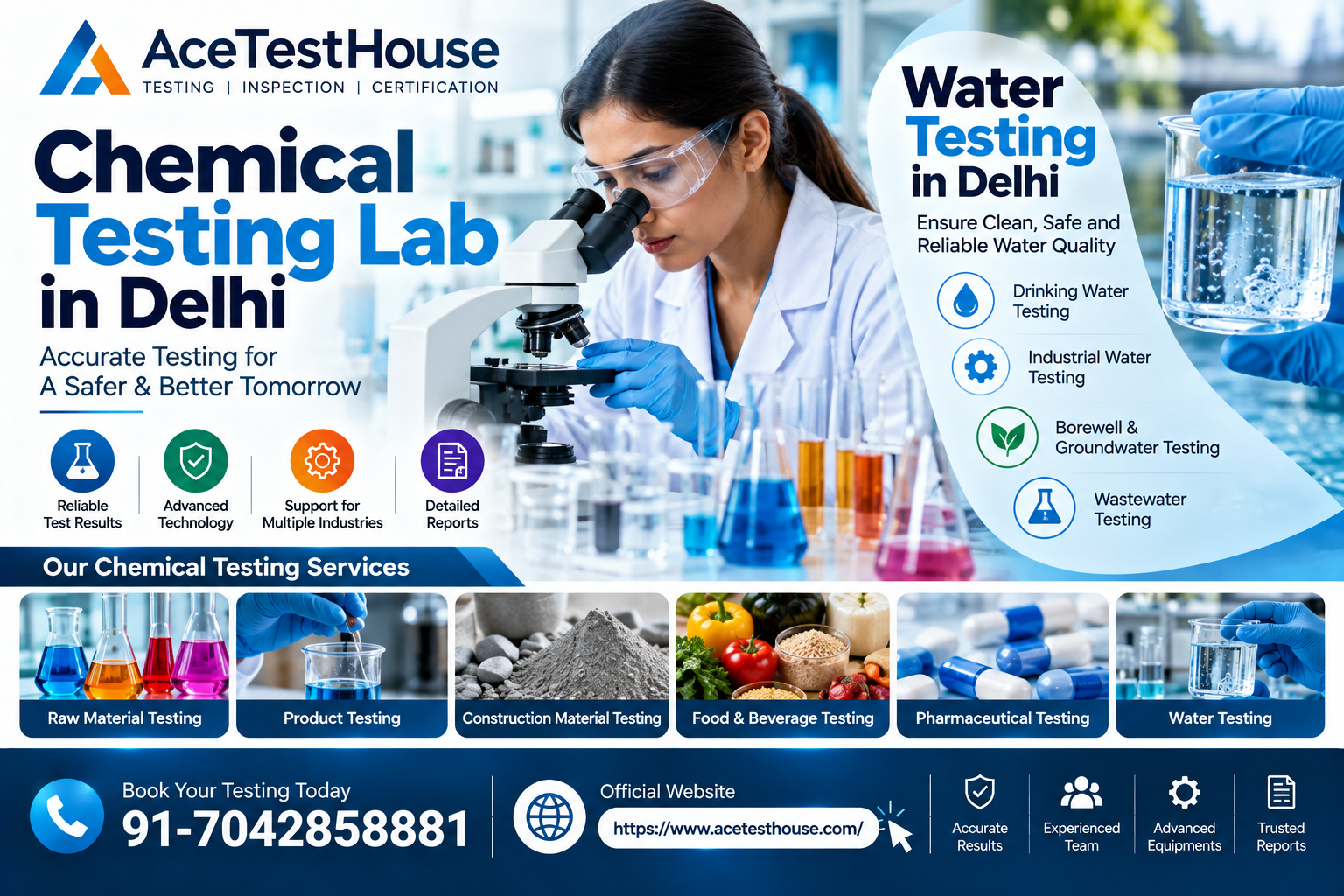
As industries, institutions, manufacturers, commercial facilities, and households place greater emphasis on safety and quality, demand for reliable laboratory analysis continues to grow. A professional chemical testing lab in delhi can help evaluate the chemical composition, purity, contamination risks, and performance characteristics of materials, while water testing in delhi helps assess whether water meets the required parameters for its intended use.
Laboratory testing plays an important role in sectors ranging from food processing and manufacturing to construction, pharmaceuticals, cosmetics, environmental monitoring, and industrial utilities. The value of testing, however, depends heavily on correct sampling, suitable analytical methods, calibrated equipment, and accurate interpretation of results.
What Is a Chemical Testing Lab in Delhi?
A chemical testing lab in delhi analyzes materials to identify their composition and measure specific chemical properties.
Depending on the sample and testing objective, laboratories may examine parameters such as:
- pH
- Moisture
- Acidity or alkalinity
- Chemical composition
- Purity
- Heavy metals
- Residues
- Dissolved substances
- Selected contaminants
- Material performance characteristics
The exact analysis required depends on the product, industry, specification, and intended use.
Chemical testing should therefore begin with a clearly defined testing objective rather than requesting a generic analysis.
Why Chemical Testing Matters
Manufacturers often rely on raw materials supplied by different vendors. Even when two materials appear identical, their chemical composition may vary.
Testing can help support:
Raw Material Verification
Incoming materials can be evaluated against purchase or technical specifications.
Production Quality Control
Testing may reveal process variations before affected products move further through production.
Product Development
Research and development teams may compare formulations and evaluate material behaviour.
Supplier Evaluation
Independent testing can help organizations assess consistency between suppliers or production batches.
Troubleshooting
When a product develops unexpected colour, corrosion, deposits, odour, or performance issues, chemical analysis may help identify possible causes.
Industries Using Chemical Testing Services
A professional chemical testing lab in delhi may support diverse industries, depending on its technical capabilities.
These can include:
- Food and beverages
- Cosmetics
- Pharmaceuticals
- Construction materials
- Metals
- Chemicals
- Plastics
- Textiles
- Environmental services
- Industrial manufacturing
- Packaging
Each sector has different testing requirements, so laboratories should be selected according to relevant technical capability.
What Is Water Testing in Delhi?
Water testing in delhi involves laboratory analysis of water samples to evaluate physical, chemical, and, when requested, microbiological characteristics.
Testing may be required for:
- Drinking water
- Borewell water
- Groundwater
- Process water
- Industrial water
- Treated water
- Wastewater
- Swimming pools
- Institutional water supplies
The required parameters depend on how the water will be used.
Water suitable for one industrial process may not necessarily meet the requirements for drinking or another technical application.
Common Water Quality Parameters
Depending on the testing objective, water may be evaluated for parameters including:
pH
pH indicates whether water is relatively acidic, neutral, or alkaline.
Total Dissolved Solids
Dissolved minerals and salts can influence taste, scaling, processing performance, and equipment operation.
Hardness
Hardness is associated primarily with dissolved calcium and magnesium and may contribute to scaling in plumbing or industrial equipment.
Chloride and Sulphate
These ions can influence taste, corrosion behaviour, and suitability for selected industrial uses.
Iron
Elevated iron may cause colour, staining, or deposits.
Nitrate
Nitrate may be relevant when groundwater or drinking-water quality is being evaluated.
Heavy Metals
Specific metals may be tested where contamination or regulatory concerns exist.
Microbiological analysis may also be necessary when evaluating drinking-water safety, although this requires appropriate methods separate from purely chemical testing.
Why Sampling Is Critical
Even advanced laboratory equipment cannot correct a badly collected sample.
Sampling errors can occur when:
- Containers are contaminated
- Water is collected from an unsuitable point
- Samples are stored incorrectly
- Excessive time passes before analysis
- Sample identification is unclear
For accurate water testing in delhi, clients should follow the laboratory’s sampling instructions.
Certain tests may require special containers, preservation methods, or rapid transportation.
Water Testing for Homes and Residential Buildings
Residents may consider water analysis when they notice:
- Unusual taste
- Odour
- Discoloration
- Repeated scaling
- Sediment
- Changes in groundwater quality
Laboratory testing can provide measured information instead of relying only on appearance.
Clear-looking water is not automatically suitable for every intended use, and visible sediment does not reveal the complete chemical profile.
Water Testing for Businesses and Industries
Industrial users often require water with specific characteristics.
Poor water quality may affect:
- Boilers
- Cooling systems
- Manufacturing processes
- Cleaning
- Product quality
- Pipes and equipment
Regular water testing in delhi can help organizations monitor incoming water, treatment systems, and process-water consistency.
For industrial operations, testing parameters should be selected according to process requirements rather than using only general drinking-water parameters.
Choosing a Chemical Testing Laboratory
Clients comparing laboratories should consider several factors.
Relevant Testing Capability
Confirm that the laboratory can analyze the required sample and parameters.
Appropriate Analytical Methods
Testing methods should be suitable for the required specification or purpose.
Equipment and Quality Control
Laboratories should maintain appropriate equipment, calibration practices, sample identification, and internal quality procedures.
Clear Reporting
Reports should clearly identify the sample, test parameters, results, units, and methods where applicable.
Technical Communication
A good laboratory should be able to explain what sample quantity is needed and how it should be collected.
Understanding a Laboratory Test Report
A report generally provides measured results, but interpretation depends on the intended application.
A value should not automatically be classified as acceptable or unacceptable without comparing it with an appropriate specification, regulatory requirement, customer standard, or process limit.
Clients should therefore tell the laboratory why the sample is being tested.
For example, testing water for drinking purposes may require a different assessment from testing water used in manufacturing.
Chemical Testing and Environmental Responsibility
Laboratory analysis can also support environmental management.
Industrial facilities may test:
- Process water
- Wastewater
- Raw materials
- Deposits
- Chemical residues
Reliable analytical data can help businesses monitor operations, identify changes, and make informed decisions about treatment or process control.
Testing itself does not solve a contamination problem, but it provides evidence that can guide corrective action.
Frequently Asked Questions
What does a chemical testing lab in Delhi test?
A chemical testing lab in delhi may analyze raw materials, finished products, water, chemicals, metals, plastics, food products, and other samples depending on its capabilities.
What is water testing in Delhi?
Water testing in delhi is laboratory analysis used to measure selected physical, chemical, and sometimes microbiological characteristics of water.
Why should drinking water be tested?
Testing provides measured information about water quality and can identify selected parameters that cannot be evaluated reliably by appearance alone.
Can borewell water be tested?
Yes. Groundwater and borewell water can be analyzed for parameters relevant to the intended use.
How much water is needed for testing?
The required quantity varies according to the parameters being analyzed. Clients should obtain sampling instructions from the laboratory beforehand.
Can I use any bottle for a water sample?
Not always. Certain analyses require clean or specially prepared containers, so laboratory instructions should be followed.
How often should industrial water be tested?
The appropriate frequency depends on process sensitivity, water source, treatment system, operating conditions, and applicable requirements.
Does a clear water sample mean it is safe?
No. Appearance alone cannot confirm chemical or microbiological quality.
How should I select testing parameters?
Choose parameters according to the water source, intended use, suspected problem, process requirement, or applicable specification.
Why are units important in laboratory reports?
Units show how a measured result is expressed and are essential when comparing the result with a specification or permissible limit.
Media Contact
Testing & Business Enquiries
Contact: +91-7042794106
Email: acetesthouse@gmail.com
Official Website: https://www.acetesthouse.com/