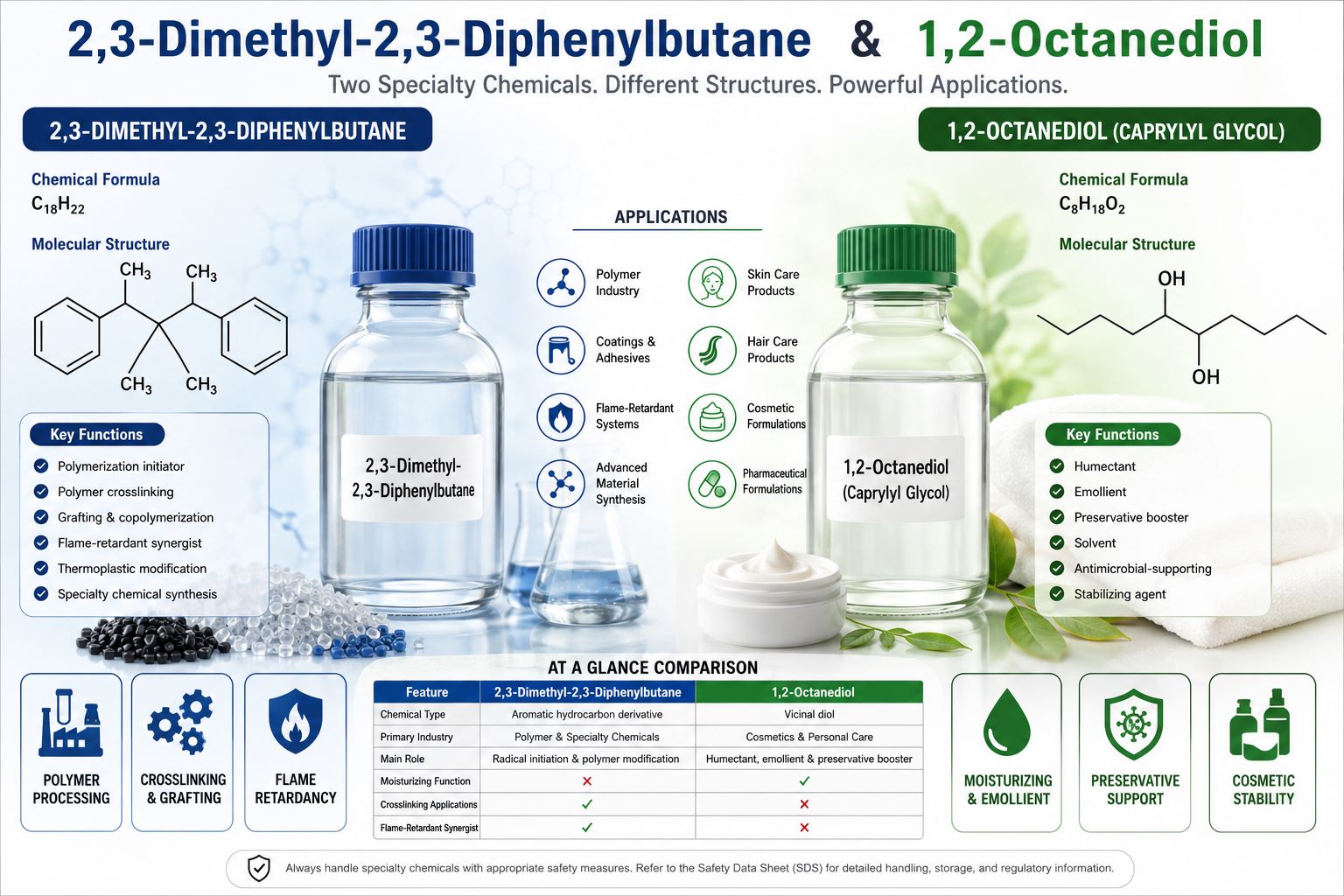
The history of these compounds reflects a broader transition in chemistry: from understanding basic molecular reactions to developing highly controlled ingredients for targeted commercial applications. Today, industries demand better performance, improved efficiency, higher purity, and more sustainable processing. These expectations are also shaping the future of both 2,3-dimethyl-2,3-diphenylbutane and 1,2-octanediol.
How Specialty Chemical Research Developed in the Past
Early industrial chemistry focused primarily on producing materials in large quantities. Performance customization was comparatively limited, and many chemicals were selected mainly because they were inexpensive and readily available.
As research techniques improved, scientists began studying how molecular structures affected stability, reactivity, solubility, thermal behavior, and compatibility.
This shift created opportunities for specialty compounds.
Instead of asking only whether a chemical could participate in a reaction, researchers started investigating how accurately that reaction could be controlled.
This change was particularly significant in polymer science and cosmetic chemistry.
Polymer engineers needed new ways to alter existing materials, while cosmetic formulators wanted ingredients that could perform several functions simultaneously.
These needs contributed to the growing technical importance of compounds such as 2,3-dimethyl-2,3-diphenylbutane and 1,2-octanediol.
Early Importance of 2,3-Dimethyl-2,3-Diphenylbutane
The historical value of 2,3-dimethyl-2,3-diphenylbutane is closely associated with free-radical chemistry.
Scientists studying thermal reactions discovered that certain carbon-carbon bonds could break under controlled heating conditions and produce carbon-centered radicals.
This was important because radicals can initiate additional reactions within organic molecules and polymer chains.
Earlier polymer-modification systems commonly depended on peroxide-based initiators. Although effective, these compounds could decompose rapidly and sometimes produce complicated reaction profiles.
Research into alternative radical sources therefore became increasingly valuable.
2,3-dimethyl-2,3-diphenylbutane attracted interest because it could support high-temperature radical processes under suitable operating conditions.
How It Influenced Polymer Research
In experimental polymer chemistry, radicals generated from this compound could interact with hydrocarbon polymer chains.
The general sequence involved:
- Heating the chemical under controlled conditions.
- Generating carbon-centered radical species.
- Abstracting hydrogen from polymer chains.
- Creating active sites along the polymer backbone.
- Allowing additional molecules to attach or react.
This provided researchers with another approach to polymer functionalization.
Transition Toward Modern Polymer Engineering
As plastics became more sophisticated, manufacturers needed polymers with specialized characteristics rather than standard mechanical properties.
Applications demanded materials offering:
- improved adhesion;
- controlled melt behavior;
- chemical functionality;
- compatibility with other materials;
- crosslinking potential;
- modified surface properties.
This helped radical-based processing become an important research area.
Today, 2,3-dimethyl-2,3-diphenylbutane remains more relevant to specialized technical applications than everyday consumer products.
Its importance lies primarily in controlled thermal radical generation and experimental polymer modification.
How 1,2-Octanediol Developed Differently
The evolution of 1,2-octanediol followed a completely different industrial path.
Personal-care products in earlier decades were often formulated using separate ingredients for separate functions.
A cream, for example, might require one ingredient for moisturization, another for texture, another for preservation, and another for skin conditioning.
As cosmetic science advanced, formulators began searching for multifunctional ingredients that could simplify formulations while maintaining product quality.
1,2-octanediol, commonly known in cosmetic applications as caprylyl glycol, became valuable because its molecular structure combines a hydrocarbon chain with two hydroxyl groups.
This structure allows it to interact with both water-related and oil-related components within certain formulations.
Growth of 1,2-Octanediol in Modern Formulation
The modern cosmetics industry places significant emphasis on skin feel, stability, moisturization, ingredient efficiency, and microbiological protection.
This has increased interest in multifunctional ingredients such as 1,2-octanediol.
It can contribute to several formulation functions, including:
- humectancy;
- emollient performance;
- skin conditioning;
- sensory improvement;
- preservative-system support.
Because of these characteristics, it may appear in moisturizers, facial products, shampoos, conditioners, cleansers, serums, body lotions, and other personal-care products.
Why Multifunctionality Matters
Modern formulators increasingly try to reduce unnecessary complexity.
Using ingredients that contribute several benefits can help streamline a formulation and potentially improve processing efficiency.
However, multifunctionality does not eliminate the need for testing.
Products containing 1,2-octanediol should still be evaluated for microbiological stability, compatibility, shelf life, sensory properties, and packaging interactions.
Past, Present, and Emerging Direction
| Area | Past | Present | Future Direction |
| 2,3-Dimethyl-2,3-Diphenylbutane | Radical chemistry research | Specialized polymer modification | Precision functionalization |
| Polymer manufacturing | Basic material production | Engineered polymers | Smarter processing |
| 1,2-Octanediol | Specialty diol research | Multifunctional cosmetic ingredient | Streamlined formulations |
| Cosmetic preservation | Conventional preservatives | Combined systems | Optimized preservation strategies |
| Chemical production | Performance focused | Performance plus quality | Performance plus sustainability |
Future Opportunities for 2,3-Dimethyl-2,3-Diphenylbutane
The future of 2,3-dimethyl-2,3-diphenylbutane may be connected to increasingly precise polymer engineering.
Manufacturers are exploring ways to modify polymers without creating entirely new materials from the beginning.
Potential future areas include:
- reactive extrusion;
- polymer grafting;
- polyolefin functionalization;
- specialized crosslinking research;
- advanced composite materials;
- polymer recycling technologies.
Reactive extrusion may be especially important because chemical reactions can potentially occur during melt processing.
This can combine modification and manufacturing into a more integrated process.
Future Challenges
Technical potential alone does not guarantee wider adoption.
Future use will depend on factors such as:
- manufacturing cost;
- energy consumption;
- reaction efficiency;
- thermal stability;
- worker safety;
- environmental performance;
- regulatory requirements.
Future Direction of 1,2-Octanediol
Future development of 1,2-octanediol will likely be strongly connected to changes in personal-care formulation.
Consumers increasingly expect effective products with carefully designed ingredient systems.
This creates demand for materials that can support multiple product characteristics at once.
Possible future applications may include:
- minimalist skincare formulations;
- advanced moisturizing products;
- sensitive-skin cosmetics;
- multifunctional preservation systems;
- premium hair-care products;
- lightweight serums and emulsions.
Research may also investigate how 1,2-octanediol performs alongside organic acids, glycols, surfactants, and other antimicrobial-support ingredients.
Sustainability and Future Chemical Design
Sustainability is becoming an increasingly important factor in specialty chemistry.
Historically, the primary question was whether a chemical worked effectively.
Future evaluation is broader.
Manufacturers increasingly consider:
- raw-material origin;
- energy requirements;
- manufacturing emissions;
- waste generation;
- process efficiency;
- recyclability;
- lifecycle performance.
For 2,3-dimethyl-2,3-diphenylbutane, improved process efficiency could become important in specialized polymer applications.
For 1,2-octanediol, future innovation may include more efficient manufacturing routes and greater compatibility with simplified cosmetic formulations.
Frequently Asked Questions
What is 2,3-dimethyl-2,3-diphenylbutane?
It is an organic specialty chemical associated with thermal radical generation and polymer chemistry.
Why was it historically important?
Researchers studied it as an alternative source of carbon-centered radicals for specialized chemical reactions.
Where can it be used today?
Its applications are mainly associated with polymer research, grafting, functionalization, and specialized processing.
What could its future applications include?
Potential areas include reactive extrusion, advanced polymer modification, and functionalized plastics.
What is 1,2-octanediol?
1,2-octanediol is a multifunctional diol widely associated with personal-care and cosmetic formulations.
What is another common name for 1,2-octanediol?
It is commonly known as caprylyl glycol in cosmetic ingredient systems.
Why is it popular in modern cosmetics?
It can contribute moisturization, conditioning, sensory benefits, and support preservation strategies.
Can it work as a preservative alone?
Its effectiveness depends on the total formulation, so appropriate preservation testing remains essential.
Are these two chemicals used for the same purpose?
No. Their molecular structures, reaction mechanisms, and industries are very different.
What will influence their future market relevance?
Technical performance, cost efficiency, sustainability, regulatory requirements, purity, and application-specific effectiveness will all be important.