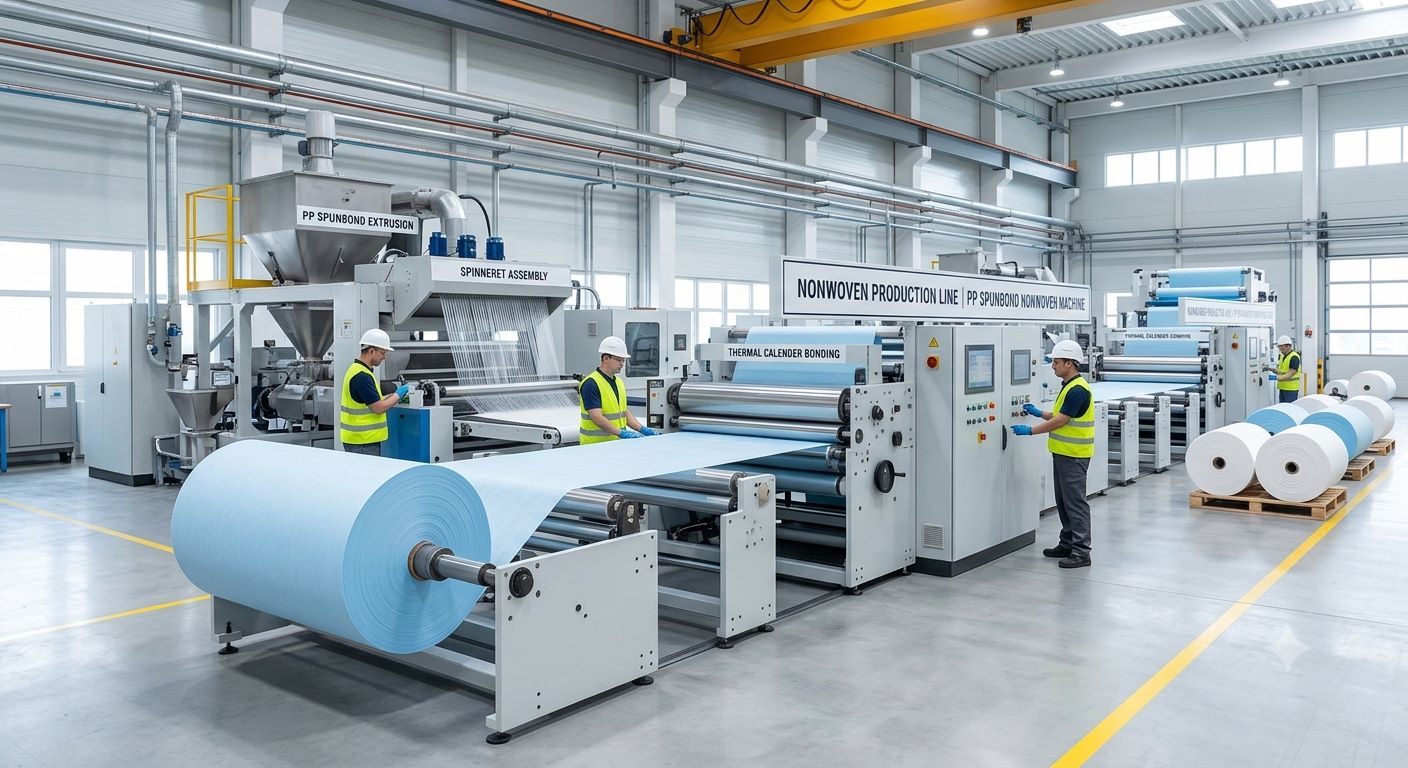
At the centre of this manufacturing process is a reliable Nonwoven Production Line. For businesses focused specifically on polypropylene-based fabrics, a PP Spunbond Nonwoven Machine provides an efficient way to manufacture lightweight, durable, breathable, and economical nonwoven material.
Understanding how these technologies work can help manufacturers make smarter investment decisions and improve long-term production performance.
What Is a Nonwoven Production Line?
A Nonwoven Production Line is an integrated manufacturing system designed to convert polymer raw materials into continuous rolls of nonwoven fabric. Depending on the technology, the line may include extrusion, spinning, web formation, bonding, cooling, winding, and cutting equipment.
Modern production lines are designed to maintain accurate control over fabric weight, thickness, width, tensile strength, and surface uniformity.
Main Production Stages
A typical production process involves:
- Feeding polypropylene or another polymer into the extrusion system.
- Heating and melting the raw material.
- Extruding molten polymer through spinnerets.
- Drawing the filaments into fine continuous fibres.
- Distributing fibres evenly onto a moving conveyor.
- Bonding the fibre web using heated rollers.
- Cooling and stabilising the finished fabric.
- Winding the material into large rolls.
Why Process Control Matters
Even small variations in temperature, pressure, spinning speed, or web distribution may affect fabric quality. Modern equipment therefore uses automated controls to maintain stable operating conditions throughout production.
Understanding the PP Spunbond Nonwoven Machine
A PP Spunbond Nonwoven Machine specialises in producing spunbond fabric using polypropylene granules. Polypropylene is widely used because it offers a favourable combination of low weight, chemical resistance, affordability, strength, and processing efficiency.
During spunbond manufacturing, polypropylene is melted and converted into continuous filaments. These filaments are stretched, distributed into a web, and thermally bonded to create finished nonwoven fabric.
The result is a material suitable for applications ranging from disposable hygiene products to agricultural crop covers.
Why Manufacturers Choose Spunbond Technology
Spunbond technology combines continuous production with high manufacturing efficiency. Because fibre formation and fabric production occur within the same process, additional yarn manufacturing and weaving stages are unnecessary.
Important advantages include:
- High-speed continuous production
- Consistent fabric structure
- Adjustable GSM and fabric width
- Good tensile strength
- Lightweight material construction
- Efficient polypropylene utilisation
- Easy colouring using masterbatch
- Suitability for multiple industrial sectors
These characteristics make a Nonwoven Production Line attractive for companies seeking scalable manufacturing capabilities.
Common Applications of PP Spunbond Fabric
The versatility of spunbond polypropylene allows manufacturers to serve several markets using similar production technology.
Medical and Hygiene Products
PP spunbond materials are frequently used for disposable medical and hygiene applications, including protective clothing components, sanitary products, masks, shoe covers, caps, and absorbent-product layers.
Agriculture
Agricultural nonwoven fabrics can be used for crop protection, weed control, frost protection, plant covers, and nursery applications.
Furniture and Bedding
Spunbond fabrics are also commonly used as mattress backing, furniture lining, protective layers, spring covers, and packaging material.
Packaging and Shopping Bags
Reusable nonwoven bags represent another major application. Manufacturers can produce fabrics in different colours, thicknesses, textures, and widths according to converting requirements.
Nonwoven Production Line vs Conventional Textile Manufacturing
| Feature | Nonwoven Production Line | Conventional Textile Process |
| Fibre Process | Direct web formation | Yarn preparation required |
| Weaving | Not required | Usually required |
| Production Speed | Generally high | Multiple processing stages |
| Material | PP and other polymers | Cotton, polyester and others |
| Applications | Hygiene, medical, agriculture, packaging | Apparel, home textiles, industrial |
| Automation | Highly automated options available | Depends on production system |
The appropriate manufacturing method ultimately depends on the intended product, material specification, production volume, and target market.
Important Factors When Selecting a PP Spunbond Nonwoven Machine
Purchasing equipment should involve more than comparing machine prices. Manufacturers need to evaluate long-term operating efficiency and product capabilities.
Production Capacity
Determine the required output based on expected customer demand. Selecting excessive capacity can increase initial investment, while inadequate capacity may create production bottlenecks.
Fabric Width and GSM Range
Confirm that the equipment can manufacture the required fabric specifications. Different applications may require substantially different weights and widths.
Automation Level
Advanced automation can simplify monitoring of temperature, speed, pressure, winding, and other operating parameters.
Energy Consumption
Energy efficiency influences the manufacturing cost of every kilogram of fabric produced. Buyers should therefore compare energy requirements alongside production output.
Technical Support
Installation assistance, operator training, spare-parts availability, troubleshooting support, and maintenance guidance should also influence equipment selection.
How to Improve Nonwoven Manufacturing Efficiency
A high-quality machine alone cannot guarantee efficient production. Proper management and preventive maintenance remain essential.
Manufacturers should:
- Maintain stable raw-material quality.
- Monitor extrusion temperatures regularly.
- Clean spinnerets according to recommended schedules.
- Inspect rollers, belts, filters, and winding systems.
- Record production parameters for different fabric specifications.
- Train operators in quality control and equipment safety.
- Schedule preventive maintenance before failures occur.
Careful monitoring can reduce unnecessary downtime and improve consistency between production batches.
Frequently Asked Questions
1. What does a Nonwoven Production Line manufacture?
It manufactures continuous rolls of nonwoven fabric from polymer or fibre-based raw materials using processes such as spunbond, meltblown, or other web-forming technologies.
2. What raw material is used in a PP Spunbond Nonwoven Machine?
Polypropylene granules are the primary raw material used for PP spunbond fabric production.
3. Is spunbond fabric woven?
No. Continuous filaments are formed into a web and bonded without conventional weaving.
4. Can fabric colour be customised?
Yes. Suitable colour masterbatch can be mixed with polypropylene during processing.
5. What does GSM mean?
GSM means grams per square metre and indicates the weight of the fabric.
6. Can one machine produce different GSM fabrics?
Many machines support adjustable GSM ranges, although capabilities vary by machine configuration.
7. Where is PP spunbond fabric used?
Applications include medical products, hygiene materials, agriculture, furniture, packaging, filtration, and reusable bags.
8. Is automation important?
Automation helps maintain stable production parameters, reduce manual intervention, and improve consistency.
9. What should buyers check before purchasing?
Buyers should evaluate capacity, width, GSM range, energy use, automation, component quality, service, training, and spare-parts support.
10. How can machine life be extended?
Regular cleaning, lubrication, inspection, correct operation, and scheduled preventive maintenance help extend equipment service life.