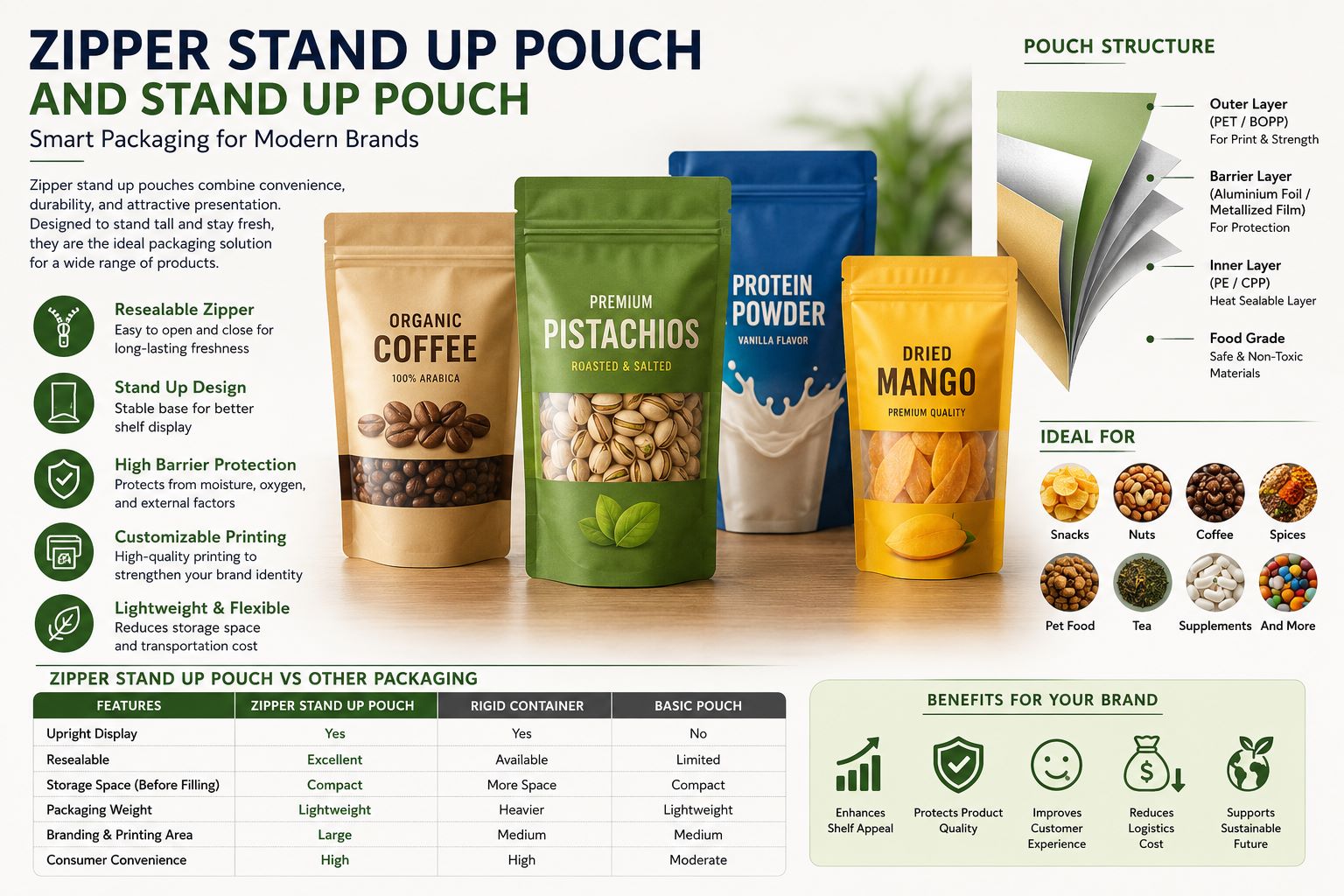
As consumer brands look for packaging that is functional, visually appealing and adaptable to different products, the zipper stand up pouch and Stand Up Pouch are gaining attention across food, beverage, nutrition, pet care, personal care and household-product categories.
Unlike conventional flat flexible bags, stand-up pouches incorporate an expandable bottom gusset designed to create a stable base after filling. This allows products to be displayed vertically while providing front and rear surfaces for branding, instructions and mandatory product information.
The addition of a resealable zipper further extends the functionality of the format, particularly for products that consumers use over several occasions.
Growing Demand for Convenient Flexible Packaging
Changes in shopping habits, product presentation and consumer expectations have encouraged brands to evaluate packaging beyond its traditional role as a protective container.
Customers increasingly interact with packaging throughout the product’s useful life. A package may need to be opened, closed, stored, carried and accessed repeatedly.
This is where the zipper stand up pouch can provide a practical advantage.
Products such as coffee, nuts, cereals, spices, dried fruits and pet treats are often consumed gradually. A built-in zipper enables customers to close the original package after taking the required amount.
Common applications include:
- Coffee and tea
- Snacks
- Dry fruits
- Nuts and seeds
- Spices and seasoning
- Cereals
- Nutritional powders
- Confectionery
- Pet treats
- Selected household products
The suitability of the format still depends on product characteristics, required barrier properties and filling conditions.
Zipper Stand Up Pouch and Stand Up Pouch Serve Different Requirements
Although both terms are closely related, they should not always be used interchangeably.
A Stand Up Pouch refers broadly to flexible packaging constructed to stand upright. A zipper stand up pouch is a version that specifically includes a resealable zipper.
| Feature | Zipper Stand Up Pouch | Stand Up Pouch |
| Bottom gusset | Yes | Yes |
| Upright display | Yes | Yes |
| Resealable zipper | Yes | Optional |
| Repeated opening | Convenient | Depends on closure |
| Custom printing | Available | Available |
| Tear notch | Common | Optional |
| Transparent window | Optional | Optional |
| Valve option | Available | Available |
| Spout option | Design dependent | Available |
| Suitable for multiple servings | Highly suitable | Depends on design |
This distinction gives brands the flexibility to choose packaging based on actual consumer behaviour rather than applying the same closure to every product.
Product Protection Remains a Key Priority
While appearance and convenience are important, packaging must first provide suitable protection for its contents.
A Stand Up Pouch can be manufactured using different film structures according to product requirements. Common materials used in flexible packaging include PET, PE, BOPP, CPP, nylon, aluminium foil and metallised films.
Different materials or layers may contribute to:
- Mechanical strength
- Heat-sealing performance
- Print quality
- Moisture resistance
- Oxygen barrier
- Light protection
- Aroma retention
There is consequently no universal pouch structure suitable for every product.
Packaging for roasted coffee, for example, may have different barrier requirements from packaging designed for dry grains or household powders.
Barrier Requirements Influence Material Selection
Packaging specialists increasingly focus on matching film performance to the characteristics of the contents.
Moisture-sensitive products may require structures designed to limit water-vapour transmission. Products susceptible to oxidation may require stronger oxygen barriers, while light-sensitive contents may benefit from opaque, metallised or foil-based structures.
A zipper stand up pouch should therefore be specified according to several factors:
- Product composition
- Fill weight and volume
- Required shelf life
- Oxygen sensitivity
- Moisture sensitivity
- Light sensitivity
- Storage environment
- Distribution conditions
Material selection based solely on price or appearance can lead to avoidable packaging problems.
Resealable Packaging Supports Multiple-Use Products
The zipper closure represents one of the most recognisable functional developments in stand-up flexible packaging.
After the original top seal is opened, consumers can access the zipper and remove the required amount of product. The zipper can then be pressed closed for subsequent storage.
For brands, this can improve the usability of larger or multi-serving packs.
However, a zipper should not be considered a replacement for appropriate barrier materials or initial heat sealing. Overall packaging performance depends on the complete structure, including film, seals, closure quality and storage conditions.
Custom Printing Creates Opportunities for Brand Visibility
The upright structure of a Stand Up Pouch provides substantial space for visual communication.
Brands can use the front panel for high-priority information such as:
- Company logo
- Product name
- Product variety
- Key features
- Net quantity
- Product imagery
Rear panels can carry ingredients, nutritional information, usage instructions, storage guidance, barcodes, manufacturer details and regulatory declarations.
Depending on production requirements, flexible packaging may use digital, flexographic or rotogravure printing.
The most suitable printing technology generally depends on order volume, artwork complexity, number of designs and production economics.
Custom Features Expand Packaging Possibilities
Modern stand-up packaging can be developed with additional features according to the intended application.
Available options may include:
- Resealable zipper
- Tear notch
- Transparent window
- Rounded corners
- Hang hole
- Matte finish
- Gloss finish
- Metallic effects
- Degassing valve
- Spout and cap
- Laser scoring
- Custom dimensions
A coffee brand, for example, may evaluate a zipper stand up pouch with a suitable barrier structure and degassing valve. A dried-food producer may consider a transparent window, while selected liquid products may require a spouted pouch.
Packaging specialists recommend selecting features according to functionality rather than adding unnecessary components.
Accurate Pouch Sizing Becomes Increasingly Important
Selecting a pouch according to weight alone can create difficulties during production.
Products with identical weights can have significantly different volumes because of differences in bulk density.
For example, 500 grams of lightweight cereal may require considerably more internal space than 500 grams of dense seasoning.
Businesses should consider:
- Product volume
- Bulk density
- Fill quantity
- Required headspace
- Bottom-gusset dimensions
- Zipper position
- Top sealing allowance
- Filling machinery
Physical filling trials can help verify whether proposed dimensions are appropriate before bulk production begins.
Quality Testing Helps Reduce Packaging Risk
Manufacturers and brands are also placing greater emphasis on testing before commercial-scale production.
Depending on the application, a Stand Up Pouch may be evaluated for:
- Seal integrity
- Leakage resistance
- Zipper performance
- Puncture resistance
- Drop resistance
- Dimensional accuracy
- Printing consistency
- Filling compatibility
- Storage performance
- Transportation durability
Shelf-life and barrier evaluations may also be necessary for products sensitive to environmental exposure.
Testing samples with the actual contents can help identify potential issues before large quantities of customised packaging are manufactured.
E-Commerce Creates New Packaging Considerations
The continued growth of online retail has introduced additional considerations for flexible packaging.
Products sold online can move through warehouses, fulfilment facilities, sorting centres and courier networks before reaching customers.
Throughout this journey, packaging may experience repeated handling, compression, vibration and impact.
As a result, a zipper stand up pouch intended for e-commerce should be assessed not only for visual presentation but also for realistic distribution conditions.
Reliable sealing and puncture resistance can be particularly important when products are transported alongside other items.
Sustainability Influences Stand-Up Pouch Development
Environmental considerations are also shaping the future of flexible packaging.
Traditional multilayer structures often combine different materials to achieve the necessary balance of strength, barrier performance and sealing. However, certain mixed-material structures can present recycling challenges within existing waste-management systems.
This has encouraged interest in mono-material flexible packaging structures for applications where required performance can be achieved.
Sustainability assessments should nevertheless consider more than recyclability alone.
Packaging weight, transportation efficiency, material consumption, product protection and prevention of product waste can all contribute to overall environmental performance.
Frequently Asked Questions
What is a zipper stand up pouch?
It is flexible packaging with a bottom gusset and integrated resealable zipper designed for repeated opening and closing.
What is a Stand Up Pouch?
It is a flexible pouch incorporating an expandable base that enables upright presentation after filling.
Are all stand-up pouches resealable?
No. Resealability depends on whether a zipper, spout, cap or another reclosure system is incorporated.
Which industries use stand-up packaging?
Food, coffee, nutrition, pet care, personal care and household-product industries are among common users.
Why are zippers useful?
They allow consumers to conveniently close multi-serving packages between uses.
Can a stand-up pouch have a transparent window?
Yes, provided the window is compatible with the product’s required barrier performance.
Can stand-up pouches be custom printed?
Yes. Custom graphics, branding and product information can be incorporated into the package.
How is the correct pouch size determined?
Product volume, bulk density, fill quantity, headspace and filling requirements should all be considered.
Can liquids be packed in stand-up pouches?
Yes, when the film, seals and closure system are engineered appropriately for the specific liquid.
What materials are commonly used?
PET, PE, CPP, BOPP, nylon, foil and metallised films are among materials used in different flexible packaging structures.
Is a zipper necessary for every pouch?
No. Zippers provide the greatest benefit for products intended to be opened and closed multiple times.
Why is sample testing important?
Testing helps confirm filling compatibility, dimensions, sealing, zipper operation and overall package performance.
Read more – https://newsgrow.blogspot.com/2026/08/foil-lid-and-stand-up-pouch.html
https://newsgrow.blogspot.com/2026/08/spout-pouch-and-stand-up-pouch-with.html
https://newsgrow.blogspot.com/2026/08/stand-up-pouch-filling-machines.html
https://newsgrow.blogspot.com/2026/08/why-zipper-stand-up-pouch-packaging-is.html
https://blogstream.net/standing-pouch-and-lidding-film-a-deep-guide-to-modern-flexible-packaging/
https://gosarkarijobs.com/how-standing-pouch-and-lidding-film-are-changing-modern-product-packaging/
https://newsgrow.blogspot.com/2026/08/shrink-sleeve-and-stand-up-pouch.html