A hose is rarely the most expensive component on a piece of heavy equipment, yet its failure can stop equipment worth far more than the hose itself. This is especially true in hydraulic machinery and oilfield fluid-transfer operations, where pressure, movement, abrasion and demanding working environments are part of everyday operation.
That is why choosing the right Hydraulic Hose or frac hose should be treated as an engineering decision rather than a routine purchase.
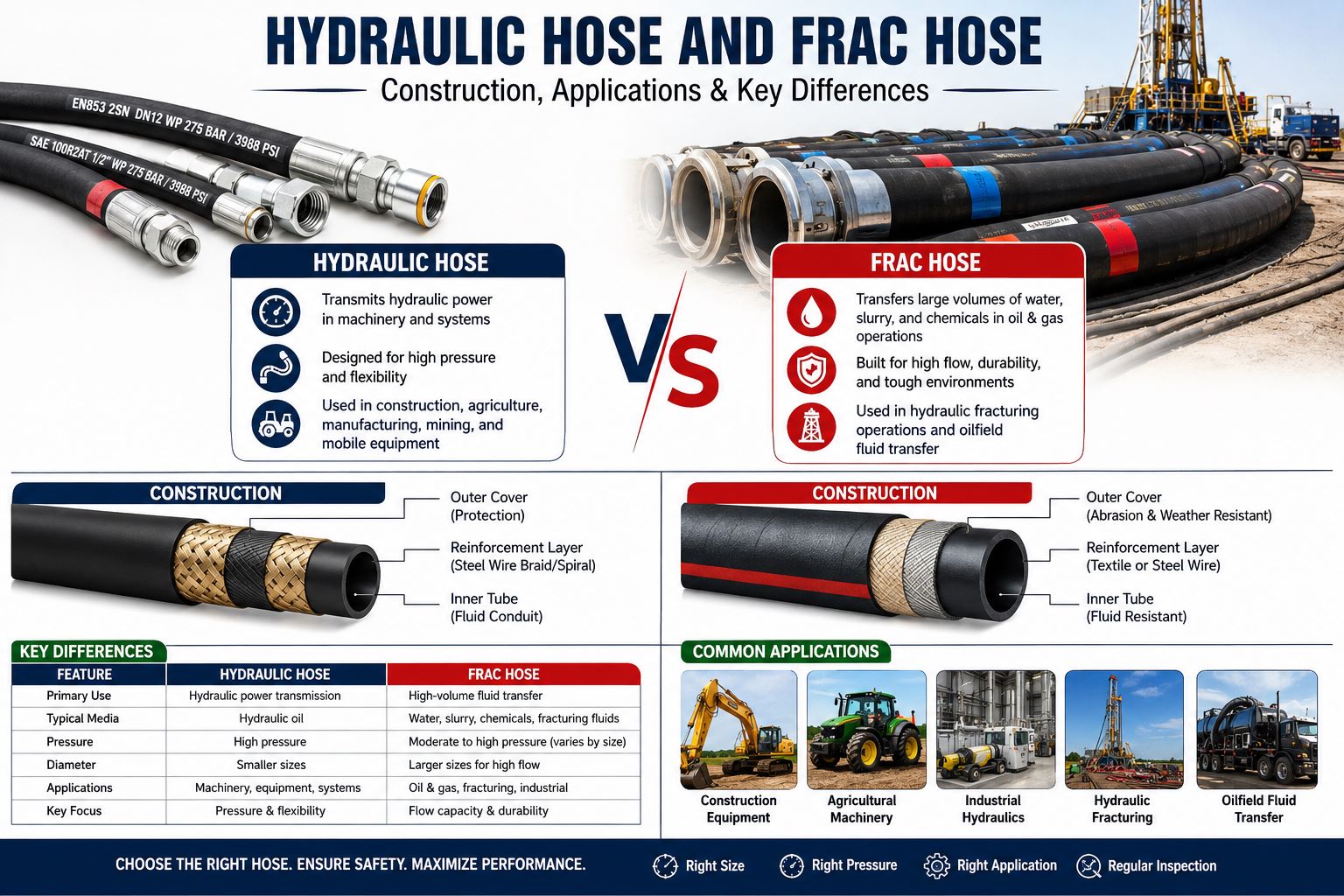
While a Hydraulic Hose helps transmit hydraulic power through machinery, a frac hose is generally associated with moving fluids in hydraulic fracturing and related oilfield operations. Understanding how each works makes it easier to choose a solution suited to real operating conditions.
The Job a Hydraulic Hose Performs Every Day
Hydraulic machinery works by transmitting energy through pressurised fluid. A pump moves hydraulic fluid through a circuit, valves control its direction, and cylinders or motors convert that energy into mechanical movement.
The Hydraulic Hose creates flexible connections within this circuit.
Picture an excavator repeatedly raising and lowering its boom. The hydraulic lines must move with the machine while continuing to transport fluid under the specified pressure. A rigid connection would be unsuitable in many of these moving areas.
This explains the widespread use of hydraulic hoses in:
- Excavators and loaders
- Mining machinery
- Agricultural equipment
- Cranes
- Forklifts
- Industrial presses
- Manufacturing equipment
- Material-handling machinery
The hose is therefore not merely carrying oil. It forms part of the machine’s power-transmission system.
Inside a Hydraulic Hose: Three Layers With Three Jobs
Cut open a typical reinforced hydraulic hose and its engineering becomes clearer.
The inner tube carries the fluid. It needs to resist the particular hydraulic oil or other approved media passing through the system.
The reinforcement provides structural strength against internal pressure. Depending on application requirements, this can include textile material, braided steel wire or spiral-wire reinforcement.
Finally, the outer cover protects the hose against abrasion, oil, weather and external damage.
Each layer matters. A hose cannot be judged accurately from its external appearance alone.
A Frac Hose Faces a Very Different Working Day
Move from a factory or construction site to an oilfield and the requirements change considerably.
Hydraulic fracturing involves complex fluid-handling operations. Water and prepared fluids may need to move between storage, blending and pumping equipment before being used in the fracturing process.
A frac hose can provide flexible connections within these transfer operations.
Depending on its construction and approved service, it may handle:
- Water
- Fracturing fluids
- Chemical mixtures
- Slurries
- Other compatible oilfield media
Where substantial transfer volumes are required, flow capability becomes a major consideration.
Why Field Conditions Matter for Frac Hose
The operating environment can be just as important as the fluid inside the hose.
A frac hose may spend its working life outdoors, where it can encounter rough surfaces, mud, changing weather and frequent handling. Some applications may also involve abrasive media.
This means a hose selected only according to internal diameter may not be appropriate.
Its construction should be evaluated for:
- Pressure requirements
- Flow capacity
- Media compatibility
- Abrasion exposure
- Temperature
- Flexibility
- Coupling requirements
- Field handling
Different frac operations may require different hose specifications.
Hydraulic Hose and Frac Hose Are Not Interchangeable Terms
It is useful to compare their typical roles.
| Feature | Hydraulic Hose | Frac Hose |
| Core purpose | Hydraulic power transmission | Oilfield fluid transfer |
| Typical location | Machinery and equipment | Fracturing/wellsite operations |
| Common media | Hydraulic fluid | Water, slurry and compatible frac fluids |
| Flow requirement | Circuit dependent | Often high-volume |
| Key challenge | Pressure, movement, heat | Flow, abrasion, field exposure |
| Main selection factors | Pressure, size, media, temperature | Media, flow, pressure, durability |
Neither category is inherently “better”. They are designed around different jobs.
Start With the Fluid, Not the Catalogue
A common purchasing mistake is finding the required diameter first and checking everything else later.
A better approach starts with the fluid.
The material forming the inner tube must be compatible with the media it carries. An incompatible material may swell, soften, harden or deteriorate.
For a Hydraulic Hose, buyers should identify the exact hydraulic fluid being used.
For a frac hose, it may be necessary to understand the complete fluid mixture, particularly when chemical additives or suspended solids are involved.
“Water-based” alone may not provide enough information to determine compatibility.
Pressure Ratings Need to Be Read Correctly
Two pressure figures are often misunderstood: working pressure and burst pressure.
Working pressure relates to the intended operating capability of the hose under specified conditions.
Burst pressure is associated with destructive testing. It should not be treated as an acceptable normal operating pressure.
For a Hydraulic Hose, system pressure, pressure fluctuations and the application’s operating characteristics should be considered.
For a frac hose, the required transfer pressure should likewise fall within the product’s specified operating conditions.
Never select a hose by assuming that a high burst-pressure figure provides extra everyday working capacity.
The Hidden Effect of Incorrect Hose Diameter
Imagine drinking through an extremely narrow straw. Moving the same volume becomes increasingly difficult.
Fluid-transfer systems follow similar principles.
If the internal diameter of a Hydraulic Hose is too small for the required flow, fluid velocity and pressure loss can increase. Additional heat generation may also become a concern.
In high-volume frac applications, incorrect sizing can restrict transfer performance.
The selection process should consider:
- Required flow rate
- Internal hose diameter
- Hose length
- Fluid properties
- Operating pressure
- Acceptable pressure loss
This is why replacing an existing hose based only on external diameter is not recommended.
Heat Can Damage a Hose From the Outside
Fluid temperature is only half of the temperature question.
Suppose a Hydraulic Hose carries fluid within its approved temperature range but runs directly beside a hot exhaust component. External heat exposure can still affect the hose.
Oilfield hoses may similarly face high ambient temperatures or prolonged outdoor exposure.
During selection and installation, consider both:
Internal temperature: the temperature of the transferred fluid.
External temperature: the environment surrounding the hose.
Where heat exposure cannot be avoided, appropriate routing or protection may be required.
Good Hose Routing Is Preventive Maintenance
Some premature hose problems begin on the day of installation.
A hose that is twisted, stretched or forced through an excessively tight bend is already operating under unnecessary mechanical stress.
Good routing means avoiding:
- Sharp bends
- Twisting
- Excessive stretching
- Constant rubbing
- Crushing
- Sharp surfaces
- Unnecessary heat exposure
The manufacturer’s minimum bend radius should always be respected.
For frac hose applications, routing should additionally consider vehicle movement and other site activities that could damage the hose.
Why Fittings Cannot Be an Afterthought
A hose assembly consists of more than the flexible hose.
Fittings and couplings create the connection between the hose and equipment. They must therefore be suitable for the hose construction, pressure and intended service.
In a Hydraulic Hose assembly, an incorrectly selected or improperly crimped fitting can undermine the reliability of the entire assembly.
Similarly, a frac hose needs couplings appropriate for its pressure, media and field requirements.
The safest purchasing approach is to treat the hose and fittings as a complete engineered system.
What Your Hose May Be Telling You
Industrial hoses often display visible warning signs before serious deterioration occurs.
During routine inspections, look for:
- Cracks in the outer cover
- Deep abrasion
- Exposed reinforcement
- Blisters
- Leakage
- Kinks
- Damaged fittings
- Corrosion
- Flattened areas
- Unusual stiffness
High-pressure fluid leaks require appropriate safety precautions. A suspected leak should never be checked by running a hand over the hose.
Inspection and replacement decisions should follow manufacturer guidance and applicable safety procedures.
Five Questions to Ask Before Buying a Hydraulic Hose
Before requesting a quotation, answer these questions.
1. What fluid will it carry?
Identify the exact media to confirm material compatibility.
2. What pressure will it experience?
Determine the system’s operating requirements rather than relying on estimates.
3. How much fluid needs to flow?
Flow requirements help determine the correct internal diameter.
4. Where will the hose operate?
Consider temperature, abrasion, movement and environmental exposure.
5. What connections are required?
Confirm fitting size, type and equipment interface.
These five answers can prevent many specification errors.
What Should Buyers Check When Ordering Frac Hose?
For frac applications, purchasing teams should collect additional field information.
Important details include:
- Required flow volume
- Fluid composition
- Solids or abrasive content
- Internal diameter
- Working pressure
- Hose length
- Temperature range
- Coupling type
- External abrasion
- Frequency of repositioning
Providing complete application data enables a supplier to recommend a product based on technical requirements rather than assumptions.
Frequently Asked Questions
1. Why is a Hydraulic Hose flexible?
Flexibility allows the hose to accommodate equipment movement and vibration while transporting hydraulic fluid.
2. Where is Hydraulic Hose most commonly used?
It is widely used in construction, agriculture, mining, manufacturing, lifting and material-handling equipment.
3. What does a frac hose carry?
Depending on its specification, it may carry water, slurry, fracturing mixtures and other compatible oilfield fluids.
4. Is every frac hose suitable for chemicals?
No. Chemical compatibility should always be verified for the specific fluid composition.
5. What is the reinforcement inside a hydraulic hose?
It is a strengthening layer that may use textile, braided wire or spiral wire depending on the hose design.
6. Does a larger hose always provide better performance?
No. Hose size should match the required flow, pressure and system design.
7. Why does Hydraulic Hose become damaged near fittings?
Excessive bending, incorrect assembly, movement or mechanical stress near the fitting can contribute to deterioration.
8. Can abrasion cause hose failure?
Yes. Severe abrasion can damage the outer cover and eventually expose or affect the reinforcement.
9. What is minimum bend radius?
It is the smallest recommended radius at which a hose should be bent during installation or operation.
10. Can I choose a hose using burst pressure?
No. Normal hose selection should be based on its specified working conditions, not burst pressure.
Read more – https://newsgrow.blogspot.com/2026/08/hydraulic-hose-manufacturer-and.html
https://newsgrow.blogspot.com/2026/08/hydraulic-hose-and-frac-hose-deep.html