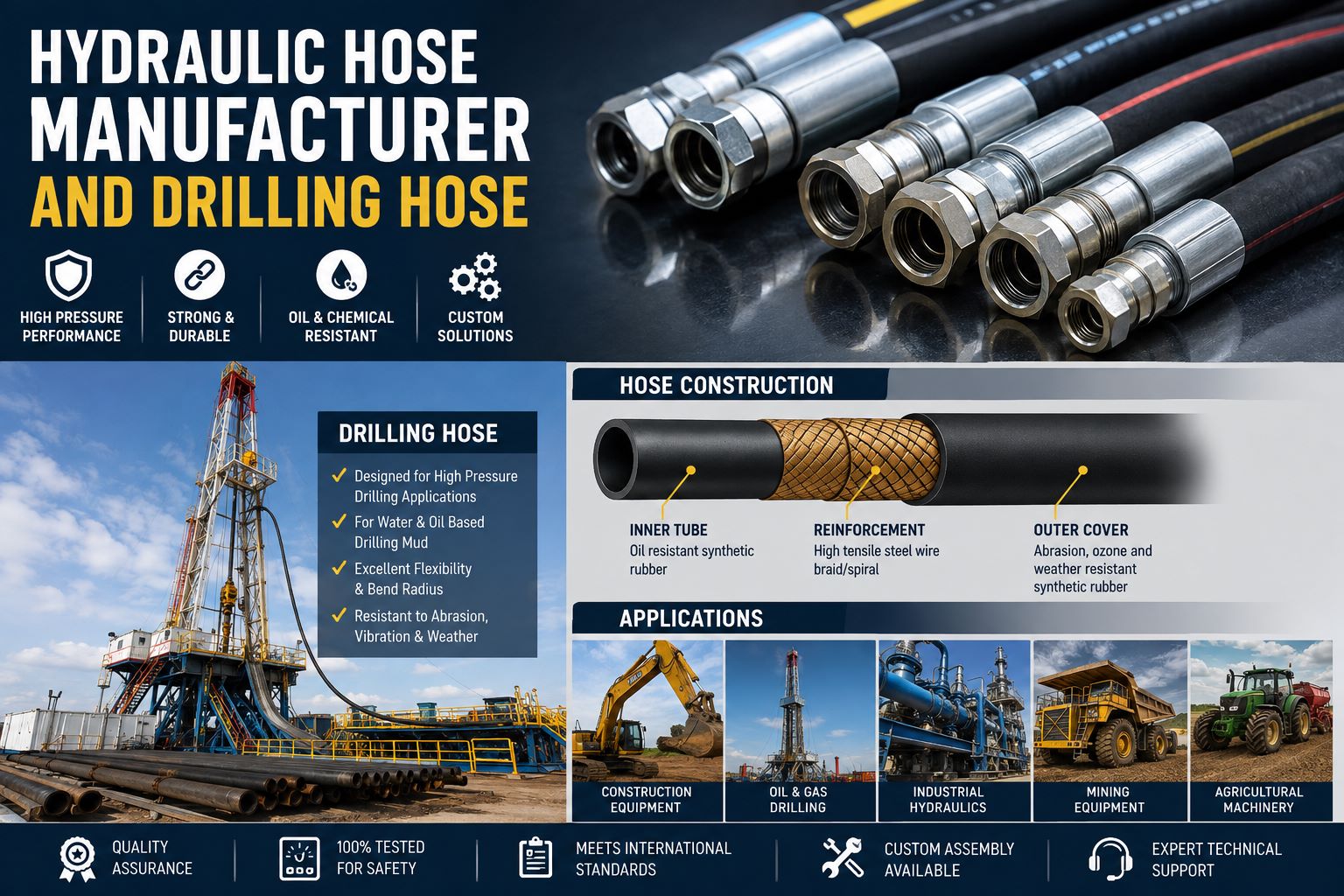
In industries where machines lift enormous loads, drill deep formations or operate continuously under pressure, hydraulic systems must perform consistently. Every connection in these systems matters, including the flexible hoses responsible for carrying pressurised fluids. This is where the expertise of a professional Hydraulic Hose Manufacturer becomes valuable.
For drilling operations, requirements are even more specialised. A drilling hose may need to carry drilling fluids while accommodating vibration, movement and difficult environmental conditions. Selecting the wrong product can create maintenance problems, while choosing a hose around actual operating requirements can support more dependable system performance.
This article explains what industrial buyers, engineers and maintenance teams should understand before selecting hydraulic and drilling hoses.
Why Hydraulic Hoses Are Essential to Modern Machinery
Hydraulic power allows relatively compact equipment to generate substantial force. Pressurised fluid travels from the pump through valves and hoses to actuators such as hydraulic cylinders and motors.
Hoses provide something rigid pipework cannot easily offer: controlled flexibility.
This flexibility is essential in equipment where components move continuously, including:
- Excavators and loaders
- Cranes
- Mining machinery
- Agricultural equipment
- Industrial presses
- Material-handling systems
- Drilling equipment
- Marine machinery
A Hydraulic Hose Manufacturer must therefore create products capable of combining pressure resistance with the flexibility required by the intended application.
How a Hydraulic Hose Handles Pressure
The strength of a hydraulic hose does not come from one material. Multiple layers work together.
Inner Tube: The Fluid Barrier
The inner tube carries the hydraulic fluid. Its compound must be selected according to the medium and operating temperature.
Chemical compatibility matters because unsuitable fluids may cause the tube to swell, soften, harden or otherwise deteriorate.
Reinforcement: The Structural Backbone
The reinforcement surrounding the tube provides much of the pressure-bearing capability.
Common reinforcement constructions include:
- Textile layers
- Steel-wire braid
- Multiple wire-braid layers
- Spiral steel-wire reinforcement
The required construction depends on pressure, hose size and application.
Outer Cover: Protection From the Environment
The outer cover protects the reinforcement from abrasion and environmental exposure.
For mining, construction and drilling applications, cover durability can be especially important because hoses may operate close to rough equipment surfaces.
Understanding the Purpose of a Drilling Hose
A drilling hose is designed for specified fluid-transfer duties associated with drilling systems.
Drilling equipment creates unusual operating conditions because the hose may need to remain flexible while the machinery moves or vibrates.
The operating environment may involve:
- High pressure
- High-volume fluid movement
- Drilling mud
- Repeated vibration
- Dynamic equipment movement
- Abrasive surroundings
- Temperature changes
- Outdoor exposure
As a result, drilling hose specification requires a broader assessment than simply matching the connection size.
Why Drilling Hose Selection Requires Technical Planning
Suppose two hoses have the same diameter and length. Does that mean either can be installed on the same drilling system?
Not necessarily.
Their pressure ratings, reinforcement, tube materials, temperature capabilities and bending characteristics may be completely different.
Before selecting a drilling hose, consider:
- Maximum operating pressure
- Fluid type
- Flow requirement
- Fluid temperature
- Ambient temperature
- Inside diameter
- Hose length
- Minimum bend radius
- Fitting requirements
- Equipment movement
Providing these details allows a Hydraulic Hose Manufacturer to evaluate the application more accurately.
Hydraulic Hose vs Drilling Hose: Key Differences
| Parameter | Hydraulic Hose | Drilling Hose |
| Function | Transfers hydraulic power | Transfers specified drilling fluids |
| Typical machinery | Construction and industrial equipment | Drilling equipment |
| Media | Hydraulic oils/approved fluids | Drilling mud/approved drilling media |
| Movement | Machine articulation | Dynamic drilling movement |
| Flow demand | Application specific | Can be high-volume |
| Main focus | Pressure and flexibility | Pressure, flow, vibration and movement |
The correct product should always be chosen according to its intended service.
Pressure Rating: A Number That Must Be Read Correctly
Pressure specifications are often misunderstood during hose purchasing.
The most important figure for normal operation is the appropriate working-pressure rating.
Burst pressure serves a different purpose. It represents performance under destructive testing conditions and should never become the normal operating target.
When contacting a Hydraulic Hose Manufacturer, buyers should provide actual system-pressure requirements and relevant operating information rather than simply requesting the hose with the highest pressure number.
Temperature Can Change Hose Requirements
Hydraulic hoses can experience temperature from two directions.
The first is internal—the temperature of the fluid passing through the hose.
The second is external—the ambient environment surrounding the hose.
High or low temperatures can influence hose materials. Consequently, both fluid and ambient temperature ranges should be considered.
This is particularly relevant when a drilling hose operates outdoors in demanding climatic or process conditions.
Fluid Compatibility Is More Important Than It Looks
Not all hydraulic or drilling fluids interact with hose materials in the same way.
For example, drilling-fluid formulations may contain different base fluids and additives. Selecting a hose without communicating these details can result in an inappropriate material choice.
Before ordering, tell the manufacturer:
- Exact fluid type
- Base medium
- Relevant additives
- Operating temperature
- Concentration where applicable
A knowledgeable Hydraulic Hose Manufacturer can use this information when assessing tube compatibility.
Correct Sizing Supports Better Fluid Flow
Inside diameter directly influences fluid velocity.
A diameter that is too small may increase velocity and pressure loss. An unnecessarily large hose can add weight, cost and installation complexity.
For drilling applications involving high flow, appropriate diameter selection can become particularly significant.
The best approach is to consider pressure, flow and hose size together rather than independently.
Why Installation Can Affect Hose Life
Manufacturing quality is only one side of hose performance. Installation is the other.
Even a correctly specified hose can experience unnecessary stress when routed poorly.
Common installation mistakes include:
- Sharp bends
- Twisting
- Stretching
- Incorrect hose length
- Excessive movement at fittings
- Abrasion against machinery
- Installation near damaging heat sources
Minimum Bend Radius Should Never Be Ignored
A hose is flexible, but flexibility has engineering limits.
Every hose has a specified minimum bend radius. Bending it more tightly than recommended can create additional structural stress.
For a drilling hose, routing should also account for how the hose moves when equipment changes position.
Plan the Complete Movement Path
Engineers should check hose position throughout the machine’s operating range, not just while equipment is stationary.
This helps identify potential abrasion, stretching or bending points before regular operation begins.
What Makes a Good Hydraulic Hose Manufacturer?
Industrial buyers should evaluate more than price and delivery.
A capable Hydraulic Hose Manufacturer should demonstrate:
- Consistent manufacturing processes
- Appropriate material selection
- Pressure-testing capability
- Product traceability
- Quality-control procedures
- Technical documentation
- Compatible fittings
- Custom assembly capability
- Application knowledge
Manufacturers should also be able to explain their recommendations clearly.
Technical transparency is particularly valuable when purchasing products for demanding applications.
Testing Hydraulic and Drilling Hoses
Different testing procedures may be used depending on hose type and specification.
Proof Pressure Testing
This helps evaluate assembly integrity under specified pressure conditions.
Impulse Testing
Repeated pressure cycles simulate an important aspect of hydraulic service and help evaluate fatigue performance under controlled conditions.
Burst Testing
Pressure is increased until failure occurs under defined test conditions. Burst results are qualification data rather than normal operating limits.
Visual Inspection
Finished products can also be checked for dimensions, markings, cover condition and assembly quality.
When Is It Time to Replace a Hose?
Regular inspection is essential because hoses are wear components.
Pay attention to:
- Visible leakage
- Cover cracks
- Severe abrasion
- Exposed reinforcement
- Bulges
- Kinks
- Flattened sections
- Damaged couplings
A questionable drilling hose should be evaluated promptly according to applicable maintenance procedures and manufacturer recommendations.
Frequently Asked Questions
1. What is a Hydraulic Hose Manufacturer?
A Hydraulic Hose Manufacturer produces reinforced flexible hoses for transferring pressurised fluids in industrial and mobile equipment.
2. What is the function of a drilling hose?
A drilling hose provides a flexible connection for transferring specified fluids in drilling systems.
3. What are hydraulic hoses made from?
They typically contain an inner tube, reinforcement layers and a protective outer cover.
4. Are hydraulic and drilling hoses interchangeable?
Not necessarily. Their fluid, pressure, flow, movement and construction requirements can differ.
5. Why is reinforcement necessary?
Reinforcement provides structural strength that helps the hose contain internal pressure.
6. What is working pressure?
It is the specified pressure capability for normal operation under defined conditions.
7. Why does hose diameter matter?
Inside diameter influences fluid velocity, pressure loss and overall flow characteristics.
8. Can drilling hose handle mud?
A properly specified drilling hose can handle compatible drilling media within its stated operating limitations.
9. What damages hydraulic hoses?
Abrasion, excessive heat, overpressure, twisting, incompatible fluids and poor routing are common causes.
10. Can hydraulic hoses be custom-made?
Yes. Manufacturers may customise length, diameter, fittings and other specifications.
Read more – https://newsgrow.blogspot.com/2026/08/hydraulic-hose-manufacturer-and.html