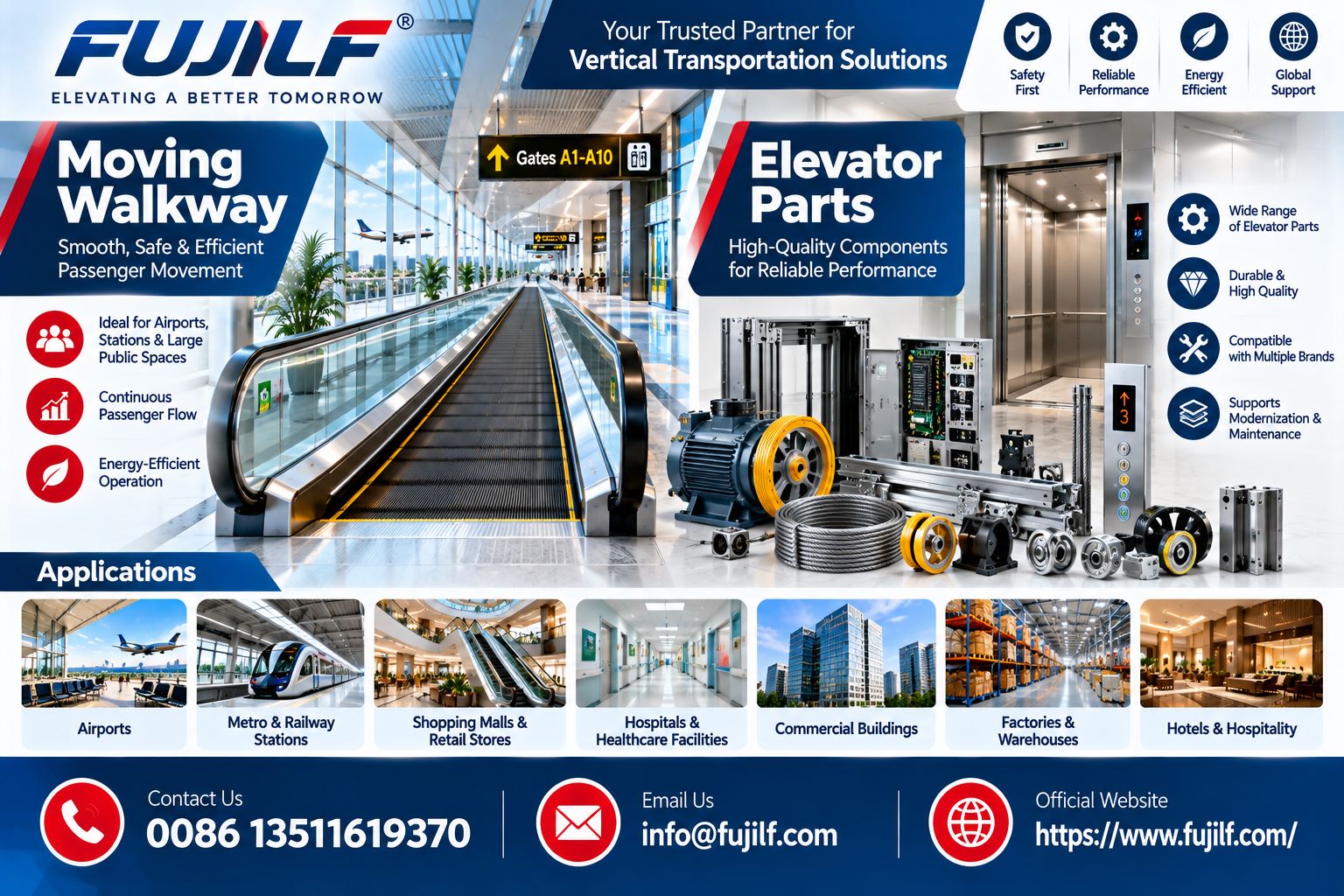
Large commercial properties and public facilities depend on transportation equipment to support convenient movement throughout their premises. Airports, railway terminals, shopping complexes, and exhibition centres require reliable systems that accommodate substantial passenger activity.
A moving walkway helps passengers travel along extended corridors and designated routes, reducing the physical effort associated with walking longer distances.
Meanwhile, properly specified elevator parts support essential functions within vertical transportation systems, including movement control, door operation, and passenger protection.
While these equipment categories perform different functions, both require structured maintenance and appropriate emergency-response planning.
Facility operators must consider not only how transportation systems perform during normal operation but also how they should respond when unexpected equipment problems occur.
This creates an important opportunity to strengthen infrastructure management through safety procedures, component traceability, and coordinated technical support.
Why Moving Walkway Emergency Planning Matters
Moving walkways operate continuously in many public environments, making their reliability important for passenger convenience.
However, mechanical faults, electrical problems, obstruction incidents, or unsuitable operating conditions may require equipment to stop.
A moving walkway must therefore include appropriate protective devices and operational controls consistent with its approved design.
Building operators should establish clear procedures for responding to equipment interruptions.
Important safety considerations include:
- Emergency stopping arrangements: Accessible controls that allow appropriate intervention when necessary.
- Passenger communication: Clear instructions for users during equipment interruptions.
- Restricted access: Suitable barriers and signage when equipment is unavailable.
- Technical inspection: Assessment by qualified personnel before restarting faulty equipment.
- Alternative circulation: Safe routes that allow passengers to continue moving through the facility.
These measures support a more organized response to unexpected equipment conditions.
Understanding the Role of Elevator Parts in Passenger Safety
Elevator systems consist of interconnected mechanical, electrical, and electronic components.
Each component contributes to the operation of the complete installation.
Reliable elevator parts are therefore essential to maintaining appropriate equipment performance.
Important component categories include door operators, control boards, drive systems, position sensors, safety switches, and protective equipment.
When a component becomes damaged or unreliable, the effects may extend beyond the individual part.
For example, a malfunctioning door mechanism can prevent an elevator from operating correctly, while certain control faults may require the system to remain unavailable until professional assessment.
A practical engineering principle explains:
This emphasizes the importance of selecting replacement parts according to documented technical specifications.
Emergency Response Procedures Require Clear Responsibilities
An effective equipment emergency plan should identify who is responsible for responding to incidents and communicating with maintenance professionals.
Security teams, facility managers, technical personnel, and authorized service providers may have different responsibilities.
Building employees should understand how to identify equipment problems and prevent unauthorized use.
However, repairs, electrical isolation, and technical interventions must be performed only by appropriately qualified personnel.
For elevator incidents involving trapped passengers, building operators should follow approved emergency communication and rescue arrangements.
Untrained employees must not attempt to open elevator doors or remove occupants through improvised procedures.
An important operational principle states:
Preventive Maintenance Reduces Avoidable Equipment Problems
Routine maintenance provides an opportunity to identify deterioration before it causes serious operational difficulties.
For moving walkways, maintenance activities may involve inspection of handrails, moving surfaces, drive mechanisms, landing areas, and protective devices.
Elevator maintenance requires attention to relevant lifting components, door systems, controllers, and safety equipment.
Inspection frequency should follow manufacturer recommendations, equipment usage conditions, and applicable regulations.
Maintenance records can help technicians identify recurring faults and determine whether particular components require additional assessment.
However, preventive maintenance does not guarantee that equipment will never fail.
Operators must maintain appropriate response procedures even when systems are serviced regularly.
Why Replacement Component Traceability Matters
Equipment maintenance often requires replacing damaged or worn components.
For elevator systems, replacement parts must be compatible with the specific model and approved configuration.
Visual similarity does not necessarily establish technical interchangeability.
Facility operators should maintain appropriate records identifying installed components, relevant part specifications, and maintenance activities.
This documentation can support:
- Accurate component identification.
- Verification of replacement compatibility.
- Better coordination with maintenance providers.
- Investigation of recurring equipment faults.
- More organized spare-parts management.
Replacement components should be evaluated according to the equipment manufacturer’s requirements and applicable safety standards.
Parts intended for elevators should not automatically be considered interchangeable with moving walkway components.
Accessibility Must Remain Part of Emergency Planning
Passenger transportation planning must consider individuals with different mobility requirements.
A moving walkway may provide convenience for many passengers, but it is not suitable for every user.
Facilities should maintain appropriate accessible routes that do not depend exclusively on moving equipment.
Elevators often provide essential step-free movement between building levels.
However, ordinary passenger elevators should not automatically be used during fire emergencies unless they are specifically designed and approved for the intended emergency function.
Building emergency plans must follow applicable fire-safety and accessibility requirements.
These considerations are particularly important in hospitals, airports, and other facilities serving diverse passenger groups.
Digital Maintenance Records Support Better Infrastructure Decisions
Digital maintenance systems can help facility managers organize equipment information and service activities.
A structured record may include equipment identification, inspection findings, replacement components, and outstanding maintenance concerns.
Such information can help maintenance teams evaluate repeated faults and prioritize appropriate technical assessments.
Digital records also support coordination when facilities operate several elevators and moving walkways.
Nevertheless, technology cannot replace qualified inspections or required safety testing.
The value of digital maintenance depends on accurate information and responsible decision-making.
Selecting Reliable Transportation Equipment Support
Building owners should evaluate technical capabilities when choosing equipment and maintenance providers.
Important considerations include appropriate component documentation, access to qualified technicians, availability of compatible replacement parts, and clearly defined maintenance responsibilities.
Providers should also communicate equipment limitations and relevant safety requirements.
The objective is to establish dependable technical support rather than relying exclusively on the lowest initial service cost.
Industry Outlook: Reliability Through Coordinated Safety Management
Safe passenger transportation requires collaboration between equipment manufacturers, installation specialists, maintenance personnel, and building operators.
A properly maintained moving walkway can support convenient circulation, while compatible elevator parts contribute to reliable vertical transportation.
Emergency preparedness, professional inspection, and accurate component documentation are essential parts of responsible infrastructure management.
A system-wide approach helps facilities prepare for disruptions while maintaining appropriate passenger safety standards.
Frequently Asked Questions (FAQs)
1. What is a moving walkway used for?
A moving walkway transports passengers along horizontal or gently inclined routes. It is commonly installed in airports, transportation terminals, shopping centres, and large commercial facilities.
2. Why are elevator parts important for safety?
Elevator parts support essential functions such as movement control, door operation, lifting, and protective systems. Correct component selection and professional maintenance help support safe equipment operation.
3. What should facility managers do when a moving walkway stops unexpectedly?
They should follow approved emergency procedures, communicate with passengers, restrict access where necessary, and arrange qualified technical inspection before returning faulty equipment to service.
4. Can elevator replacement parts be used across different models?
Not automatically. Replacement components must meet the technical requirements of the particular elevator system. Compatibility should be verified using appropriate manufacturer documentation.
5. How can buildings improve transportation equipment reliability?
Buildings can establish preventive maintenance programs, maintain accurate equipment records, train relevant personnel, use compatible replacement components, and follow applicable safety regulations.
Media Contact
Department: Business Enquiries & Vertical Transportation Solutions
Industry: Elevators, Moving Walkways, Escalators & Transportation Equipment
Contact: 008613511619370
Email: info@fujilf.com
Official Website: https://www.fujilf.com/