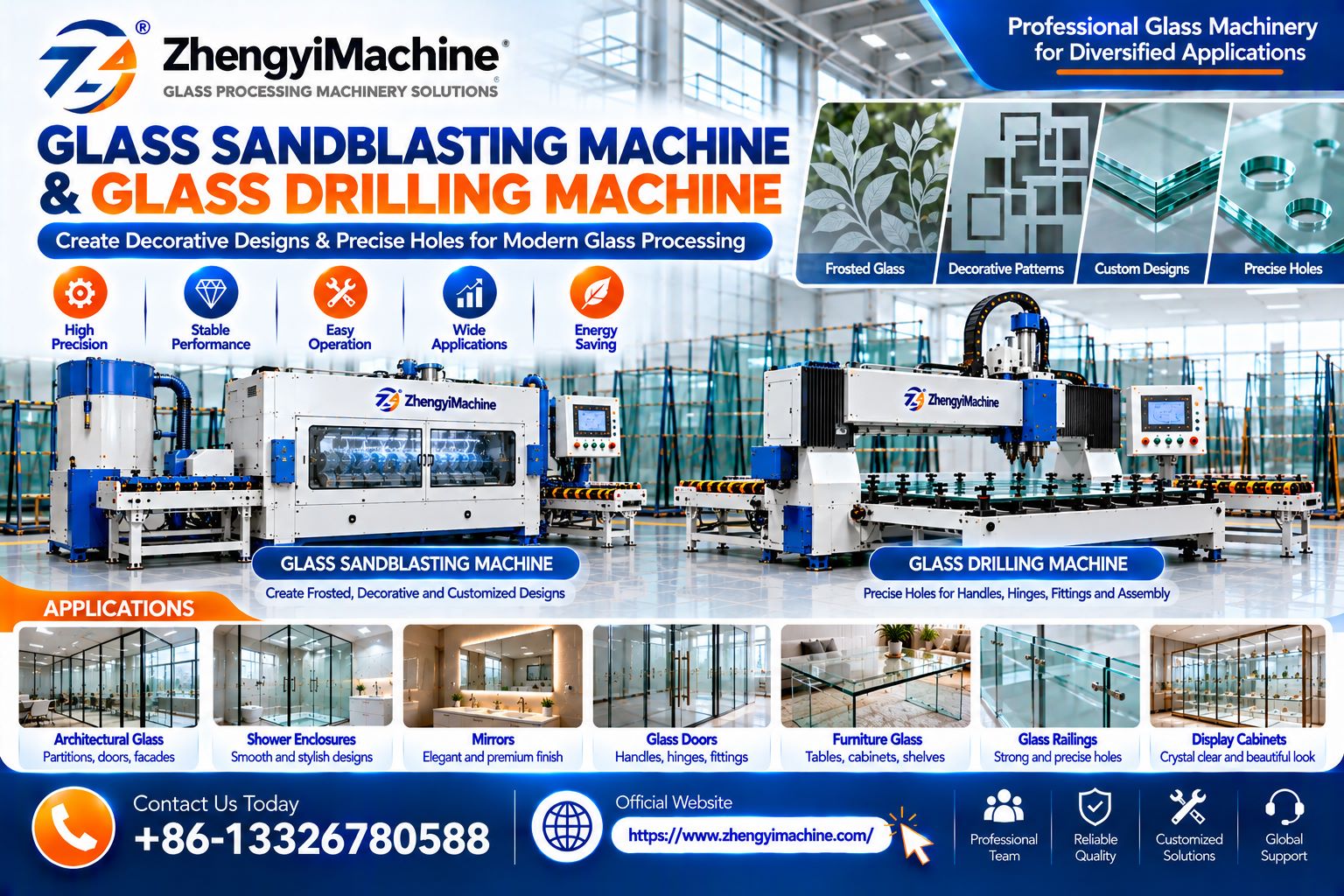
Architects, interior designers, and furniture manufacturers increasingly require customized glass panels that combine decorative effects with accurate installation features.
A modern glass machine helps manufacturers perform specialized processing operations according to defined production requirements.
A Glass Sandblasting Machine creates textured or frosted effects on suitable glass surfaces, allowing manufacturers to produce decorative patterns and privacy-enhancing finishes.
Meanwhile, a Glass Drilling Machine produces accurately positioned holes required for compatible fittings, mounting arrangements, and selected architectural applications.
When these technologies are incorporated into a coordinated production workflow, manufacturers can produce customized glass components with improved design consistency.
The key challenge is translating architectural ideas into products that meet both aesthetic and technical specifications.
Why Customized Glass Is Important in Modern Architecture
Glass is widely used in commercial offices, residential interiors, shopping complexes, hotels, and furniture manufacturing.
However, standard transparent panels cannot satisfy every design requirement.
Some projects require privacy, while others need decorative patterns, hardware openings, or specific mounting arrangements.
Customized processing allows manufacturers to address these different needs.
Common applications include:
- Office partitions: Combining transparent areas with privacy-enhancing frosted designs.
- Interior doors: Creating decorative patterns and accurately positioned hardware openings.
- Furniture panels: Producing customized glass components for cabinets and displays.
- Commercial interiors: Incorporating visual patterns into architectural glass installations.
- Decorative features: Creating distinctive surface designs for selected residential applications.
These requirements encourage manufacturers to evaluate machinery that supports both creative flexibility and dimensional accuracy.
Glass Sandblasting Machine Technology Supports Creative Surface Design
A Glass Sandblasting Machine uses controlled abrasive blasting to modify the appearance of suitable glass surfaces.
The process creates a textured finish by treating exposed areas of the glass.
Depending on equipment capabilities and processing methods, manufacturers may produce frosted panels, decorative patterns, or selected privacy effects.
Masking techniques can protect portions of the glass while designated areas receive the abrasive treatment.
This approach allows manufacturers to combine clear and textured sections within the same panel.
An important manufacturing principle explains:
The quality of sandblasting depends on suitable abrasive media, process control, surface preparation, and equipment condition.
Manufacturers must also evaluate whether the selected glass is appropriate for the intended treatment.
Glass Drilling Machine Applications Support Accurate Installation
Decorative appearance is only one aspect of customized glass production.
Many glass installations require precisely positioned openings for approved fittings, handles, or mounting components.
A Glass Drilling Machine produces holes according to specified dimensions and locations.
Depending on the equipment configuration, drilling operations may involve suitable tools, controlled feed arrangements, and appropriate cooling.
Accurate drilling is particularly important when glass components must align with surrounding architectural hardware.
Glass Doors
Selected glass doors require openings for compatible handles, fittings, and other approved hardware.
Interior Partitions
Certain partition systems use mechanically fastened glass components that require designated holes.
Furniture Manufacturing
Glass furniture may incorporate openings for approved mounting or assembly arrangements.
Commercial Displays
Specialized display installations can require precisely located holes for suitable connection systems.
The dimensions and placement of these openings must follow the engineering requirements of the finished product.
Coordinating Decorative Patterns With Drilling Requirements
Customized glass manufacturing becomes more complex when a single panel requires multiple processing operations.
For example, an interior partition may feature a frosted decorative pattern alongside mounting holes.
The manufacturer must ensure that these elements do not interfere with one another.
A suitable production plan should identify the glass dimensions, decorative areas, hole locations, edge requirements, and intended installation method.
Design drawings should clearly communicate the relationship between decorative patterns and hardware positions.
A useful production observation states:
This approach helps reduce misunderstandings between designers, machine operators, and installation teams.
Why Processing Sequence Matters in Glass Fabrication
Glass processing operations must follow a sequence appropriate to the material and finished product.
Drilling, decorative surface treatment, edge processing, and thermal strengthening are not interchangeable operations.
For conventional thermally toughened glass, required cutting and drilling are generally completed before tempering because subsequent machining can cause breakage.
Manufacturers should therefore confirm all hole locations and dimensional requirements before the strengthening process.
Sandblasting also requires careful evaluation because abrasive treatment can affect glass surface strength.
Its suitability and placement within the production sequence must be assessed according to the glass type, intended application, and relevant standards.
A professional technical review can help determine an appropriate manufacturing route before production begins.
Automated Glass Machine Systems Improve Production Consistency
Automation can support repeatability when manufacturers produce multiple panels with identical design requirements.
Depending on the model, a glass machine may incorporate programmable controls, adjustable processing parameters, or automated material-handling features.
For decorative processing, controlled operation can help maintain consistent treatment across approved production batches.
For drilling, suitable positioning systems can support repeated hole placement according to established specifications.
However, automated equipment does not eliminate the need for trained operators.
Incorrect drawings, inappropriate tooling, or unsuitable settings can still result in defective products.
Manufacturers should combine equipment capabilities with reliable inspection and process-control procedures.
Quality Inspection Remains Essential for Customized Glass
Customized glass products require inspection of both appearance and functional characteristics.
For sandblasted panels, manufacturers may examine pattern consistency, surface uniformity, and visible processing defects.
For drilled components, relevant checks include hole positioning, dimensions, edge condition, and signs of damage.
Inspection requirements should reflect the glass specification and intended installation.
Manufacturers should avoid assuming that an attractive decorative finish guarantees structural suitability.
Products used in architectural applications must satisfy relevant design and safety requirements.
Accurate documentation supports communication between fabrication teams and customers.
Safety and Environmental Considerations in Glass Processing
Sandblasting and drilling involve technical hazards that require suitable workplace controls.
Abrasive blasting may produce airborne particles, while drilling can generate glass fragments, heat, and processing residues.
Manufacturers should provide appropriate machine guarding, dust extraction or containment, and worker protection.
Abrasive media and processing methods must comply with applicable occupational safety requirements.
Drilling operations should use approved tooling and suitable cooling arrangements where required.
Equipment maintenance and employee training are essential parts of responsible manufacturing.
Waste materials and processing residues should also be handled according to relevant environmental regulations.
Selecting Suitable Glass Processing Equipment
Before purchasing machinery, manufacturers should evaluate their intended products and operational requirements.
Important selection criteria include:
- Glass compatibility: Confirm supported glass types, thicknesses, and dimensions.
- Processing capabilities: Evaluate available sandblasting patterns and drilling functions.
- Accuracy requirements: Review achievable positioning and finishing specifications.
- Production capacity: Match equipment performance with expected manufacturing demand.
- Technical support: Assess operator training, maintenance procedures, and spare-parts availability.
Equipment selection should reflect actual production requirements rather than advertised features alone.
Frequently Asked Questions (FAQs)
1. What is a glass machine used for?
A glass machine performs industrial processing operations such as cutting, grinding, drilling, washing, polishing, or decorative surface treatment, depending on its design.
2. What does a Glass Sandblasting Machine do?
A Glass Sandblasting Machine uses controlled abrasive treatment to produce frosted, textured, or decorative effects on suitable glass surfaces.
3. What is the purpose of a Glass Drilling Machine?
A Glass Drilling Machine creates accurately positioned openings in suitable glass panels for approved fittings, hardware, and mounting applications.
4. Can glass be drilled after tempering?
Conventional fully tempered glass generally cannot be drilled after tempering without breaking. Required holes are normally produced before the thermal strengthening process.
5. How can manufacturers improve customized glass production?
Manufacturers can improve consistency through accurate design documentation, suitable machinery, appropriate processing sequences, quality inspection, and trained technical personnel.
Media Contact
Department: Sales, Product Information & Media Enquiries
Industry: Glass Processing Machinery, Sandblasting & Drilling Equipment
Contact: +86-13326780588
Email: zhengyi@zhengyi.cc
Official Website: https://www.zhengyimachine.com/