Safe and reliable water is essential for homes, offices, factories, hospitals, schools, hotels, restaurants, and commercial facilities. Yet water that appears clear may still contain dissolved salts, microorganisms, chemicals, heavy metals, or other contaminants that cannot be identified without scientific analysis. This is why professional water testing in Delhi has become increasingly important for individuals and organisations concerned about water quality.
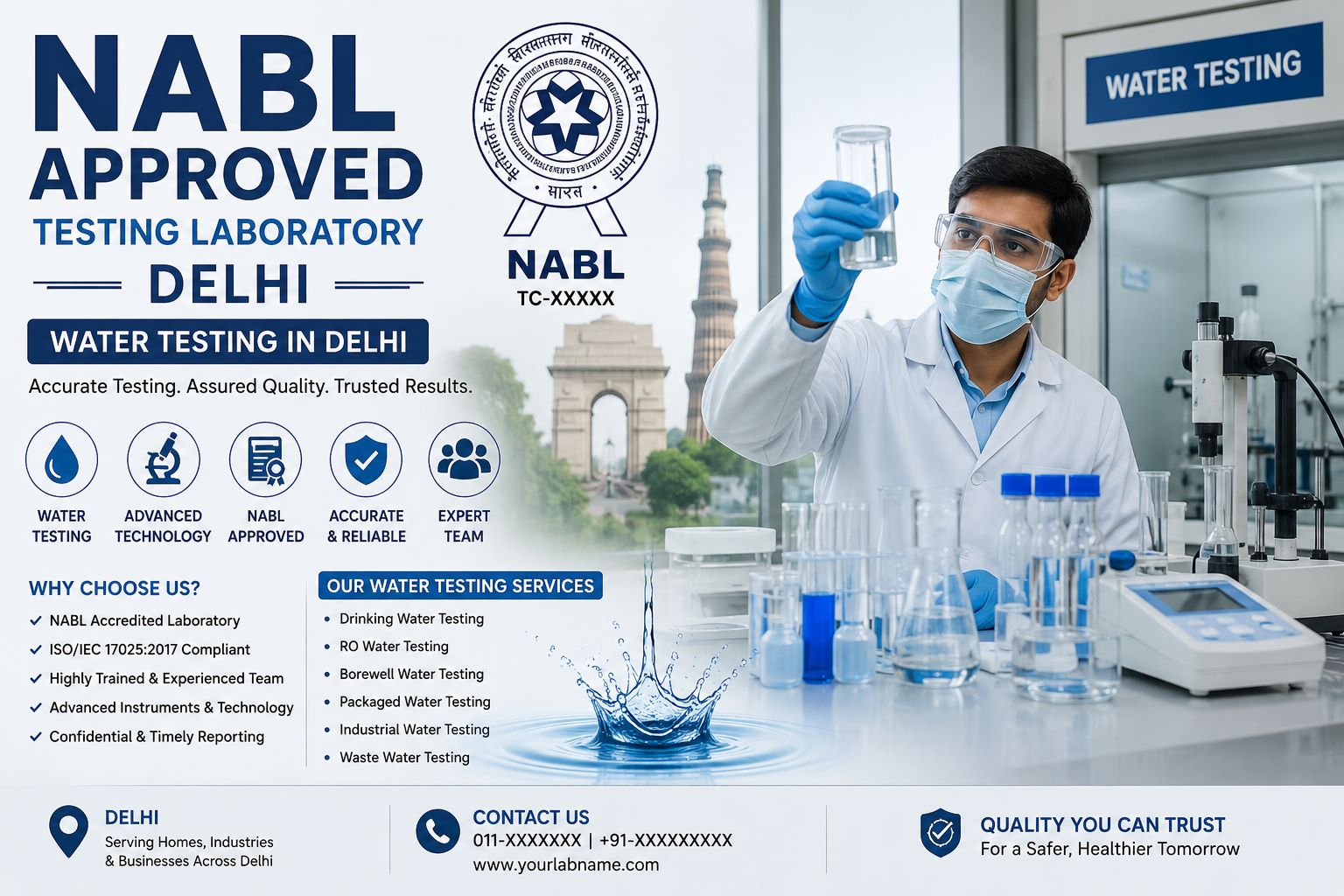
Selecting a NABL approved testing laboratory Delhi can provide greater confidence in testing procedures, technical competence, equipment, documentation, and reporting. Whether the sample comes from groundwater, borewell water, municipal supply, RO water, packaged water, industrial water, or another source, laboratory analysis helps determine its characteristics and suitability for the intended purpose.
What Is a NABL Approved Testing Laboratory Delhi?
NABL stands for the National Accreditation Board for Testing and Calibration Laboratories. Laboratory accreditation is intended to demonstrate technical competence for specific testing activities within an approved scope.
When searching for a NABL approved testing laboratory Delhi, it is important to check not simply whether the laboratory mentions accreditation but whether the required water parameters fall within its current accredited scope.
An experienced laboratory generally follows documented procedures for sample receipt, identification, testing, quality control, equipment management, and report generation.
This structured approach is particularly valuable when test reports are required for compliance, internal quality assurance, industrial processes, supplier assessment, environmental monitoring, or professional decision-making.
Why Is Water Testing in Delhi Important?
Delhi receives water from different sources, while residential and commercial properties may also depend on groundwater, tankers, storage tanks, filtration systems, and borewells. Water quality can therefore differ according to source, locality, storage conditions, pipelines, treatment systems, and seasonal factors.
Professional water testing in Delhi provides measurable information rather than relying on colour, taste, or smell alone.
Testing may help identify issues involving:
- pH and acidity or alkalinity
- Total dissolved solids
- Hardness
- Chloride
- Fluoride
- Nitrate
- Iron
- Turbidity
- Alkalinity
- Microbiological contamination
- Selected heavy metals
- Other chemical or physical characteristics
The exact parameters should be selected according to the source of water and its intended application.
Drinking Water Testing for Homes and Residential Properties
Many households use RO systems or water purifiers without knowing the characteristics of the incoming and treated water. While treatment equipment can improve water quality, proper maintenance and appropriate filtration depend on actual water conditions.
Laboratory testing can provide useful information about both untreated and treated water.
For example, homeowners may compare:
- Incoming supply water
- Water stored in tanks
- Water after purification
Such comparison can help evaluate whether the treatment system is functioning as expected and whether maintenance or further investigation may be required.
A reliable NABL approved testing laboratory Delhi can also guide customers regarding sample quantity, container requirements, preservation conditions, and transportation procedures.
Water Testing for Commercial and Institutional Facilities
Businesses often have broader water-quality requirements than individual households. Hotels, restaurants, hospitals, educational institutions, offices, food-processing facilities, and manufacturing units may use water for drinking, cleaning, processing, cooling, production, or other operational activities.
Regular water testing in Delhi can support quality management by identifying changes before they become larger operational concerns.
Commercial facilities may require testing for:
- Drinking water quality
- Borewell water
- Process water
- RO-treated water
- Cooling water
- Boiler feed water
- Wastewater
- Effluent samples
- Swimming pool water
Testing requirements should always be determined according to the actual application.
Physical, Chemical and Microbiological Water Testing
Water analysis is normally divided into different categories.
| Testing Category | Examples of Parameters | Why It Matters |
| Physical Testing | Colour, odour, turbidity | Indicates visible or sensory characteristics |
| Chemical Testing | pH, hardness, chloride, nitrate | Evaluates chemical composition |
| Microbiological Testing | Relevant bacterial indicators | Helps identify microbial contamination |
| Metal Analysis | Iron and selected heavy metals | Detects specific metallic contaminants |
A comprehensive testing programme may include multiple categories depending on the source and intended use of the water.
How Water Samples Should Be Collected
Accurate laboratory analysis begins before the sample reaches the laboratory. Incorrect collection, unsuitable containers, poor storage, or excessive transportation time can influence results.
Customers should therefore obtain sampling instructions directly from the selected laboratory.
Important considerations include:
- Using the recommended sampling container
- Avoiding accidental contamination
- Properly labelling each sample
- Recording the source and collection details
- Following preservation instructions
- Transporting samples within the recommended period
Microbiological samples can require particularly careful handling because contamination during collection may affect the test outcome.
Benefits of Selecting a NABL Accredited Laboratory
Choosing a competent NABL approved testing laboratory Delhi can offer several practical advantages.
Technical Competence
Accredited laboratories are assessed against defined requirements within their accredited testing scope.
Documented Procedures
Testing is conducted using established laboratory procedures and appropriate methods.
Quality Control
Quality-control practices help laboratories monitor the consistency and reliability of analytical work.
Traceable Reporting
Professional reports clearly identify samples, testing parameters, methods, and reported results.
Better Decision-Making
Reliable laboratory data allows individuals and organisations to make informed decisions regarding treatment, maintenance, processes, and further investigation.
How to Choose a Laboratory for Water Testing in Delhi
Do not select a laboratory based only on price. The quality and relevance of the analysis are far more important.
Before submitting a water sample, consider asking:
- Is the laboratory currently accredited for the required tests?
- Are the required parameters included within its scope?
- Which sample container should be used?
- Does the sample require preservation?
- What quantity of water is needed?
- What testing method will be followed?
- How will the report present the results?
- Can the laboratory test both chemical and microbiological parameters?
Clear communication before collection reduces the possibility of incorrect sampling or unnecessary repeat testing.
Water Testing Should Match the Intended Use
There is no single testing package suitable for every water source.
Drinking water, industrial process water, swimming pool water, wastewater, boiler water, and groundwater may require different analytical parameters.
For example, testing household drinking water may focus strongly on physical, chemical, and microbiological quality, while industrial water analysis may evaluate parameters that affect scaling, corrosion, manufacturing processes, or equipment performance.
This is why customers should explain the intended use when requesting water testing in Delhi.
Frequently Asked Questions
1. What does NABL accreditation mean for a testing laboratory?
NABL accreditation indicates that a laboratory has been assessed for technical competence for activities covered by its accredited scope. Customers should verify that their required tests are included in that scope.
2. Why should water be tested if it looks clean?
Many dissolved chemicals and microorganisms cannot be detected simply by looking at water. Laboratory testing provides measurable information about its quality.
3. How often should drinking water be tested?
Testing frequency depends on the water source, application, regulatory requirements, previous results, storage conditions, and potential contamination risks.
4. Can borewell water be tested?
Yes. Borewell and groundwater samples are commonly analysed for physical, chemical, and microbiological characteristics depending on their intended use.
5. Can RO water be tested?
Yes. Testing incoming and treated RO water can help compare water characteristics and evaluate treatment performance.
6. What parameters are commonly checked during water testing?
Common parameters can include pH, TDS, hardness, alkalinity, chloride, nitrate, fluoride, iron, turbidity, and relevant microbiological indicators.
7. Can I collect a water sample myself?
In many cases, yes, provided you carefully follow the laboratory’s sampling and transportation instructions. Certain situations may benefit from professional sampling.
8. How much water is required for laboratory testing?
The quantity depends on the number and type of parameters being analysed. Ask the laboratory for suitable containers and required sample volume before collection.
9. Can a testing laboratory analyse industrial water?
Yes. Laboratories may offer testing for process water, cooling water, boiler water, wastewater, effluent, and other industrial samples according to their capabilities and scope.
10. How do I find a reliable NABL approved testing laboratory Delhi?
Check accreditation status, accredited scope, available testing parameters, sampling guidance, analytical methods, reporting practices, technical support, and experience with your type of water sample.