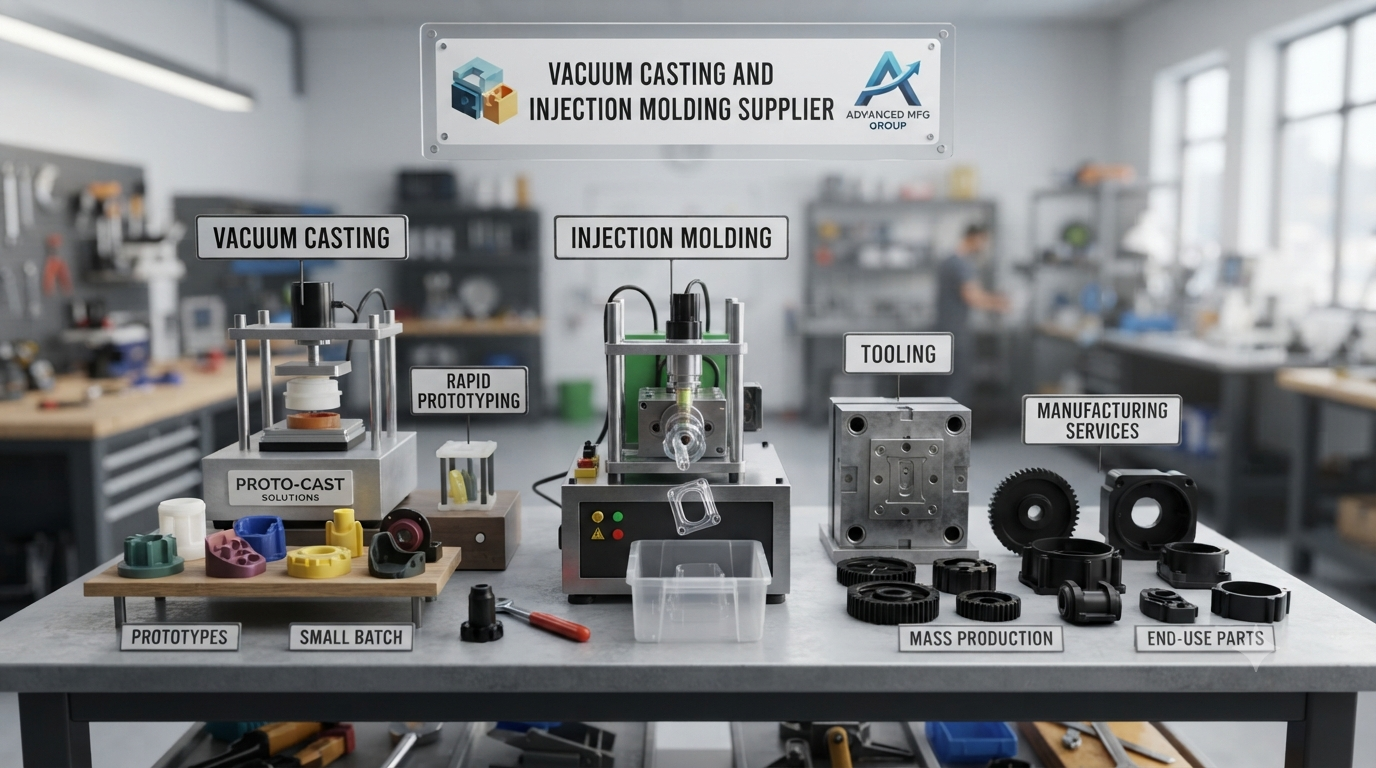
Turning a product concept into a reliable physical component requires more than a good design. Material selection, production volume, tooling cost, dimensional accuracy, surface quality, and delivery schedule can all influence the manufacturing method. Two widely used solutions are vacuum casting and injection molding.
For businesses developing prototypes, testing new products, or preparing for mass production, understanding these processes helps reduce development risks and unnecessary costs. Working with an experienced injection molding supplier can also make the transition from prototype to commercial production considerably smoother.
What Is Vacuum Casting?
Vacuum casting is a manufacturing process commonly used to produce high-quality plastic prototypes and low-volume components. A master model, usually manufactured through CNC machining or 3D printing, is placed inside liquid silicone to create a flexible mould.
After the silicone cures, the master model is removed. Polyurethane resin or another suitable casting material is then poured into the mould under vacuum conditions. The vacuum removes trapped air, helping manufacturers achieve smooth surfaces and detailed reproductions.
The process is particularly useful for:
- Functional prototypes
- Product appearance models
- Pre-production testing
- Marketing samples
- Engineering validation
- Low-volume customised parts
- Consumer electronics housings
- Automotive prototype components
Because silicone tooling costs significantly less than conventional metal tooling, vacuum casting offers an economical solution when only a limited number of components are required.
How Does Vacuum Casting Work?
The production process normally follows several controlled stages.
- A detailed master model is manufactured.
- The model is positioned inside a casting container.
- Liquid silicone is poured around the master pattern.
- The silicone mould is cured and carefully separated.
- The master pattern is removed from the mould.
- Selected polyurethane resin is mixed and prepared.
- Material is cast into the silicone mould under vacuum.
- The component is cured, removed, trimmed, and inspected.
This method can reproduce fine textures, complex geometries, colours, transparent components, rubber-like parts, and various surface finishes.
Key Advantages of Vacuum Casting
The main advantage of vacuum casting is its balance between quality, speed, and low initial investment.
Lower Tooling Investment
Silicone moulds are considerably cheaper and faster to manufacture than hardened steel injection moulds. This makes the process practical for prototypes and small production batches.
Excellent Surface Quality
Components can reproduce very fine details from the original master pattern. Painting, polishing, texturing, colour matching, and other finishing operations can further improve appearance.
Wide Material Simulation
Polyurethane casting materials can simulate properties similar to ABS, polypropylene, acrylic, rubber, and other production plastics.
Faster Product Development
Manufacturers can produce small batches without investing immediately in expensive production tooling, allowing engineering teams to evaluate products before committing to mass manufacturing.
What Is Injection Molding?
Injection molding is a high-volume manufacturing method where molten plastic is injected under pressure into a precision-machined mould. Once the material cools and solidifies, the mould opens and the completed component is ejected.
A professional injection molding supplier can manufacture thousands or even millions of consistent plastic components using precisely controlled production equipment.
Common applications include:
- Automotive components
- Electrical enclosures
- Consumer products
- Medical device components
- Industrial parts
- Packaging components
- Household appliances
- Electronic products
Injection molding requires greater tooling investment initially, but its cost per component becomes highly competitive when production quantities increase.
Why Choosing the Right Injection Molding Supplier Matters
Selecting an injection molding supplier should involve more than comparing quotations. Manufacturing expertise directly affects product quality, production efficiency, delivery reliability, and long-term cost.
A capable supplier should understand mould design, material behaviour, shrinkage, draft angles, wall thickness, cooling systems, tolerances, gate positioning, and production optimisation.
Before selecting a supplier, consider:
- Manufacturing experience
- Quality control systems
- Toolmaking capability
- Available injection molding machines
- Engineering support
- Material expertise
- Production capacity
- Lead times
- Secondary finishing services
- Communication and project management
Design for manufacturability support is particularly valuable because potential production problems can often be identified before tooling begins.
Vacuum Casting vs Injection Molding
| Factor | Vacuum Casting | Injection Molding |
| Tooling | Silicone mould | Metal mould |
| Initial cost | Lower | Higher |
| Production volume | Low | Medium to very high |
| Development speed | Fast | Longer tooling preparation |
| Material options | Polyurethane simulations | Production-grade thermoplastics |
| Part consistency | Very good | Excellent |
| Cost per part | Higher at volume | Lower at high volume |
| Best application | Prototypes and small batches | Commercial mass production |
Neither process is universally better. The correct choice depends primarily on product development stage, required quantity, material specifications, and commercial objectives.
When Should You Choose Vacuum Casting?
Choose vacuum casting when you need approximately a small batch of realistic prototype components without investing in expensive production tooling.
It is particularly suitable when a company needs to evaluate:
- Product appearance
- Assembly compatibility
- Ergonomics
- Customer feedback
- Packaging configuration
- Functional performance
- Different colour variations
Vacuum-cast components can therefore bridge the gap between early 3D-printed prototypes and final injection-molded production parts.
When Should You Choose Injection Molding?
Injection molding becomes preferable when demand is sufficiently high to justify metal tooling.
An experienced injection molding supplier can optimise tooling and production conditions to achieve repeatable dimensions, short cycle times, reduced waste, and dependable quality across large production batches.
It is especially suitable for established designs where production consistency and unit economics are important.
Moving From Vacuum Casting to Injection Molding
Many successful product development projects use both technologies.
The typical sequence is:
Concept design → 3D prototype → vacuum casting → testing and validation → design optimisation → production tooling → injection molding.
This approach allows manufacturers to identify design problems before making a substantial tooling investment.
Frequently Asked Questions
What is vacuum casting mainly used for?
It is mainly used for realistic prototypes, engineering samples, functional testing, and low-volume plastic component production.
Is vacuum casting suitable for mass production?
Generally, no. Silicone moulds have limited production life, making injection molding more appropriate for large quantities.
How accurate is vacuum casting?
Accuracy can be very good when the master model, mould preparation, material selection, and process conditions are properly controlled.
What materials are used?
Polyurethane resins are commonly used to simulate rigid, flexible, transparent, and rubber-like production plastics.
What does an injection molding supplier do?
A supplier may provide mould engineering, tooling, material selection, injection molding, inspection, assembly, finishing, and production management.
Is injection molding expensive?
Initial tooling can be expensive, but high production volumes typically reduce the cost per component considerably.
Which process is faster for prototypes?
Vacuum casting is generally faster because complex metal production tooling is not required.
Can vacuum-cast products have different colours?
Yes. Pigments, painting, surface treatments, and other finishing processes can create different colours and appearances.
Can injection molding produce complex components?
Yes. Proper mould and product engineering can support highly detailed and complex geometries.
How should I choose between these processes?
Consider production quantity, budget, material requirements, tolerances, product maturity, surface finish, and future manufacturing volumes.