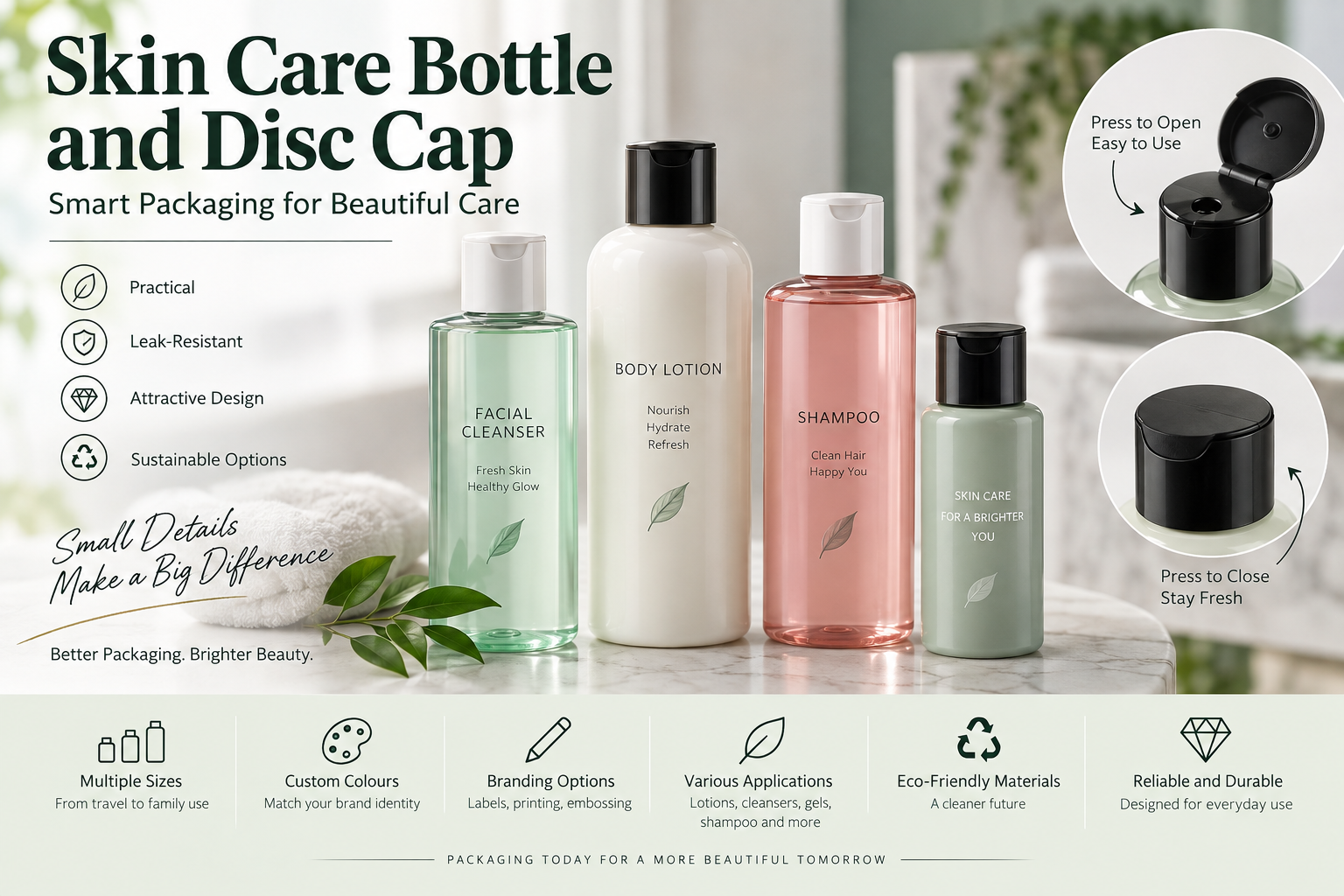
While formulation quality remains the foundation of successful skincare, the right packaging protects that formulation, improves usability, and creates a strong visual identity. Two important components used across the beauty and personal care industry are the skin care bottle and disc cap.
From facial cleansers and moisturising lotions to serums, body oils, shampoos, and hand care products, manufacturers need packaging that is practical, attractive, hygienic, and convenient. Selecting an appropriate bottle and dispensing closure helps brands maintain product quality while giving customers a smooth everyday experience.
Why Skin Care Bottle Packaging Matters
A skin care bottle is more than a container. It creates the first physical interaction between the consumer and the product. Before customers evaluate texture, fragrance, or effectiveness, they often notice the bottle’s appearance, shape, label, and dispensing system.
Good skincare packaging should protect the formulation from external contamination, minimise leakage, and allow controlled product dispensing. Different products also require different packaging solutions depending on viscosity, ingredients, usage frequency, and target market.
For example, a lightweight lotion may work effectively with a squeeze bottle, while a thicker cream cleanser may require a wider dispensing opening.
Important characteristics of quality skincare bottles include:
- Strong and durable construction
- Compatibility with cosmetic formulations
- Convenient dispensing
- Attractive visual presentation
- Leak-resistant design
- Suitable capacity options
- Easy labelling and branding
- Comfortable handling
The right packaging can improve both functionality and perceived product value.
What Is a Disc Cap?
A disc cap is a popular dispensing closure frequently used for cosmetic, skincare, haircare, and personal hygiene products. It normally operates through a simple press mechanism. Pressing one side of the top causes the opposite side to rise, revealing a dispensing opening.
Consumers can then squeeze or pour the required amount of product before pressing the closure back into position.
This straightforward mechanism makes disc closures particularly useful for frequently used products such as lotions, shampoos, conditioners, cleansers, body washes, and massage products.
Unlike closures that must be completely removed before every application, a disc-style closure stays connected to the bottle, making everyday use faster and more convenient.
Benefits of Combining Skin Care Bottles with Disc Caps
Combining a suitable skin care bottle with a reliable disc cap creates practical packaging for numerous beauty formulations.
One major advantage is dispensing control. Consumers can release a reasonable quantity of product instead of accidentally pouring too much. Controlled dispensing can reduce unnecessary waste while creating a cleaner application experience.
Another benefit is convenience. Customers can normally operate the closure using one hand, which is useful for bathroom products and everyday skincare routines.
Additional advantages include:
- Quick opening and closing
- Reduced need to remove separate lids
- Cleaner product dispensing
- Convenient travel and storage
- Attractive packaging appearance
- Compatibility with multiple bottle designs
- Suitable application for different cosmetic categories
These characteristics explain why disc closures remain widely used across personal care packaging.
Choosing the Right Material for a Skin Care Bottle
Material selection influences packaging durability, appearance, product compatibility, transportation requirements, and recyclability.
Plastic bottles are commonly manufactured from materials such as PET, HDPE, and PP. Each material provides different properties.
PET bottles are valued for their clarity and attractive finish. They are commonly used where brands want consumers to see the colour or remaining quantity of the formulation.
HDPE provides excellent strength and durability and is frequently chosen for shampoos, lotions, cleansers, and body care products.
PP is another versatile packaging material and is widely associated with cosmetic closures, including many disc cap designs.
Manufacturers should conduct compatibility testing because cosmetic ingredients, fragrances, oils, alcohol content, and active ingredients may interact differently with packaging materials.
Skin Care Bottle and Disc Cap Comparison
| Packaging Feature | Skin Care Bottle | Disc Cap |
| Main Purpose | Stores and protects formulation | Controls product dispensing |
| Common Materials | PET, HDPE, PP | Mainly PP and similar plastics |
| Applications | Lotion, cleanser, serum, oil | Shampoo, lotion, gel, cleanser |
| Branding Potential | High | Moderate to high |
| User Convenience | Depends on bottle design | Very convenient |
| Customisation | Shape, size, colour, decoration | Colour, diameter, opening style |
When designed together, these components create a complete packaging solution rather than functioning as separate elements.
Applications Across Cosmetic and Personal Care Products
A quality skin care bottle equipped with a disc closure can accommodate many formulations.
Common applications include:
- Facial cleansers
- Moisturising lotions
- Body lotions
- Sunscreen products
- Shampoo and conditioner
- Shower gel
- Hand lotion
- Massage lotion
- Hair treatments
- Facial gels
The formulation’s viscosity should always be considered. The dispensing opening must allow the product to flow comfortably without releasing excessive quantities.
Customisation and Branding Opportunities
Modern skincare packaging must often balance functionality with brand differentiation. Bottle manufacturers can provide various customisation options, allowing brands to create packaging aligned with their visual identity.
Common possibilities include bottle colour, capacity, finish, shape, closure colour, printing, labels, screen printing, embossing, and decorative effects.
Minimalist brands may prefer neutral packaging with clean typography, while premium skincare businesses may choose specialised finishes or distinctive bottle silhouettes.
Matching the disc cap colour with the bottle, label, or brand palette creates a more coordinated appearance.
What Manufacturers Should Consider Before Ordering
Selecting packaging should involve technical evaluation rather than appearance alone.
Businesses should consider:
- Product viscosity
- Chemical compatibility
- Bottle capacity
- Neck dimensions
- Closure compatibility
- Leak resistance
- Transportation conditions
- Target market
- Decoration requirements
- Minimum order quantity
- Sustainability objectives
Requesting production samples before placing a large order can help companies test filling, dispensing, sealing, storage, and transportation performance.
Sustainability in Skincare Packaging
Sustainability has become increasingly important within cosmetic packaging development. Brands are exploring lightweight bottles, recyclable materials, recycled plastic content, refill systems, and simplified packaging structures.
Reducing unnecessary material can lower packaging waste and transportation weight. However, sustainability should not compromise essential functions such as formulation protection or leakage prevention.
Brands should evaluate the complete packaging lifecycle rather than relying only on environmental marketing claims.
Frequently Asked Questions
1. What is a skin care bottle?
It is packaging specifically designed to store and dispense skincare formulations such as lotions, cleansers, gels, oils, and moisturisers.
2. What is a disc cap used for?
A disc cap provides convenient controlled dispensing through a press-to-open mechanism.
3. Are disc caps suitable for lotions?
Yes. They are commonly used for lotions with suitable viscosity.
4. Can skincare bottles be customised?
Yes. Colours, shapes, capacities, printing, labels, and finishes can usually be customised.
5. Which material is best for skincare bottles?
PET, HDPE, and PP are common choices, but the ideal material depends on formulation compatibility.
6. Are disc closures leakproof?
Quality closures can provide strong leak resistance when correctly matched and tested with compatible bottles.
7. Can they be used for shampoo?
Yes. Disc closures are widely used for shampoo and conditioner packaging.
8. What bottle capacity should I choose?
Capacity depends on product usage, positioning, formulation, and customer requirements.
9. Should packaging undergo compatibility testing?
Yes. Testing helps determine whether the formulation interacts safely with the bottle and closure.
10. Can disc caps match brand colours?
Yes. Manufacturers may offer standard colours or customised colours depending on production quantities.