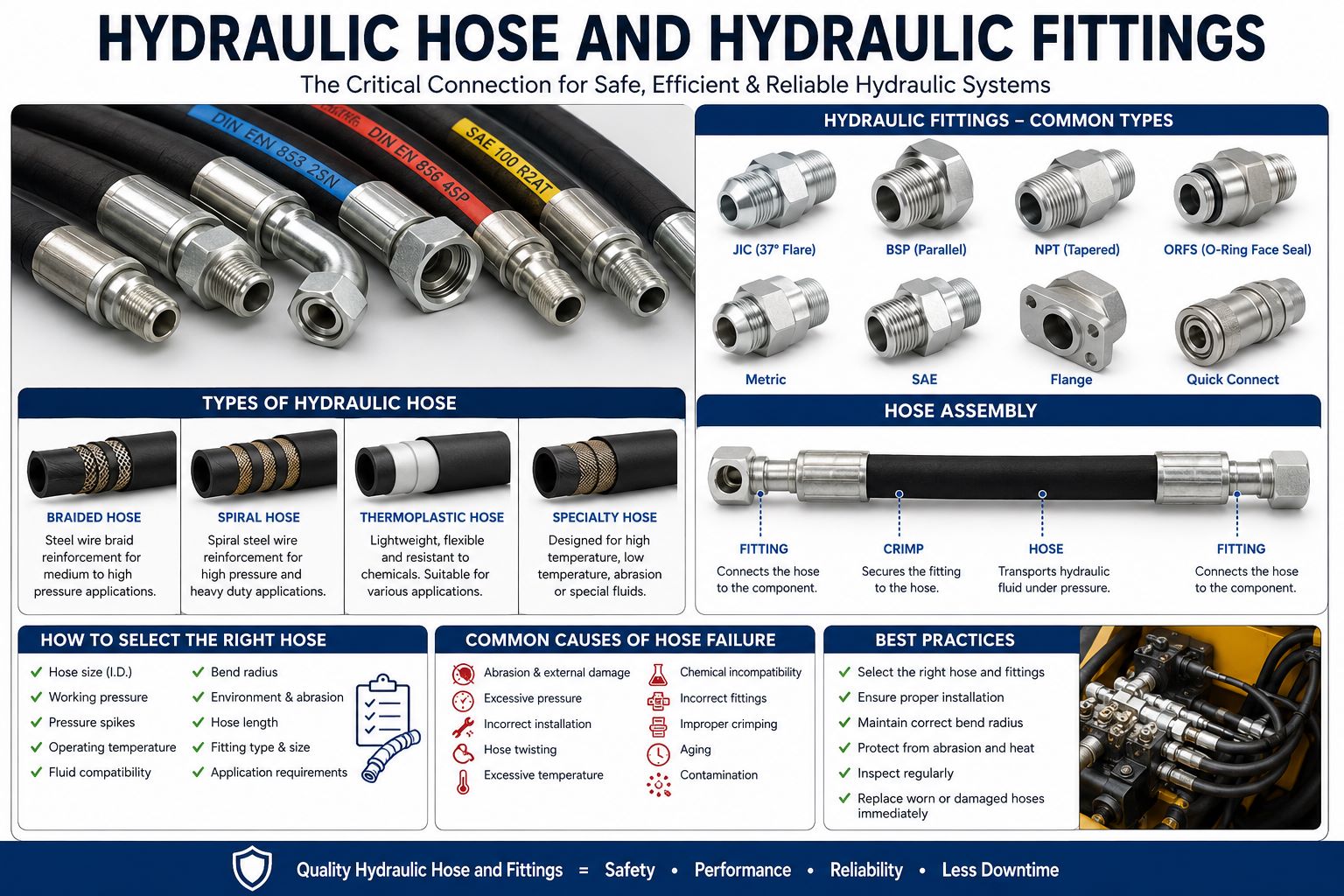
Modern industries depend heavily on hydraulic power to move, lift, press, steer, clamp, and control heavy loads. Whether it is an excavator working on a construction site, a hydraulic press operating inside a factory, or agricultural machinery working continuously in demanding conditions, reliable fluid transmission is essential. Two components that make this possible are Hydraulic Hose and Hydraulic Fittings.
These components form the flexible connection network of a hydraulic system. Their quality, compatibility, installation, and maintenance directly influence pressure stability, operational efficiency, equipment reliability, and workplace safety.
Understanding how they function together helps engineers, maintenance professionals, equipment operators, and buyers make better decisions when designing or maintaining hydraulic systems.
Understanding the Role of Hydraulic Hose
A Hydraulic Hose is designed to carry pressurized hydraulic fluid between different parts of a hydraulic circuit. Unlike rigid pipes, hoses provide flexibility, making them suitable for equipment where components move, vibrate, rotate, or operate within limited spaces.
A typical hose contains three functional layers.
- The inner tube carries hydraulic fluid and must resist chemical deterioration.
- The reinforcement provides mechanical strength against internal pressure.
- The outer cover protects against abrasion, moisture, weather, oil, and external damage.
Depending on the pressure requirement, reinforcement may consist of textile fibers, braided steel wire, or multiple spiral-wire layers.
Understanding the Function of Hydraulic Fittings
While hoses transport fluid, Hydraulic Fittings create secure connection points throughout the hydraulic circuit.
They connect hoses with:
- Hydraulic pumps
- Cylinders
- Control valves
- Motors
- Manifolds
- Filters
- Accumulators
- Other hoses and tubes
A fitting must maintain a dependable seal while experiencing pressure fluctuations, vibration, temperature changes, and mechanical movement.
A small compatibility problem at the connection point can compromise an otherwise properly designed hydraulic system.
How Hydraulic Hose and Hydraulic Fittings Work Together
A hydraulic hose assembly consists of more than simply a hose with connectors attached at both ends. It should be treated as an engineered pressure-carrying component.
Hydraulic Hose and Hydraulic Fittings must be compatible in terms of hose construction, dimensions, fitting design, crimp specifications, operating pressure, fluid type, and application.
When hydraulic fluid enters the hose under pressure, reinforcement prevents excessive expansion. The fitting creates a controlled mechanical connection between the hose and equipment.
If either component is incorrectly selected, the integrity of the entire assembly can be affected.
Different Hydraulic Hose Constructions
The correct hose construction depends heavily on operating conditions.
Wire Braided Hose
Wire-braided hoses use one or more layers of steel-wire braid. They offer a useful combination of flexibility and pressure resistance.
They are widely used in manufacturing equipment, agricultural machinery, material-handling systems, and general mobile hydraulics.
Spiral Wire Hose
Spiral-wire construction uses several layers of high-strength wire positioned around the inner tube.
These hoses are commonly selected for severe high-pressure and high-impulse applications, including mining machinery, excavators, drilling equipment, and heavy construction systems.
Textile Reinforced Hose
Textile reinforcement can be suitable for lower-pressure hydraulic and industrial fluid-transfer applications where flexibility is particularly important.
Thermoplastic Hose
Thermoplastic hoses offer lightweight construction and good resistance to various chemicals and environmental conditions. Certain designs are also used where electrical non-conductivity is required.
Major Types of Hydraulic Fittings
Different regions and equipment manufacturers may use different connection standards.
Common Hydraulic Fittings include:
- JIC 37-degree flare fittings
- BSPP and BSPT fittings
- NPT connections
- SAE connections
- Metric fittings
- ORFS fittings
- Flange connections
- Quick-release couplings
Each connection has its own thread geometry and sealing principle.
For example, some fittings seal through tapered threads, while others use O-rings, flare surfaces, or dedicated sealing faces.
Identifying the correct standard is therefore essential before replacing a fitting.
Key Differences Between Hose and Fittings
| Parameter | Hydraulic Hose | Hydraulic Fittings |
| Main function | Carries hydraulic fluid | Creates secure connections |
| Structure | Flexible | Generally rigid |
| Typical materials | Rubber, thermoplastic, reinforcement | Steel, stainless steel, brass |
| Important specification | Pressure and diameter | Thread and sealing type |
| Movement | Handles flexing and vibration | Provides connection stability |
| Typical damage | Abrasion, cracking, rupture | Leakage, corrosion, seal failure |
Despite their differences, both components must function as one compatible assembly.
Selecting the Right Hydraulic Hose
Correct selection should consider more than pressure alone.
A widely used engineering approach involves evaluating size, temperature, application, material or media, pressure, ends, and delivery requirements.
Important considerations include:
- Inside diameter
- Maximum working pressure
- Temperature range
- Hydraulic fluid
- Minimum bend radius
- Hose length
- External environment
- Abrasion exposure
- Movement requirements
- End connections
Correct sizing is especially important.
A hose with an excessively small internal diameter can increase fluid velocity, pressure losses, heat generation, and energy consumption.
Selecting Compatible Hydraulic Fittings
Choosing Hydraulic Fittings requires precise identification of both the hose and equipment connection.
Technicians should examine thread diameter, pitch, fitting orientation, sealing method, material, pressure rating, and connection standard.
Never force two fittings together because their threads appear similar.
Incorrectly matched threads may initially tighten but fail to create a reliable seal. They may also permanently damage the connection.
Understanding Working Pressure and Safety Factor
Working pressure represents the pressure a hose assembly is designed to withstand during normal service under specified conditions.
Burst pressure is different. It represents a laboratory performance characteristic and should never be treated as the normal operating pressure.
The working pressure of the complete assembly is generally determined by the lowest-rated compatible component.
This means a hose rated for higher pressure cannot compensate for an inadequately rated fitting.
Temperature Can Change Hose Performance
Temperature is sometimes overlooked during hydraulic component selection.
High fluid temperatures can accelerate deterioration of the inner tube. External heat sources such as engines, exhaust systems, furnaces, and industrial processes can also damage the hose cover.
Extremely low temperatures may affect flexibility.
Both internal fluid temperature and surrounding environmental temperature should therefore be evaluated before selecting a Hydraulic Hose.
Fluid Compatibility Matters
Not every hose material is compatible with every hydraulic fluid.
Systems may use petroleum-based hydraulic oils, synthetic fluids, biodegradable oils, water-glycol fluids, or other specialized media.
Incompatible fluids may cause swelling, softening, cracking, hardening, or deterioration of hose materials and seals.
Compatibility should always be confirmed using the hose and fitting manufacturer’s technical information.
Why Proper Routing Is Essential
Even correctly selected Hydraulic Hose can fail prematurely when routed incorrectly.
Avoid:
- Sharp bends
- Hose twisting
- Excessive stretching
- Contact with sharp surfaces
- Unnecessary rubbing
- Direct exposure to excessive heat
- Insufficient allowance for movement
The manufacturer’s specified minimum bend radius should always be respected.
Protective sleeves or guards can provide additional protection in abrasion-prone locations.
Common Warning Signs of Hydraulic Hose Problems
Routine visual inspections can reveal developing problems before they cause major downtime.
Watch for:
- Cracked outer covers
- Exposed reinforcement
- Severe abrasion
- Oil leakage
- Blisters or bubbles
- Flattened sections
- Corroded fittings
- Damaged threads
- Hose movement near fittings
- Unusual deformation
A damaged assembly should be evaluated promptly rather than waiting for complete failure.
Why Hydraulic Fittings Develop Leaks
Leakage does not necessarily mean that a fitting simply needs additional tightening.
Possible causes include damaged O-rings, contaminated sealing surfaces, incompatible threads, incorrect installation, vibration, corrosion, excessive pressure, or damaged fitting seats.
Overtightening can actually deform sealing surfaces and make the problem worse.
Correct diagnosis should therefore come before repair.
Preventive Maintenance for Hydraulic Connections
A structured inspection program can significantly improve hydraulic system reliability.
Maintenance teams should regularly:
- Inspect hoses for physical deterioration.
- Examine fitting connections for leakage.
- Check routing and hose supports.
- Look for abrasion points.
- Inspect protective sleeves.
- Monitor operating temperatures.
- Replace damaged assemblies promptly.
- Maintain records for critical hose assemblies.
High-pressure hydraulic leaks should never be checked using hands. A small stream of pressurized fluid can penetrate skin and cause a serious injection injury.
Frequently Asked Questions
1. What is the main purpose of a hydraulic hose?
A Hydraulic Hose carries pressurized fluid between components while accommodating movement, vibration, and flexible routing requirements.
2. Why are hydraulic fittings necessary?
Hydraulic Fittings provide secure connections between hoses and hydraulic components while helping maintain system pressure and fluid containment.
3. What is the difference between braided and spiral hose?
Braided hoses generally offer greater flexibility, while spiral designs are commonly intended for demanding high-pressure and impulse applications.
4. How is hydraulic hose size determined?
Hose selection considers internal diameter, required flow, pressure, fluid velocity, equipment specifications, and application conditions.
5. Can any fitting be installed on any hydraulic hose?
No. Hose and fitting compatibility must be confirmed according to manufacturer specifications and approved assembly procedures.
6. What causes hydraulic hose leakage?
Leakage may result from abrasion, aging, improper installation, excessive pressure, damaged fittings, incorrect crimping, or incompatible materials.
7. How long does a hydraulic hose last?
There is no universal service life. Usage, pressure cycles, temperature, environment, routing, maintenance, and storage all influence durability.
8. What is minimum bend radius?
It is the smallest recommended radius through which a hose can bend without compromising its construction or expected performance.
9. Should a leaking fitting simply be tightened?
Not always. The leak should first be inspected for damaged seals, incorrect threads, contamination, corrosion, or sealing-surface problems.
10. Why is hose inspection important?
Regular inspection helps detect deterioration before failure, reducing unexpected downtime, fluid loss, equipment damage, and potential safety hazards.
https://newsgrow.blogspot.com/2026/08/industrial-hose-technology-evolves-as.html