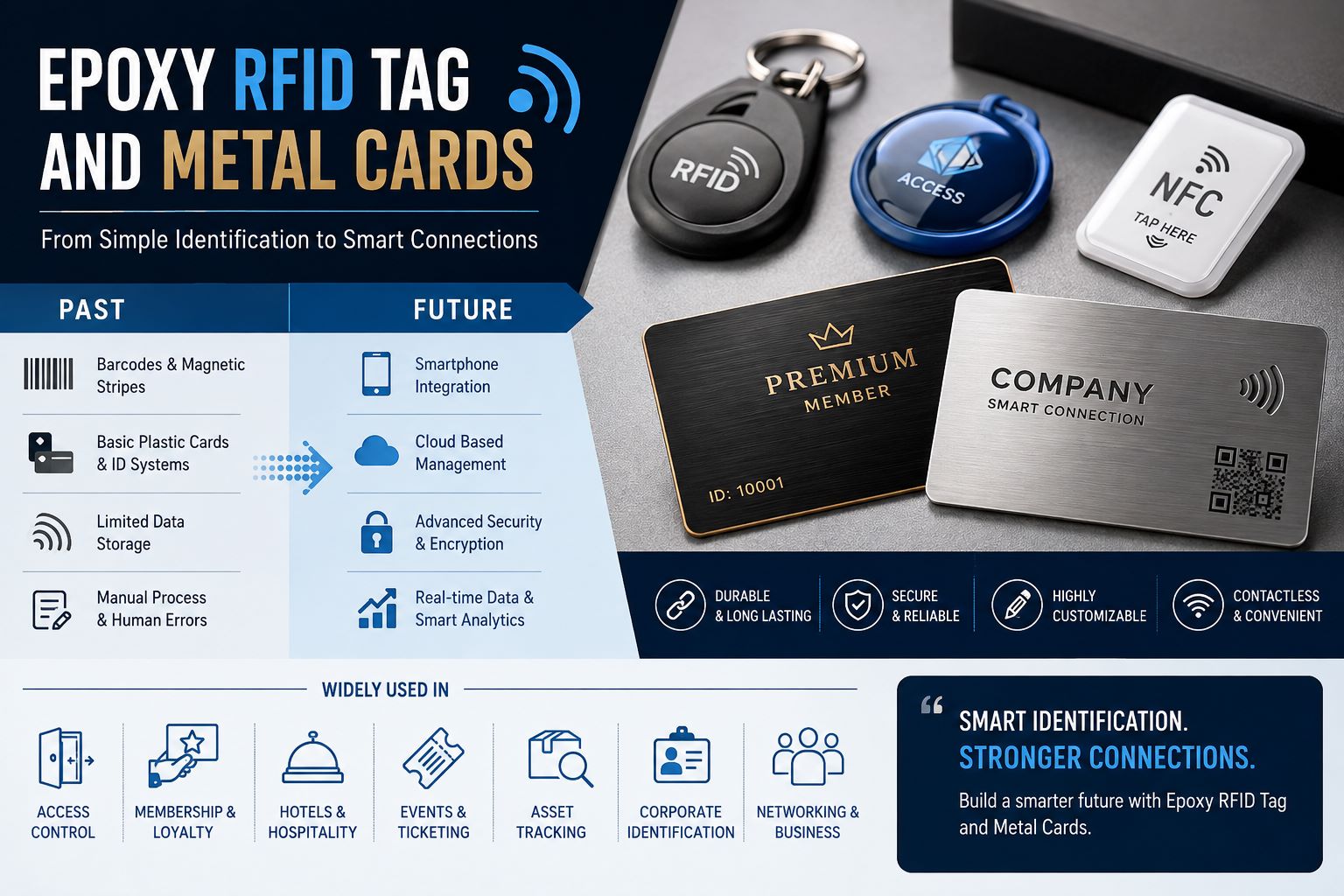
Modern identification technology is moving beyond plastic cards and printed labels. Businesses increasingly want products that are durable, attractive, contactless, and digitally connected. Two important solutions are Epoxy RFID tag products and metal cards. Both combine durability with branding, identification, access control, and customer engagement.
What Is an Epoxy RFID Tag?
An Epoxy RFID tag is a compact RFID-enabled device covered with transparent or colored epoxy resin. The resin protects the embedded chip, antenna, artwork, and surface from moisture, scratches, dust, and regular handling.
These tags can use different RFID or NFC frequencies. NFC versions are commonly used for smartphones, digital business profiles, authentication, interactive marketing, and smart keychains.
Main Components
A typical tag contains:
- RFID or NFC microchip
- Internal antenna
- Printed PVC or PET base
- Protective epoxy resin
- Optional adhesive, keyring, or hole
Why Epoxy Coating Matters
The epoxy dome creates a glossy, three-dimensional appearance while improving resistance to wear. It also gives branding a more premium finish than a standard printed sticker.
How Epoxy RFID Tags Work
When an RFID reader or compatible smartphone approaches the tag, electromagnetic energy activates the chip. Stored information is then transmitted to the reader.
Depending on the chip, the tag may store a unique ID, URL, contact information, access credential, product data, or authentication record.
Common applications include:
- Access control
- Membership identification
- NFC business cards
- Asset tracking
- Loyalty programs
- Event registration
- Product authentication
- Website sharing
Because an Epoxy RFID tag can be customized in different shapes and printed designs, it works well when functionality and visual branding are equally important.
What Are Metal Cards?
Metal cards are premium identification, membership, business, promotional, or access cards manufactured mainly from metal rather than conventional PVC.
They are popular for their weight, texture, durability, and luxury appearance. Designs can include laser engraving, cut-out patterns, brushed surfaces, matte finishing, QR codes, numbering, or embedded contactless technology.
Common Metal Materials
| Material | Main Characteristic | Common Use |
| Stainless steel | Strong and premium | VIP and membership cards |
| Aluminum | Lightweight | Business cards |
| Brass | Heavy luxury feel | Exclusive invitations |
| Copper | Distinctive finish | Creative branding |
Epoxy RFID Tag vs Metal Cards
Both products support identification and branding, but they solve different needs.
| Feature | Epoxy RFID Tag | Metal Cards |
| Contactless capability | Excellent | Optional |
| Water resistance | High | High |
| Visual impact | Modern and glossy | Premium and luxurious |
| Portability | Very compact | Standard card format |
| Custom shapes | Flexible | More limited |
| Smartphone interaction | Common with NFC | Possible with NFC |
| Typical use | Tracking, access, sharing | Membership, business, VIP branding |
An Epoxy RFID tag suits compact contactless interaction, while metal cards are more appropriate when presentation and long-term brand recognition are priorities.
Important Design and Manufacturing Factors
The best specification should match the operating environment, expected scan distance, reader type, branding goals, and required service life for deployment.
RFID Frequency and Chip Selection
Different systems require different frequencies and chip specifications. NFC applications commonly use high frequency, while inventory and longer-range tracking may use UHF technology. Compatibility with the intended reader should always be confirmed before production.
Metal Interference
Metal can interfere with RFID communication. Products installed directly on metal may require anti-metal shielding or specially engineered antennas. When contactless technology is integrated into metal cards, antenna and metal structure must be designed carefully.
Printing and Personalization
Customization may include:
- Full-color printing
- Laser engraving
- Serial numbers
- QR codes
- Barcodes
- Logo printing
- UID encoding
- Variable data
- Custom shapes
Key Benefits for Businesses
An Epoxy RFID tag connects physical objects with digital information quickly through tapping or scanning. Metal cards strengthen brand presentation while providing excellent durability. Businesses use these products for access management, product traceability, digital networking, memberships, and authentication.
How to Choose the Right Solution
Choose an Epoxy RFID tag when you need compact size, NFC interaction, asset identification, keychain functionality, or frequent scanning.
Choose metal cards when your priority is premium appearance, executive networking, luxury memberships, invitations, or long-lasting customer cards.
For advanced applications, both concepts can be combined. A specially engineered metal card with NFC functionality can deliver luxury presentation and digital interaction together.
Frequently Asked Questions
1. Are epoxy RFID tags waterproof?
Many epoxy-coated tags provide strong moisture resistance, but the exact rating depends on construction and manufacturer.
2. Can an Epoxy RFID tag work with smartphones?
Yes. NFC-compatible tags can work with NFC-enabled smartphones when correctly encoded.
3. What information can RFID tags store?
They may store identifiers, URLs, contact details, authentication data, or application-specific records.
4. Are metal cards heavier than PVC cards?
Yes. Stainless steel, brass, and similar materials usually feel heavier than plastic cards.
5. Can metal cards contain NFC technology?
Yes, but special antenna engineering is necessary because metal can interfere with radio-frequency signals.
6. Can epoxy RFID tags be customized?
Yes. Shape, printing, logo, numbering, chip type, attachment style, and encoding can be customized.
7. Are metal cards suitable for business cards?
Yes. Their durability and premium feel make them popular for executive and luxury business cards.
8. How long do epoxy tags last?
Service life depends on resin quality, environment, attachment method, chip quality, and handling.
9. Can RFID tags support authentication?
Yes. Suitable RFID or NFC chips can support product verification, access credentials, and authentication systems.
10. Which option offers stronger premium branding?
Metal cards emphasize luxury presentation, while epoxy tags emphasize compact smart interaction.