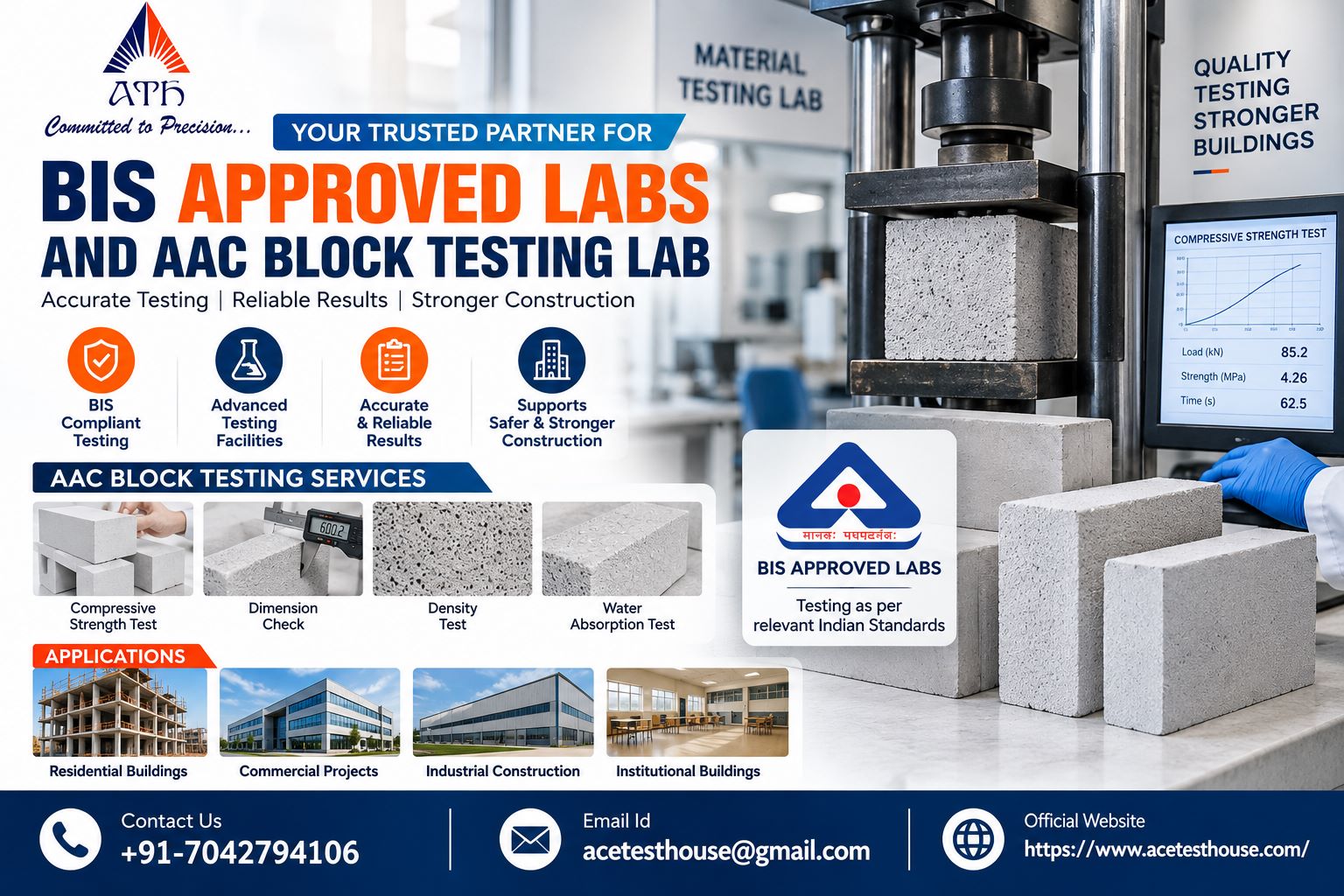
Quality assurance is becoming an essential part of responsible construction, with builders, manufacturers, developers, and infrastructure contractors placing greater importance on laboratory-tested materials.
Autoclaved Aerated Concrete (AAC) blocks are widely considered for construction projects because of their lightweight structure, dimensional characteristics, and thermal insulation properties.
However, consistent product quality cannot be established through appearance alone.
Professionals searching for BIS approved Labs often want reliable testing services that support product evaluation against relevant Indian Standards.
Similarly, an AAC block Testing lab examines selected physical and mechanical properties to help determine whether construction blocks meet specified requirements.
The growing emphasis on laboratory verification reflects a broader need for transparent material quality assessment across construction projects.
Why AAC Block Quality Matters in Construction
AAC blocks are manufactured using cementitious materials, fine aggregates or suitable alternatives, water, and an expanding agent, followed by autoclave curing.
Their cellular structure helps reduce material weight while providing characteristics useful in suitable building applications.
Nevertheless, manufacturing variations can influence strength, dimensions, density, and durability-related properties.
Blocks that fail to meet project specifications may contribute to installation difficulties, increased material consumption, or unsuitable wall performance.
Appropriate laboratory testing helps manufacturers and buyers evaluate these characteristics using defined procedures.
What Are BIS Approved Labs?
The phrase BIS approved Labs is commonly used when searching for laboratories associated with testing under standards issued by the Bureau of Indian Standards.
However, the terminology requires careful interpretation.
BIS recognizes laboratories for specified testing activities under its applicable schemes. Laboratory recognition, accreditation, and product certification are different processes.
A laboratory’s recognition should therefore be verified for the exact product category, testing method, and current scope required.
Important Distinctions
- BIS Laboratory Recognition: Recognition under an applicable BIS arrangement for specified testing capabilities.
- NABL Accreditation: Accreditation demonstrating laboratory competence within a defined scope.
- BIS Product Certification: Certification of eligible products under applicable conformity assessment requirements.
- Indian Standards Testing: Examination of materials using specified Indian Standard methods.
A laboratory should never be described as universally BIS-approved merely because it performs tests based on Indian Standards.
Understanding an AAC Block Testing Lab
An AAC block Testing lab evaluates defined properties of autoclaved aerated concrete blocks using suitable laboratory methods.
The testing requirements depend on the product specification, intended application, and relevant standards.
In India, IS 2185 (Part 3) addresses autoclaved cellular concrete blocks.
Testing helps determine whether submitted samples satisfy the applicable requirements for their declared category.
Common AAC Block Tests
Compressive Strength: Evaluates the resistance of blocks to crushing under specified loading conditions.
Dry Density: Measures material density according to the relevant test method.
Dimensional Accuracy: Examines whether block dimensions fall within permitted tolerances.
Drying Shrinkage: Assesses dimensional changes associated with moisture loss under defined conditions.
Moisture-Related Properties: Evaluates selected characteristics where required by the applicable specification.
The complete testing package should be determined by the relevant standard and project requirements.
Why Compressive Strength Testing Is Important
Compressive strength is an important mechanical property of AAC blocks.
It indicates the load-resisting capacity of a specimen under controlled testing conditions.
Testing involves preparing suitable specimens and applying a defined compressive load using appropriate equipment.
Results are evaluated according to the specified testing procedure.
However, block strength alone does not establish the structural suitability of a complete wall.
Designers must also consider wall configuration, load conditions, connections, and other engineering requirements.
Density and Dimensional Accuracy in AAC Blocks
Density influences the weight and certain performance characteristics of AAC products.
A suitable AAC block Testing lab can measure dry density and help verify whether the material corresponds to the specified product classification.
Dimensional accuracy is equally important.
Inconsistent dimensions may affect joint thickness, alignment, finishing requirements, and material consumption.
Laboratory results help identify characteristics that require further manufacturing or procurement review.
How Laboratory Testing Supports AAC Manufacturers
AAC block manufacturers need consistent quality control to manage variations in production.
Laboratory analysis provides measured evidence that can support internal quality decisions.
Testing may help manufacturers evaluate whether products satisfy declared specifications before distribution.
Where results fall outside requirements, manufacturers can investigate factors such as raw materials, mixing conditions, curing processes, and production controls.
Independent testing can also support communication between manufacturers, contractors, and project quality teams.
However, a satisfactory report for submitted samples does not automatically establish conformity of every block in an entire production lot.
The Role of Testing in Construction Procurement
Construction companies frequently evaluate multiple suppliers before purchasing building materials.
Product descriptions and commercial quotations provide useful information, but technical performance requires suitable supporting evidence.
Buyers researching BIS approved Labs should confirm whether a laboratory can perform the required AAC tests under the relevant recognized or accredited scope.
Procurement teams should also review sample identification, test methods, reported results, and applicable acceptance criteria.
A clear testing specification helps reduce misunderstandings between suppliers and contractors.
Sample Selection and Laboratory Reliability
The usefulness of testing depends partly on whether submitted samples appropriately represent the material being evaluated.
Poor sample selection can produce results that do not accurately describe the intended batch.
Recommended Quality Control Practices
- Identify the relevant product specification.
- Select samples according to the required sampling procedure.
- Record manufacturer and batch identification.
- Protect samples against damage during transport.
- Confirm the necessary test methods with the laboratory.
- Review results against the applicable acceptance criteria.
Where sampling is undertaken by the customer, the report should clearly distinguish submitted-sample results from broader batch conformity conclusions.
How to Choose a Suitable AAC Testing Laboratory
Before selecting a laboratory, manufacturers and contractors should evaluate its technical competence and reporting procedures.
Important considerations include appropriate testing equipment, trained personnel, sample handling practices, and relevant recognized or accredited testing scope.
A credible laboratory should communicate which tests it can perform and explain any limitations.
Customers should request a clear report identifying the sample, test method, measurements, and applicable specification.
Transparent reporting helps technical teams make defensible quality decisions.
Frequently Asked Questions (FAQs)
1. What are BIS approved Labs?
The term commonly refers to laboratories recognized by BIS for specified testing activities. Customers should verify the laboratory’s exact recognition status and scope.
2. What does an AAC block Testing lab examine?
It evaluates relevant AAC block characteristics such as compressive strength, dry density, dimensional accuracy, and other specified properties.
3. Which Indian Standard applies to AAC blocks?
IS 2185 (Part 3) covers autoclaved cellular concrete blocks. The applicable requirements should be confirmed for the specific product and testing purpose.
4. Is NABL accreditation the same as BIS recognition?
No. NABL accreditation and BIS laboratory recognition are distinct arrangements with different requirements and defined scopes.
5. Why should construction companies test AAC blocks?
Testing provides measured evidence of selected material properties and helps buyers evaluate products against project specifications and applicable standards.
Media Contact
Department: Construction Materials and AAC Block Testing Enquiries
Email: info@acetesthouse.com
Contact: +91 7042794106
Address: Kh. No. 1048, Near Laxmi Narayan Mandir, Village Bhalswa, New Delhi – 110033, India
Official Website: https://www.acetesthouse.com/