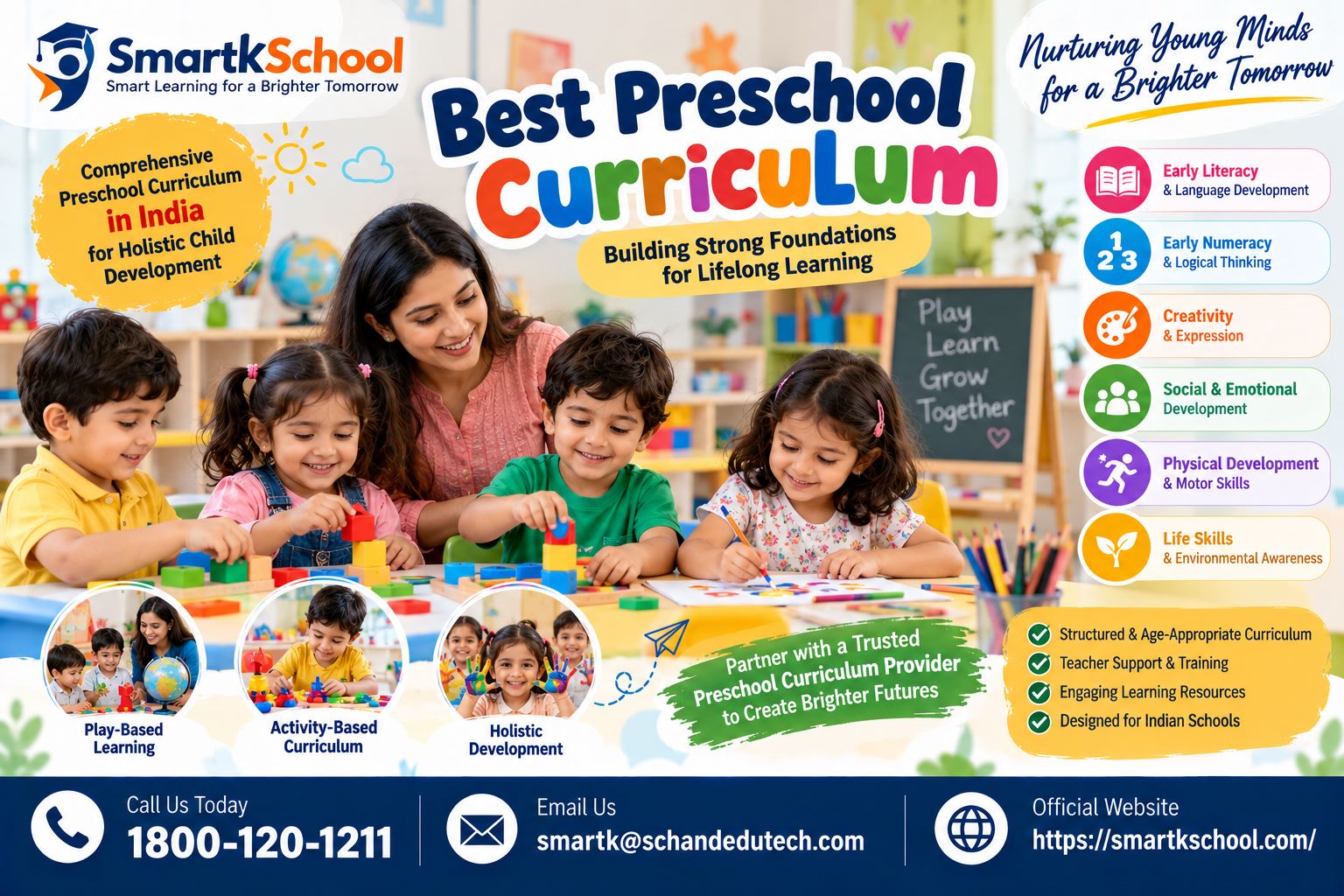
Choosing the right educational programme is one of the most important decisions for preschool owners, school administrators, and early childhood educators. A curriculum influences classroom experiences, teaching quality, children’s development, and parents’ confidence in an institution.
For schools searching for the best preschool curriculum, the priority should extend beyond attractive textbooks and colourful learning materials.
An effective programme must provide developmentally appropriate learning experiences, practical teaching resources, structured educational objectives, and flexibility for different classroom environments.
Working with a professional preschool curriculum provider can help educational institutions establish consistent teaching practices while maintaining a child-centred approach.
Understanding how to evaluate curriculum quality allows schools to make informed decisions and build stronger foundations for early childhood education.
Why Curriculum Selection Is a Strategic Decision
A preschool curriculum determines how children encounter language, numbers, creativity, social interaction, and everyday problem-solving.
An unsuitable programme may place excessive emphasis on worksheets, memorisation, or formal academic activities.
A thoughtfully developed curriculum, however, encourages exploration, meaningful communication, and practical learning experiences.
For school management teams, curriculum selection should therefore be treated as an educational investment rather than a simple purchase of teaching materials.
What Defines the Best Preschool Curriculum?
The best preschool curriculum is not necessarily the programme containing the largest number of books or activities.
Its effectiveness depends on how successfully learning objectives, classroom practices, and developmental needs work together.
A strong curriculum should offer a balanced approach across essential learning areas.
Important Quality Indicators
- Developmentally Appropriate Content: Activities suited to children’s abilities and learning needs.
- Play-Based Learning: Opportunities for exploration, imagination, and discovery.
- Language Development: Meaningful listening, speaking, and early literacy experiences.
- Early Numeracy: Practical activities involving patterns, shapes, counting, and comparison.
- Social-Emotional Learning: Opportunities to develop cooperation, confidence, and emotional awareness.
- Creative Expression: Art, music, storytelling, and movement-based activities.
The curriculum should connect these learning areas instead of treating them as completely separate subjects.
The Role of a Preschool Curriculum Provider
A preschool curriculum provider develops or supplies educational frameworks, teaching resources, and implementation support for early childhood institutions.
Depending on its services, a provider may offer structured learning plans, classroom activity materials, educator guidance, assessment resources, and teacher development support.
However, the quality and extent of these services can vary.
Schools should examine whether the provider understands actual classroom challenges and can explain how its materials support children’s learning.
A curriculum supplier should contribute to educational quality rather than simply deliver printed products.
Why Teacher Support Matters More Than Resource Quantity
Teachers are responsible for transforming curriculum objectives into meaningful learning experiences.
Even well-designed educational materials can produce limited results when educators do not understand their intended purpose.
A suitable provider should explain how activities can be introduced, adapted, and assessed.
For example, a counting activity should encourage children to understand quantity rather than simply repeat number sequences.
Teacher guidance can help educators recognise this distinction.
Training support, clear instructions, and opportunities for professional development can therefore influence successful curriculum implementation.
How Schools Can Evaluate Curriculum Materials
Before selecting a provider, preschool administrators should review sample learning materials carefully.
An attractive design alone does not establish educational quality.
Practical Evaluation Checklist
- Examine whether learning objectives are clearly explained.
- Check the balance between play and teacher-guided activities.
- Review the suitability of tasks for different developmental abilities.
- Evaluate the clarity of teacher instructions.
- Look for opportunities for movement, creativity, and communication.
- Assess whether materials can accommodate different learning needs.
- Check how children’s progress is documented.
Schools can also ask educators to evaluate sample activities through supervised classroom demonstrations.
This provides practical feedback about usability and children’s engagement.
Why Curriculum Flexibility Is Essential
Preschool classrooms include children with different interests, home languages, experiences, and developmental profiles.
A rigid approach may not respond effectively to these differences.
The best preschool curriculum should allow teachers to adjust activities while preserving meaningful learning objectives.
For example, a storytelling activity may encourage one child to describe pictures while another responds through gestures or short phrases.
Both forms of participation can support communication development.
Such flexibility encourages inclusive learning without expecting every child to demonstrate understanding identically.
Curriculum Selection and Parent Expectations
Parents often evaluate preschools through teaching methods, classroom environments, educational materials, and communication practices.
A clearly structured curriculum helps schools explain what children are learning and why particular activities are included.
However, schools should avoid promising accelerated academic achievement as the primary measure of educational success.
Instead, they can communicate how classroom experiences support independence, curiosity, communication, and social development.
Transparent communication can strengthen trust between families and educators.
Comparing Curriculum Provider Services
Not every provider offers the same level of educational assistance.
| Evaluation Area | Basic Resource Supplier | Comprehensive Curriculum Partner |
| Learning Materials | Books and worksheets | Integrated classroom resources |
| Teaching Guidance | Limited instructions | Structured implementation guidance |
| Teacher Development | May be unavailable | May offer training support |
| Assessment Resources | Standard exercises | Observation-based tools |
| Adaptability | Fixed activities | Flexible teaching approaches |
These distinctions describe possible service models, not guaranteed features of individual suppliers.
Schools should verify actual offerings through written proposals and sample materials.
Understanding the Real Cost of Curriculum Implementation
Selecting a preschool curriculum provider requires considering more than the initial price.
Educational institutions should evaluate material replacement costs, teacher preparation requirements, classroom resources, and any additional support charges.
A programme with a lower purchase price may require more independent lesson preparation.
Conversely, a broader resource package may offer useful support but include materials a school does not need.
The most suitable choice is the one that provides educational value within the institution’s operating requirements.
Common Mistakes Schools Should Avoid
Curriculum selection can become ineffective when decisions focus primarily on marketing claims.
Common mistakes include choosing programmes solely because they advertise advanced academic content, purchasing excessive worksheets, and overlooking teacher readiness.
Another concern is adopting a curriculum without examining whether its activities suit the school’s available space and resources.
Schools should also avoid assuming that identical activities will work equally well for every child.
A thoughtful evaluation process helps institutions select resources that support practical classroom implementation.
Frequently Asked Questions (FAQs)
1. What makes the best preschool curriculum?
A strong curriculum combines age-appropriate learning objectives, play-based activities, language development, creativity, social-emotional learning, and practical teacher guidance.
2. What does a preschool curriculum provider offer?
Depending on the organisation, services may include curriculum frameworks, teaching materials, lesson guidance, classroom activities, assessment resources, and educator support.
3. How can preschool owners compare different curriculum providers?
They should examine sample resources, teaching methods, implementation support, flexibility, educational objectives, and total costs.
4. Is teacher training necessary when introducing a new curriculum?
Teacher preparation is highly valuable because it helps educators understand learning objectives, adapt activities, and implement educational resources effectively.
5. Can one preschool curriculum work for every school?
A common framework can support different institutions, but effective implementation requires adaptation to classroom conditions, children’s needs, language environments, and available resources.
Media Contact
Department: Preschool Curriculum Solutions and Educational Partnerships
Email: smartk@schandedutech.com
Phone: 1800-120-1211
Official Website: https://smartkschool.com/